After five years of reading and archival research plus three fascinating trips to the Canadian battlefields in Italy, I continue to marvel at the endurance and accomplishment of the Allied soldiers and puzzle over the meaning and significance of a campaign that lasted twice as long as the advance from Normandy to the Baltic. Most of the 30 articles I wrote for Legion Magazine that form the basis fo this website deal with the campaign at the tactical level but my focus today is on strategic and operational questions that Canadians should consider when remembering the campaign in Italy.
I want to begin these comments by placing the Mediterranean theatre within the meta-narrative of the Second World War that I use in my classes. My version of “Why we won the war” drew upon Professor Phillips O’Brien’s 1989 article in the Journal of Strategic Studies titled “East versus West in the Defeat of Nazi Germany.” Dr. O’Brien would be the first to agree that his work is suggestive rather than definitive but his careful statistical argument is a welcome change from the ideologically-influenced insistence that the eastern front was the decisive theatre where in Richard Overy’s words “democracy was saved by the exertions of communism.”
O’Brien, using readily available manpower and war production figures, argued that by mid-1943 the majority of the German war effort was directed against the west especially in the defence of Germany against air attack. He writes, “while only 15% of the efforts of the Wehrmacht were focused away from the Eastern Front almost all of Germany’s naval effort, 65% of its Luftwaffe commitment, 70% of anti-aircraft guns and munitions and 100% of air raid defence were used in the war against the west.” O’Brien did not explore Germany’s investments in radar, the V1, V2 or V3 rockets and other high cost, science-intensive weapons in his 1989 article but he has offered a detailed account of how in 1943, the V weapons became “the single highest priority weapon for Nazi Germany” in his book How the War was Won (2015).
The Allied rationale for the invasion of mainland Italy was to tie down German forces preventing their transfer to France before Overlord. A secondary purpose, establishing a strategic air force within range of southern Germany and the Rumanian oil fields was satisfied after the advance to the Foggia plain. Sharp disagreements between Americans and the British began to develop in late 1943 as the British sought to nourish the armies in Italy with men and equipment while the Americans insisted on the overriding priority of Overlord. Throughout 1944 veteran divisions were transferred to England and then the continent despite British protests. This placed extraordinary burden on the troops left in Italy who were repeatedly committed to battle despite the terrain, the weather and detailed knowledge of the movement of German forces in and out of Italy. This information from Ultra suggested that the threat of Allied action, particularly sea-borne assaults, greatly influenced German troop movements. So a key question for students of the Italian campaign is how much Allied effort was required to hold large German forces in Italy and how to achieve a breakthrough and win a great victory.
After mid-1943, the war in the Mediterranean began to add dramatically to the proportion of war materiel, manpower and airpower devoted to the war against the West. In simple numerical terms, the Germans sacrificed 125,000 men in Tunisia and had committed 195,000 men to the defence of Italy before Operation Husky begun in July 1943. That number rose steadily. On 1 April 1944, the German total was close to 400,000 men, a year later, April 1945, Army Group C had 599,000 men on strength These totals are exclusive of German forces committed to Greece and the Balkans, a proportion of whom were present to forestall or defeat an Allied crossing of the Adriatic.
One reason that Germany was willing to maintain such large land forces in the Mediterranean after 1943 was the role Northern Italy played in the German war economy. The industries of Turin and Milan together with the agriculture of the lowland plain became more important assets with the shrinking of German economic space in the east. This, together with Hitler’s irrational commitment to Mussolini, his oldest ally, are basic realities of any overview of what happened in Italy.
The Luftwaffe also committed significant resources to the Mediterranean. As Williamson Murray has shown, German aircraft losses in July 1943 when the Wehrmacht was engaged in the battle of Kursk-Orel were 40% higher in the Mediterranean than on the Eastern front.
Major-General Sir William Jackson, the British official historian uses divisional comparisons to argue that the Italian campaign succeeded as a holding action because after August 1944 the Germans committed more divisions to Italy than the Allies. The Canadian official historian, Col. G.W.L. Nicholson, accepts this ratio of division but adds that “throughout 1944 the total strength of Allied forces in Italy continued to exceed one and a half million.” So who was fighting the holding action? The 1.5 million figure is only part of the story. The total commitment of Allied forces, men and women to the Mediterranean theatre in 1944 was over two million. All of them had to be fed, and clothed using resources shipped from North America or Great Britain. Many of them had to be armed. Very large numbers were hospitalized at some point during 1944, nearly three times the number admitted to medical units in Northwest Europe due largely to diseases such as malaria.
More needs to be said about battle casualties in Italy. An Army Operational Research Report (AORG 2/54) titled, “Battle Wastage Rates of Personnel in War,” was prepared by a team of OR scientist-mathematicians to revise the Evetts scale for predicting casualties which had been in use during the war.
The report is a gold mine of information about casualties by arm of service, officer-other rank ratios, killed-wounded ratios and much else. Maj. Gen. Evetts had failed to anticipate the nature of the war with its attritional battles resulting in a concentration of casualties among front line combat troops, especially infantry. The senior researcher H.G. Gee was puzzled by the evidence from Italy where battle casualties as a percentage of troops engaged were 50 percent lower than in Northwest Europe. His team concluded that divisions had committed fewer battalions to each action in Italy and the Evetts definition of “intense” periods of combat, “one or more battalion in direct action with the enemy,” needed to be revised as casualties appeared to be directly proportionate to the number of infantry battalions engaged.
Neuro-psychiatric casualties, battle exhaustion, or combat fatigue as the Americans called it, also raise some interesting questions. As always, caution should be employed in citing numbers because so much depends, as it does today with Post-Traumatic Stress Disorder, on who is making the diagnosis. Nevertheless, there is strong evidence that the toll of such casualties was much higher in Italy than in Northwest Europe; the figures for the British Army, 30 per thousand are double the number when we annualize 1944 figures for NWE. American numbers show a similar pattern and it appears that the incidence of disabling psychiatric illness continued to plague soldiers inItaly in and out of combat, until the last days of the war.
The related problem of absence without leave and desertion also needs to be integrated into accounts of the campaign. Always a serious problem in Italy, it reached crisis proportions in the winter of 1944-45 when deserters and absentees in the British Army averaged 1000 men a month. More than 5000 British soldiers were serving sentences for desertion in 1944 and the numbers for Fifth U.S. Army were similar. Most such offenses occurred “in anticipation of action against the enemy,” meaning soldiers took off after they learned their formation would be returning to the front lines.
Staying with numbers, it appears that the casualty rates in Italyas between nations require further study. Existing accounts do not really explain why Americans incurred 36% of all casualties (3 September 1943 to 2 May 1945) while British, as distinct from Empire losses total 29.1 percent. Indeed, when French Expeditionary Corps numbers are added, Fifth U.S. Army appears to have endured about the same number of casualties as all British and Commonwealth forces combined. Within Eighth Army, the Canadians, New Zealanders, Indians and Poles account for fully 40% of the casualties. One might explain this by noting that on average just 30% of British troops served within the combat-zone but we then must consider the significance of having more than 300,000 British soldiers serving behind the rear divisional boundaries in Italy. Particularly when in 1944, the British divisions were forced to reduce their infantry strength by 25 percent.
The specific Canadian role in this vast enterprise needs to be better rooted in some contextual analysis. The 1st Division and 1st Canadian Tank Brigade were sent to Italy because the Minister of National Defence, Col. J. L. Ralston was determined to get Canadian troops into action in 1943. The British reluctantly stood down 3rd British Division, allowing the Canadians to take their place. Despite three years of training in England, the division was far from ready for combat and the 3rd Brigade performed so poorly at the amphibious training school in Scotland that consideration was given to replacing it in the order of battle. Fortunately, the division’s introduction to combat was gradual and by the time heavy fighting began on 20 July, Simonds was able to selectively employ the best battalions of 1st and 2nd Brigades with the highly capable Three Rivers Regiment. By the end of the Sicilian campaign, 1st Division was on its way to becoming a highly effective formation.
The 5th Armoured Division, the headquarters and ancillary troops of I Canadian Corps were forced on Alexander by Ralston and the long acrimonious debate over the employment of the corps and the capacity of Lieut-General E.L.M. “Tommy” Burns to command it began.
I have always been puzzled by the argument historians who insist that the divisions of II Canadian Corps “failed” in Normandy because they “did not get enough out of their training.” When 1st Division, which had much less time to train before going into action, is generally highly regarded. Perhaps we need a little more multi-variable analysis in our explanatory tool kit.
The successive commanders of Eighth Army made extensive use of the Canadians, detaching 1st Canadian Armoured Brigade, which many considered to be the best independent tank brigade in Italy, to support British formations and committing the Canadians to the heaviest fighting at the Moro River and beyond.
A total of 92,257 Canadians served in Italy. Of these, 5,399 lost their lives and 19,486 were wounded. A further 1002 became prisoners of war and 365 died from “causes other than war.” Expressed as a percentage, this means that almost one third of the Canadians who served in Italy became casualties of war, not counting those who were evacuated for battle exhaustion. The number of Canadians labeled as neuro-psychiatric casualties in Italy was exceptionally high with 5020 individuals so designated during the 17 months of the campaign. This means that one in five non-fatal casualties was evacuated for “battle exhaustion” with much higher rates in periods of intense combat. Bill McAndrew, who wrote the chapters on Italy in our book on the subject, attributed this to the poor quality of reinforcements sent to Italy; but the character of the campaign and the professional views of A.M. Doyle, the Canadian psychiatrist, who was convinced that such casualties occurred among men who were pre-disposed to break down by heredity and life experiences are more likely factors. Doyle made considerable use of a catch-all diagnosis “psychopathic personality inadequate,” which was applied to individuals suffering from combat stress or physical exhaustion who did not fit into any recognized categories. This was the same garbage diagnosis used for men reported to be homosexuals.
Canadians rates for absence without leave and desertion were also striking. When I Canadian Corps moved to Holland in February 1945, 1033 Canadian soldiers were left behind to serve out their prison sentences of one to five years hard labour. “Another 100 were awaiting trial or sentencing and there were 500 deserters at large.” Almost all were from infantry battalions. Clearly we are describing the outlines of a very large problem that got worse towards the end of 1944 when fewer and fewer front line soldiers retained any confidence in those who issued orders to continue a seemingly pointless struggle in the cold and rain of a second bitter winter.
Canadian casualties from August to December 1944 were very heavy, 4511 in the battles for the Gothic and Rimini Lines, and 2581 in the Battle of the Rivers, more than one quarter of all those we suffered in Italy. But, as C. P. Stacey pointed out the decision to assault the Gothic Line and continue the attritional battle into the winter “was taken almost casually” without input or indeed information made available to the countries including Canada that would pay a disproportionate share of the human costs.
If the decision to continue major offensive operators in Italy after the withdrawal of American and French divisions for Anvil-Dragoon is contested, what can be said of the decision to continue the struggle in the mud and misery of the Romagna plain? The British official history suggests that “the least said about the autumn battles in the Romagna the better” but Canadians should not take such a detached view. Few of us have paid much attention to those who fought and died on the banks of the Lamone, the Senio or the streams in between, but an analysis of casualties raises important questions.
Was there a case for continuing costly offensive action in Italy when the threat of such action was proving sufficient to hold German divisions south of the Alps? It seems to me that much of the impulse for action in the latter half of 1944 came from the grand designs of Churchill and Alexander who sought to pursue broader British strategic goals in the Mediterranean. These goals included a major victory that would be seen to be won in a British-dominated theatre of operations. Ironically, there were few British troops available to pursue these objectives. Only one of the six active divisions in Eighth Army was British in late 1944.
The result was that the costly battles fought in December 1944 required Canada to pay a particularly heavy price. Dr. Geoff Keelan, a then graduate student at the University of Waterloo, developed a Commonwealth Forces Fatal Casualty database for Italy that allows us to analyse fatal casualties by division, brigade and battalion. It offers a much finer tool for comparing fatal casualties, including date and rank. Keelan’s figures show that 515 of the 799 fatal casualties incurred by Eighth Army in December were Canadians.
Where was the Canadian government or senior Canadian Army officers in all this? Prime Minister King had informed the British government that Canadian troops could not be employed outside of Italy in the various missions underway in Greece, the Middle East and Yugoslavia. But, the army, apart from endorsing the view that I Canadian Corps ought to join their comrades in Northwest Europe as soon as possible, had no mechanism for expressing its view of the orders issued by Eighth Army. The Corps Commander, Charles Foulkes, who in theory could have declined to commit his troops, simply followed orders. The Canadians in Italy, like the Poles, New Zealanders and Indians, functioned as Imperial troops pursuing an Allied holding action and the fading dreams of post-war British influence in the Mediterranean.
When we construct a Canadian memory of the Italian campaign, we rightly emphasize examples of operational and tactical effectiveness, individual courage and a significant contribution to the defeat of Nazi Germany. There are however other stories that need to be told about the nature, purposes and cost of the campaign. In 1994, I was presenting a paper at a conference in Edinburgh and was able to meet the Scottish poet Hamish Henderson who wrote 3/3 of the original version of the D-Day Dodgers. He sang it for us in a light tenor voice, by the last verse we were all in tears.
From the bare mountains of central Sicily, through the Moro River and Ortona and on to the Liri Valley, the Gothic Line and the rivers of northern Italy, Canadian and Commonwealth forces faced extraordinary challenges, always attacking, always up against a determined, powerful enemy. There were no soft spots in the series of continuous fronts the soldiers encountered, no flanks to be easily turned, no breakthroughs to be quickly exploited. Their story is one of courage and endurance.
Eighty years later, historians are deeply divided over the value of the strategic and operational decisions that committed large Allied forces to the campaign. The debate continues to resonate because in addition to the very considerable Allied battle casualties, 320,000 killed, wounded and captured, non-battle sickness and injury especially malaria, jaundice and battle exhaustion took an enormous toll. It is also necessary to remember that the peak effective strength of 5th and 8th armies, 550,000 troops, represented less than a third of the air, naval and land forces committed to the Italian theatre in 1944. Almost everything these men and women consumed or used had to come from Britain or North America and this imposed a great logistical weight on the Allied war effort.
The enemy forces, enjoying interior lines of communication, proximity to Germany and control of the agricultural and industrial production of northern Italy, were able to limit Allied advances even though they employed roughly one third of the manpower committed by the Allies.
All Canadians with a personal connection to the men or a serious interest in the history of our nation should consider a trip, a kind of pilgrimage to Italy and it should begin in Sicily. Go the spring or fall, when it is not too hot. Fly to Rome, make a connection to Catania and pick up a rental car. Once there you will find friendly people and well marked routes to battlefields. Stay in Taormina, Syracuse or Enna and concentrate on the Canadian role in the battles for Assoro, Agira, Leonforte and Regalbuto.
The Canadian military cemetery in Sicily in near Mount Etna. Canadian casualties in Sicily were 584 killed, 1,757 wounded and 76 taken prisoner. All the identified burials are located at the Cemetery. The list of names, as for all Commonwealth war graves cemeteries, is available at http://www.cwgc.org.
It is a brief ferry ride from Sicily to the mainland, on a route that retraces the path taken by the Canadians in Operation Baytown. There was only slight resistance and the men began to follow a long and very winding road into the toe and instep of the Italian boot.
Today Calabria is far more accessible with better roads and a wide range of tourist accommodation. If you have time for a route that approximates the advance of 1st Canadian Division take E90 east to SS534 and E45 to Potenza and on Campobasso. The coastal scenery as well as the inland mountains are well worth the time. Many visitors will prefer to go north to Salerno and the famous Amalfi coast before rejoining the 1st Canadian Division’s path at Potenza or Campobasso.
The Canadian Cemetery near Ortona. Source: Commonwealth War Graves Commission.
Ortona is the name attached to the best remembered Canadian action in Italy, but to understand the events of that bleak December in 1943 you need to begin at the Commonwealth war cemetery above the Sangro River. General Bernard Montgomery’s plan to advance on Rome from the east required the Eighth Army to cross a series of rivers beginning with the Sangro. Both the Canadian armoured brigade and the infantry division were committed to support this advance with 1st Div. taking over the coastal sector from 78th British Div. after its costly battle for the Sangro.
A derelict Sherman tank on the road between Alessa and Paglieta in the Sangro Valley; Monte Amaro and Miella Massif in background. Source: Canadian War Museum, CWMMCG Photos 52A 4 114.58
The Via Valeria, the lateral road between Pescara and Rome, is less than 30 kilometres north of the Sangro, but for the New Zealand, Indian and Canadian divisions it might as well have been on the moon. For those retracing the Canadian campaign it is worth spending several days in the Ortono-Orsogna area. The Moro River and the Gully, notorious battlefields south of Ortona, as well as the city should be seen. The marvellous museum of the battle of Ortona in the city centre is strongly recommended. The Moro River Canadian War Cemetery is the burial place of 1,375 Canadians who lost their lives in the struggle.
There are good hotels in Ortona but visitors may wish to stay at one of the beachfront hotels at the Lido Ricco just north of Ortona. The Lido and the hill above it (Pt. 59) were the last positions wrested from the Germans before the offensive was abandoned.
In the spring of 1944, the Canadians crossed to the other side of Italy to take part in the Battle for Rome. To understand the events of May and June you must begin at Cassino where the famous abbey and the Monte Cassino massif overlooks the southern approaches and guards the narrow Liri Valley that opens the way to Rome.
The view from Monte Cassino is spectacular and the abbey has been fully restored. The Polish military cemetery lies just below the abbey and contains the graves of more than 1,000 men of the Polish Corps. Their commander, General Wladyslaw Anders, was buried here following his death in 1970. Our Polish comrades fought alongside the Canadians in many battles and large numbers moved to Canada after the war. The memorial plaque at Cassino is an eloquent reminder of the contribution and sacrifice they made. It reads:
We Polish soldiers
For our freedom and yours
Have given our souls to God
Our bodies to the soil of Italy
And our hearts to Poland.
The British Commonwealth Cassino War Cemetery lies below the mountain. In addition to individual graves, there are the names of 4,054 Commonwealth soldiers who lost their lives in the Sicilian and Italian campaigns, but have no known grave. They are inscribed on the Cassino Memorial within the cemetery grounds. Included are 194 Canadians.
The Canadians entered the battle after months of frustrating, small-scale attempts to gain control of Monte Cassino and the defences known as the Gustav Line. Operation Diadem, the code-name for the offensive, was timed to draw enemy resources away from France in the weeks before D-Day (June 6, 1944). Eleven divisions, including 1st and 5th Canadian, were to mount the attack. First Canadian Armoured Bde. assisted 8th Indian Div. in the assault phase across the Gari River with the Canadian Corps held in reserve to exploit.
The SR630 road west from Cassino takes travellers to the Pontecorvo road (SP45). There are several vantage points where visitors can quickly grasp the problem of pushing elements of two army corps, Canadian and British through this mountain-edged valley. The stone bridge across the Forme d’Aquino is the same one seized intact by the 48th Highlanders in a textbook right flanking action. Once in Pontecorvo, look for the new plaque honouring the Canadians in the main square. There are few remaining signs of the formidable defences, but the terrain hasn’t changed much.
The 5th Canadian Armd. Division’s advance to the Melfa River and beyond can be traced with a stop at the actual crossing point. The house seized by Lieutenant Edward Perkins and his Lord Strathcona’s Horse reconnaissance squadron, and the battlefield where Major John Mahony of the Westminster Regt. earned the Victoria Cross is almost exactly where the highway crosses the river. It can be reached by crossing the Melfa on the old road—the S6—and turning left to San Giovanni Incarico. There is a commemorative plaque on the farmhouse wall.
The Canadian Corps was pulled out of the battle before the entry into Rome, but Canadians serving in the First Special Service Force were very much involved. The Allies were unable to trap the German forces or pursue them energetically and in mid-June, 1st Canadian Armd. Bde. provided much of the hitting power when British XIII Corps caught up with the enemy at what became known as the Trasimene Line. The area west of Lake Trasimeno is also well worth a visit on the way north to the Gothic Line.
The Gothic Line battles of September 1944 were among the most challenging and costly engagements fought by Canadians in the Second World War. To appreciate the incredible Canadian achievements, visitors should first view the battlefield from the church square in Montemaggiore, named Belvedere Churchill because this is where British prime minister Winston Churchill watched the attack unfold. Visitors can follow the routes taken by the Canadian divisions through countryside that is little changed so long as you do not wander too close to the coast. Be sure and stop at the memorial located on Pt. 204, where a gun turret and explanatory plaques help make sense of this complex hilly terrain.
Coriano Ridge War Cemetery, which includes the graves of 427 Canadians killed in action in the region, is located in the heart of the battlefield.
The armies of many nations whose sons and daughters are part of the contemporary Canadian mosaic are part of the story of the Italian Campaign. British and Polish soldiers, the New Zealand Div., and Greek Mountain Bde., Italian partisans and army units, and divisions of the Indian Army recruited from what is now Pakistan, as well as India. Almost 6,000 soldiers of that army lost their lives in the campaign. About half are buried in cemeteries, the rest—for religious reasons—were cremated and their memorials may be found near Rimini, for the Gurkhas, and Forli, for Sikhs and others.
The Battle of the Rivers, which began in October 1944 and was still underway when the Canadians left Italy to rejoin First Canadian Army in Holland, is the least known of all the Canadian actions in the Second World War. The distance from Rimini and the Gothic Line to Ravenna and the Senio River is less than 40 kilometres and the key points in the flat terrain can be seen in a day. Those with a particular family connection or special interest in the 5th Armd. Div. should visit the Villanova Canadian War Cemetery, one of just three in Italy, including Sicily, designated as Canadian. All but six of the gravestones display the Maple Leaf.
A nearby monument to the engineers of Eighth Army is a sharp reminder of the enormous importance of the men who cleared minefields, built bridges and performed a myriad of other vital tasks. The plaque notes that 2,494 bridges were built to support Commonwealth and Polish operations in Italy. Nearby, the Ravenna War Cemetery includes British, Canadian and Indian army graves and a section contains headstones marked with the Star of David and the trilingual badge (Hebrew, Arabic and English) of the Palestine Regt. which was commanded by Canadian Brigadier Ernest F. Benjamin. No other campaign had the international character of the battles for Italy.
Hamish Henderson, a Scot who originally served with 51 Highland Div., wrote the original version of the D-Day Dodgers:
Look around the mountains
In the mud and rain
You’ll find scattered crosses,
Some which bear no name.
Heart break and toil and suffering gone
The boys beneath them slumber on,
For they’re the D-Day Dodgers,
Who stayed in Italy
I had the good fortune to hear Hamish sing the last verse, and I have never forgotten his words.
After the capture of Rimini on Sept. 21, 1944, 1st Canadian Division was withdrawn into Eighth Army reserve to rest, reorganize and retrain while absorbing hundreds of replacements. Since Operation Olive, the battles for the Gothic Line began the division had suffered 2,511 battle casualties, including 626 killed in action. More than 1,000 other men had been evacuated as “sick,” including over 400 evacuated for “battle exhaustion.”
Psychiatric casualties had proved to be a major issue in all of the Allied armies, accounting for 20 to 25 per cent of casualties. The Canadians had long since determined that the large majority of men who broke under stress of battle could not be safely returned to combat units, so Special Employment Companies were created to provide a useful role in the rear areas.
The division’s rest period on the coast near Cattolica included opportunities to swim in the still-warm Adriatic and trips to Riccione or Florence. The leave centre in nearby Riccione was operated by the Salvation Army and was located in the Grand Hotel, “a first-class resort in peacetime.” Reserved for non-commissioned officers and ordinary soldiers, the hotel could accommodate 500 men in rooms with clean sheets and hot water. There were movies, army shows and dance music every night. The food was supplied by the army, but prepared and served by Italian chefs and waiters. Everyone in I Canadian Corps was eligible for a 48-hour pass to Riccione where, for a brief period, the war seemed to exist in a parallel universe.
Hitler, however, was determined to defend Italy south of the Po River because the industrial production of northern Italy was needed and “another withdrawal might be too much of a shock for the German people.” Churchill, who had stopped in Rome en route to meet Stalin in Moscow, was determined to press forward in Italy and mount an amphibious assault across the Adriatic. Resources for such an adventure could only come from the Americans, but President Roosevelt refused to consider new initiatives in the Mediterranean. He told Churchill that “overshadowing all other military problems is the need for quick provision of fresh troops to reinforce Eisenhower in his battle to break into Germany and end the European War.” Neither Churchill nor General Alexander accepted this view and plans for a continued advance in Italy as well as a quick strike across the Adriatic were developed. Alexander ordered Eighth Army to continue operations to seize Ravenna while Fifth Army withdrew divisions into reserve until the weather improved and a new offensive could be mounted.
All of this meant that 1st Canadian Division’s rest period came to an abrupt end as the new commander of Eighth Army, Sir Richard McCreery, ordered the Canadians to relieve a British division taking over the advance to Cesena, using the Via Emilia, the main road between Ravenna and Bologna as their centre line. The New Zealand Div. was to advance to the Savio River on 1st Division’s right flank while V British Corps worked forward in the foothills of the Apennine Mountains.
General E.L.M. “Tommy” Burns met with his divisional commanders to explain McCreery’s plan. In his memoirs, titled General Mud, Burns recalled their reaction: “All divisional commanders pointed out the very bad going, and expressed the opinion that we might be drifting into carrying on an offensive in similar conditions to those of last autumn and winter where hard fighting and numerous casualties resulted in no great gain.”
Canadian 17-pounder anti-tank gun in Cesena, Italy. Source: Canadian War Museum, CWMMCG Photos 52A 4 64.110
Burns, who notoriously lacked any human touch in his relations with subordinates, won no friends when he replied curtly that “other troops in Italy and Northwest Europe were fighting under similar conditions and 1 Canadian Corps would have to do its share.” Despite this, Burns carried their protest to McCreery who reluctantly changed the plan to emphasize V British Corp’s advance in the foothills with the Canadian Corps providing support.
The protests of the divisional commanders reflected a crisis in morale that was affecting front line troops in both 5th and 8th Armies. The Canadians, short of trained reinforcements, were particularly bitter about the Zombies, those conscripted for service in Canada only. Farley Mowat, in his postwar history of the Hastings and Prince Edward Regiment, described “the growing disillusionment with all authority…beyond the regiment,” quoting the sardonic verses troops sang as they marched back into battle:
Six and twenty panther tanks are waiting on the shore, But Corps intelligence has sworn there’s only four. We must believe there are no more, The information Comes from Corps. So onward to Bologna— drive onward to the Po!
Another, more famous line, “We are the D-Day dodgers—in sunny Italy” was sung with particular emphasis in the cold October rain.
Despite their doubts about another winter campaign, the Hasty Ps went about their task with consummate skill. The British 56th Div. had won a shallow bridgehead across the Fiumicino and occupied the village of Savignano before handing over to 1st Canadian Brigade. The Hasty Ps, with a squadron of Strathconas, carved a deep salient into the German lines well beyond the New Zealand Div. that had been held up by stronger resistance. With artillery and air support the Hastings and Strathconas, who had never worked together before, in “a spontaneous demonstration of genuine, wholehearted co-operation between infantry and tanks” attacked out of the salient into the flank of the 90th Panzer Grenadier Div. which was blocking the New Zealand advance. The 48th Highlanders joined in and the Germans began to withdraw towards the town of Cesena and the Savio River.
The Loyal Edmonton Regt., now commanded by Lieutenant-Colonel J.R. “Big Jim” Stone, was the first to reach the enemy rearguards. Stone had served in every appointment in the regiment from private to regimental sergeant major and was admired in the battalion for his courage and concern for every soldier under his command. Stone carried out his own reconnaissance and decided on a silent night attack. The squadron commander from one of the regiment’s familiar partners, the 12th Royal Tanks, found a crossing and together they forced an enemy withdrawal to the Savio.
German prisoners-of-war carrying wounded members of the 1st Canadian Corps through Cesena, Italy, 21 October 1944. Source: Library and Archives Canada, Item ID 3240082
The Royal 22nd Regt. led 3rd Brigade’s advance to Cesena. Lt.-Col. J.C. Allard commanded a battle group that included two troops of tanks, a platoon of heavy mortars, plus a troop of self-propelled anti-tank guns. The Carleton and York Regt. passed through and reached the town centre late on Oct. 19. It was, as usual, raining and the Savio was threatening “to lose its banks.” The best news was that 10th Indian Div. was across the river a few miles to the west and 4th British Div., was to cross the next morning.
Urban expansion had blurred the outlines of Cesena’s old town and with a 21st Century population of 100,000 spread out beyond the river, the main visible landmark left is the town fortress on a craggy extension of an Apennine ridge. Below the castle, winding streets—lined with houses—show no signs of the battle that raged here in 1944. North of the town the Savio widens near the village of Martorano where the Princess Patricia’s Canadian Light Infantry was the first Canadian battalion to try and cross.
The Canadian official history of the Italian Campaign describes the Savio as “a strong natural military barrier, at all times a tank obstacle, and when in flood, virtually impassable to infantry,” so it is not unreasonable to wonder what prompted the order to send the PPCLI across a rapidly rising river before the results of 4th Division’s crossing were known. The Canadians were supposed to be supporting V Corps, not the other way around, and the Savio was a much less formidable upriver in 4th Division’s sector. To make matters worse, the PPCLI was to cross on its own—there was no prospect of tanks joining since the river lay in a muddy trough 15 feet below the dikes lining the bank.
When Lt.-Col. R.P. Clark called his orders group on the afternoon of Oct. 20, British battalions were across the river 500 yards southwest of Cesena. Despite this there was no change in the Canadian brigade’s orders and two PPCLI companies began to cross while the early evening light still held. Sydney Frost’s memoir, Once a Patricia, describes the scene: “The whole front erupts in one tremendous roar. Shells scream over our heads. Mortars fill the air with deadly missiles. Tons of steel land on the far side of the river and explode in sheets of flame and clouds of dust and smoke. Able and Dog companies rise from their positions as one man…and surge forward to the riverbank. The barrage lifts 100 yards. The Germans stream out of their dugouts and run to their weapon pits. Smoke… gives our troops little cover… our men start to fall. German tanks are seen closing up the river.”
The Patricia’s Dog Company went to ground before reaching the river, a small group—17 men of Able Co.—got to the far side and clung to positions along the bank.
Brigadier Pat Bogert decided to commit both the Seaforths and Edmontons to the battle, using the darkness to get the lead companies across. The Savio was still rising as the advance began and the surface was black with an oily mixture that saturated the uniforms of the men wading across the river. The Loyal Eddies reached a cluster of houses beyond the Savio and held them against enemy infantry and armour. The Seaforths gained an equally small bridgehead, employing their tank-hunting platoon equipped with PIATs and Tommy guns to counter the threat by “a German force consisting of four Panther tanks, two self-propelled guns and 30 infantrymen.”
Sergeant K.P. Thompson positioned the tank-killers to trap and destroy the German armour. Placing a string of anti-tank mines across the road, he put the PIAT teams in ambush position. The lead enemy vehicle, a self-propelled gun, hit a mine, breaking its track. It came to a halt and was quickly destroyed. Private Ernest “Smokey” Smith dealt with the next arrival, a Panther, by stopping it with a single shot at a range of 30 yards. Smith then held his position against German panzer grenadiers and rescued his team partner who had been wounded in the encounter. Smith earned the Victoria Cross for his “dogged determination, outstanding devotion to duty, and superb gallantry.” Major Stewart Lynch, the company commander who recommended the award, noted that “it was a section commander’s battle…and each did his job more than admirably. Some were luckier than others, some results more spectacular, but I can assure you when it came to the question of awards it was a very difficult decision to favour one over the other.”
The next morning the bridgehead was far from secure. The Savio, running as deep as 16 feet, was in full flood and the engineers could not construct a bridge on the water-softened banks. As the rain eased, slings and rafts were used to transport basic supplies, including rum and PIAT bombs. The saturated ground was also causing problems for the enemy who complained that their counterattacks were foiled because “our tanks bogged down.”
On the night of Oct. 22, D Co. of the Patricia’s was ordered to cross the river at a point where engineers believed a bridge could be built. Before the advance could begin, the rain returned and when the lead Patricia’s bumped into a German patrol, all surprise was lost and a chaotic battle developed. The West Nova Scotia Regt., temporarily under 2nd Brigade’s command, did manage to get two companies across and one company was able to establish itself in a farmhouse 300 yards beyond the river. Major J.K. Rhode, who was awarded the Distinguished Service Order for his actions, held off counterattacks with the assistance of his PIAT team and the artillery. The next morning enemy fire destroyed the farmhouse and Rhodes had to direct the battle from a shell hole. A troop of self-propelled guns from 1st Anti-Tank Regt., Royal Canadian Artillery, knocked out a particularly aggressive German assault gun but the engineers reported that the rain had softened the river banks, ending all attempts to bridge the river. Rhodes and his men withdrew under a smokescreen, leaving the Edmontons and Seaforths clinging to their precarious positions.
The 5th Cdn. Armoured Div. had relieved the New Zealanders at the Savio and Burns outlined a plan for a new attack. Burns did not know, or did not appreciate, the significance of 4th British Division’s success west of Cesena where tanks were across the river. When he explained his intentions to the army commander, Burns was told to cancel further offensive operations. That night Canadian patrols reported a German withdrawal allowing the engineers to construct a bridge and bring tanks across the river. The new Eighth Army commander, Lieut-Gen. Sir Richard McCreery sent a congratulatory letter to Brig. Pat Bogert praising 2nd Brigade’s efforts as “a great example of how determined, well trained infantry can destroy enemy tanks with their weapons.” The men of 2nd Brigade who together with the West Novas had suffered 191 casualties, 33 of them fatal, were less sure that they had won an important victory as the Germans simply withdrew to the next river line.
Ravenna
The Battle for Italy’s Savio River, Oct. 20-23, 1944, marked the turning point in the difficult relationship between Lieutenant-General E.L.M. Burns and his senior officers. Despite the success the Canadian Corps enjoyed under Burns’ leadership, his two divisional commanders had begun to echo British complaints about his style of command.
Burns, who was ironically nicknamed Smiley, lacked the kind of easy-going leadership skills that were so highly valued in the Eighth Army. His relations with the brash, profane divisional commander Chris Vokes had always been difficult, but in the misery of the October battles another divisional commander, Bert Hoffmeister, “lost all confidence” in his corps commander, complaining that Burns “interfered with forward commanders.” Hoffmeister stated that “in spite of his best intentions” he was “inclined to be insubordinate” and he asked that either he or Burns be relieved of command.
Staff officers at Corps Headquarters reported that the tension between Burns and his subordinates made the atmosphere at conferences “unpleasant and embarrassing.” The divisional commanders “ignore Burns’ directions” and the corps commander “lacked the personality or ability to obtain co-operation.” Lieutenant-General Dick McCreery, the new commander of the Eighth Army, and General Harold Alexander were momentarily tempted to try their preferred solution, breaking up the corps and placing the Canadian divisions under British command. However, the Canadians would never have accepted this move and so McCreery reluctantly agreed that “Vokes would be acceptable” as a replacement.
In his memoirs titled General Mud, Burns, who was unaware of the role Hoffmeister and Vokes had played in his removal, recalled that he “did not believe it would be sound policy to continue an all-out offensive, and to incur further heavy casualties under the conditions in Italy’s Romagna region, where prospects for decisive victory during the winter months of rain, snow and mud appeared negligible.” Burns made no secret of his view and he thought this difference of opinion was behind McCreery’s decision to fire him.
Lt.-Gen. Foulkes near Cattolica, Italy. Source: Library and Archives Canada, Item ID 4233348
The final decision to remove a Canadian corps commander could only be made by the senior Canadian officer General Harry Crerar who had defended Burns when the British had sought to replace him after the Liri Valley battles. Now, with Canadian officers demanding a change, Crerar had little choice. He was, however, determined to appoint a new corps commander from outside the Eighth Army who would understand that Canadian and British interest were not always identical. Crerar’s choice, Charles Foulkes, had been less than impressive as a divisional commander, but he did possess good organizational skills.
Sending Foulkes to Italy presented a problem because in the small Canadian professional army everyone knew that Vokes could never work under Foulkes. The two men could not stand each other. Vokes was, therefore, brought to Holland to take over 4th Armoured Division, replacing Harry Foster who was sent to Italy to command 1st Infantry Div. In the meantime, acting generals were appointed. Fortunately, the Canadians spent most of November in reserve, so there was time for officers to get used to new command styles while the combat troops, deeply weary after two months of action, got some rest.
Infantrymen of The Carleton and York Regiment preparing to lob a hand grenade into a sniper’s hideout, Campochiaro, Italy, 23 October 1943. Source: Library and Archives Canada, Item ID 3200692
Finding accommodations for 80,000 men in the shattered towns of eastern Italy was no easy task. The 11th Bde. ended up in the beautiful and undamaged city of Urbino while the rest of 5th Div. was scattered along the coast. The battalions of 1st Div. needed replacements as well as time to recover from the agonies of the Savio battle, but they were also told to reorganize for the next offensive.
A new anti-tank company was authorized to provide better protection when the supporting armour was held up by water barriers. It was equipped with the “Little John”, a high-velocity version of the old two-pounder anti-tank gun. The first Wasp and Crocodile flame-throwers had arrived in Italy and the lessons learned from using these highly effective weapons in Northwest Europe were passed on in demonstrations and training films.
All of these efforts to increase combat effectiveness were necessary because the battle for the Savio River crossing had deeply affected the morale of Eighth Army’s infantry battalions. Self-inflicted wounds, absence without leave and desertion became major problems and the Canadians were not immune. The Historical Officer attached to 1st Cdn. Div. noted that the October attacks had been marred by inadequate preparation time, useless or impossible tasks and shortages of manpower at the sharp end. He quoted the words of a Princess Patricia’s Canadian Light Infantry company commander who reported that poor morale was due to the belief that the war would be over soon, the recollection of last winter’s misery, the belief that the Gothic Line battles were supposed to be the last show for Canadian infantrymen in Italy and general war weariness, “especially in Italy.” The officer added that these morale problems were not unique to the PPCLI; “at the present time all brigades are busily occupied with Courts Martial, chiefly desertion and Absence Without Leave charges.”
Given the problems of weather, terrain, manpower shortages and morale issues, the decision to continue an all-out offensive in Italy needs to be understood. The orders issued to Alexander in early November 1944 required 5th and 8th Armies to “maintain maximum pressure… in early December” when Eisenhower was hoping to launch a major offensive in Northwest Europe—an offensive that was delayed, then postponed indefinitely when the Germans attacked through the Ardennes in the Battle of the Bulge.
While the phrase “maximum pressure” was subject to interpretation, the intent was clear; tie down German troops in a holding action to prevent them from transferring divisions out of Italy. Alexander, backed by Churchill, would not accept this limited role and so he continued to plan for “a two-handed punch—the right hand punch by 8th Army across the Adriatic and the left hand strike by 5th Army on the Italian mainland…both Armies converging on the Trieste.…” Once Trieste was secure, Alexander proposed an advance to Vienna through the Brenner Pass.
This ambitious and deeply flawed plan was scheduled for early 1945, requiring an all-out offensive to secure the cities of Bologna and Ravenna in the last weeks of 1944. The Joint Chiefs did not accept Alexander’s plan for Trieste and Vienna but they did authorize a renewed offensive in Italy “to contain German Field Marshal Albert Kesselring’s armies.” With Bologna and Ravenna as objectives.
While the bulk of the Canadian Corps was enjoying a month out of the line, the Royal Canadian Dragoons, 2nd Field Regiment, Royal Cdn. Artillery, 5th Medium Regt., RCA, and the 12th Field Company, Royal Canadian Engineers, joined British gunners and the 27th Lancers tank regiment in a battle group known as Porterforce. Its task, to protect the right flank of V British Corps and capture Ravenna, seemed too ambitious for 2,000 men, no matter how much firepower it had. As the RCD history relates, “the enemy had opened the dikes of the Savio and flooded the area so that the road (Route 16) was under water in places and in others ran like a causeway across the drowned countryside. Troops and vehicles moved on that highway like the targets in a penny shooting gallery.… In its worst dreams, the Regiment had never seen itself advancing in such a position.”
A slow, artillery-supported advance was nevertheless possible and on Nov. 1, the RCDs were delighted to learn that Popski’s Private Army was to take over the coastal flank. The arrival of several hundred Italian partisans—part of the Garibaldi Brigade—further strengthened Porterforce.
The leader of the partisans Arrigo Boldrini, who used the nom de guerre Major Bulow, made his way to Canadian Corps headquarters on 20 November. He sought to co-ordinate the actions of his 28th Garabaldi Brigade with the Canadians in the liberation of Ravenna. Captain D.W. Healey, an Italian-speaking officer of the corps intelligence staff, joined Bulow to maintain communication with Porterforce. Setting out in a row boat Healey and Bulow reached a beach well behind enemy lines
No sooner had we beached our craft than the shrill cry of a night hawk rang out. One of our oarsman replied and we were soon surrounded by a band of armed cut-throats… who lifted out craft onto an oxcart. A rear party worked to cover our tracks… then women and children from the neighborhood… finished the job.
Healey sent off a request for the supplies that would make the brigade a more effective force, especially ammunition and gun oil to lubricate the weapons. Healey participated in a major raid designed to determine the strength of German mobile reserves. His report offered this description:
After dinner three companies, total strength 150 men set off for Porto Corsini. We went through a maze of canals in small boats and finally landed at a point where we could hear Germans singing in their billet 500 yards away. The partisan crowed forward to within 150 yards…
After a volley cut down the sentries a firefight developed Bulow ordered a withdrawal leaving an ambush party. Healey reported,
Enemy force… estimated at 50 reacted to our attack. We silenced two machine guns and inflicted casualties. Details not yet available. Troops still leaving Ravenna. Some went north-west to reinforce Porto Corsino after partisan attack.
Using the aged and infirm, women and small boys as runners Healey got information through to Corps headquarters, including locations of enemy artillery. Bulow’s men entered Ravenna meeting Porterforce and Canadian armour.
The liberation of Ravenna was accomplished on the eve of Eighth Army’s next offensive, an operation given the wildly inappropriate name, “Chuckle”. Both Canadian divisions were begin an advance on Dec. 2, assuming responsibility for a 16-kilometre-wide front on Eighth Army’s Adriatic flank. The Canadians faced a flat, saturated landscape crossed by ditches, canals and three rivers, the Lamone, Senio and Santerno—all with diked banks. The enemy had improved these man-made obstacles by scooping out tunnels “revetted with stout timbers with openings the size of ship portholes. From these holes protruded the ugly muzzles of the enemy’s guns.”
These mutually supporting positions along the meanders of the rivers allowed the defenders “to sweep a wide front with converging and enfilade fire.”
The bridges had all been destroyed, presenting the engineers with a formidable challenge. One possible solution was the Brown Bridge developed by Captain B.S Brown of 4 Field Company, Royal Canadian Engineers. The bridge could be carried forward on two tanks and used to cross an 80-foot gap. A second invention, the Olafson Bridge, developed by Capt. E.A. Olafson, Royal Canadian Electrical, Mechanical Engineers, could be quickly constructed out of portable sections of half-inch pipe to provide an infantry footbridge. Olafson bridges were constructed for each infantry battalion before Operation Chuckle began.
Brigadier J.D. “Des” Smith, the Acting Commander of 1st Cdn. Div. reminded battalion commanders of the enemy’s pattern of holding each water barrier long enough to force a set-piece attack then quickly withdrawing to the next barrier. Smith stressed the need to get patrols up to the next obstacle “as soon as a bridgehead has been formed.” The enemy was thin on the ground and everyone “right down to the company level” must move forward and forget about flanks. “Avoid house fighting,” he argued. The best course was to use artillery, “bring down fire before we reach them.”
This was no doubt sound advice, but the real problems confronting the infantry were the dike defenses. Major-General C.E. Weir, who left the New Zealand Div. to command the 46th British Div. in November, had gone so far as to forbid his infantry to cross rivers “unless tanks and anti-tank guns could bring their immediate support.” No such restriction was proposed by Canadian commanders.
The 3rd Cdn. Inf. Bde. led off the attack from a bridgehead that 10th Indian Div. had secured across the Montone. Their task was to clear the town of Russi, then seize a crossing of the Lamone, three kilometres to the north. Today, Russi is a pleasant town of 10,000, popular with visitors to the archeological museum and the mosaics of the nearby Villa Romano. Veterans of the 1944 battle would not recognize the place that was hammered by air strikes and artillery in those dismal December days.
The West Nova Scotia Regt. and the Royal 22nd Regt. reached Russi after overcoming some tough enemy delaying positions. Brig. Paul Bernatchez ordered a night advance to the Lamone, but it quickly became apparent that the railway embankment which crossed the entire front north of Russi was a main line of resistance. After two hastily prepared attacks failed, Bernatchez added his reserve, the Carleton and York Regt., to a three-battalion night attack, supported by extensive artillery concentrations. The enemy withdrew to the river and 3rd Bde. quickly overcame the rearguards, reaching the Lamone to find the bridges blown and the far bank strongly defended.
The German withdrawal from the railway embankment had been hastened by the actions of an aggressive battle group leading 5th Armoured Division’s advance to Ravenna. The Princess Louise Dragoon Guards and the Lanark and Renfrew Scottish Regt. led while the Westminster Regt. captured a vital crossing of the Montone River, opening up a supply route. The operations log of 12th Bde. proudly recorded the results of this speedy and successful advance that carried the brigade “through the enemy’s delaying line (the railway) east of the River Lamone.”
Ravenna was now outflanked and on the night of Dec. 3-4, local partisans reported that Ravenna was undefended. The PLDGs, partisans and Lt.-Col. Porter’s regiment, the 27th Lancers, all reached the city centre at about the same time.
During the first three days of Operation Chuckle, the two Canadian divisions had suffered 211 casualties evenly divided between 3rd and 12th Bde. A similar number of men had been evacuated as non-battle casualties. In the cold calculus of the war, this was an “acceptable” wastage rate for the capture of Ravenna, one of the main objectives of the offensive.
The Lamone and Senio Rivers
The original plan for I Canadian Corps’ Operation Chuckle, December 1944, called for the capture of Ravenna and an advance beyond the Senio and Santerno rivers to the town of Massa Lombarda. If the Canadians succeeded, their thrust would outflank German positions at Imola and threaten the enemy’s hold on Bologna further to the west. While Ravenna was liberated on Dec. 4, the 1st Canadian Division suffered a serious reversal when a hastily prepared attack across the Lamone River failed, forcing a withdrawal.
Two battalions of 1st Brigade, the Royal Canadian Regiment and the Hastings and Prince Edward Regt., suffered close to 200 casualties in this ill-advised, chaotic action. For the Hasty Ps, Dec. 5 was a particularly black day as their own medium artillery struck them down on the banks of the river.
Fortunately, 5th Armoured Div. reached the Lamone in good order where it paused to prepare for a proper co-ordinated assault crossing. The Eighth Army commander, McCreery, had promised that his troops would “not have to fight both the weather and the enemy.” So, the attack was postponed when heavy rain began to fall. The enemy took full advantage of the respite and the weather, which limited air operations, to reorganize their forces. The fighting strength of German battalions averaged less than 250 men, raising the possibility of a more favourable force ratio for the Eighth Army if something could be done to get Allied armour across the water obstacles.
During the weeklong wait a series of command changes took place. Both Brigadier Allan Calder and Lieutenant-Colonel J.W. Ritchie, commanding officer of the RCRs, were replaced due to their “failure” in the abortive attack across the Lamone. Ironically, Brig. J.D. Smith, who as acting divisional commander had ordered the improvised assault, was given command of Calder’s brigade when Major-General Harry Foster arrived from Holland to take up his appointment as divisional commander.
Foster presided over his first Orders Group on Dec. 10, confirming the division’s part in a corps attack scheduled for that night. Third Bde. Brig. J.P.E. Bernatchez was to take the first bound in an effort to create a half-mile-deep bridgehead across the Lamone. If all went well, 1st Bde. would follow and press forward to Bagnacavallo, a town astride the Canale Navaglio. Since the action was to take place on the same stretch of river that the 1st Bde. had failed to secure, no effort was spared in preparing for the new operation.
This time, both Canadian divisions would launch a simultaneous assault while a British brigade staged a feint attack. Two medium artillery regiments with increased ammunition allocations were available, and when dawn broke, the RAF would, weather permitting, engage the enemy employing a new method of air-to-ground support known as Timothy Targets. Using flights of 12 aircraft and direct contact with a Forward Air Control Post, pilots were briefed to strafe and bomb areas to a depth of 1,000 yards in front of a Bomb Safety Line identified by smoke. Marauder B26 medium bombers were tasked to destroy a long list of identified targets.
Bernatchez was given command of an additional battalion of the 48th Highlanders for the crossing, allowing the use of three battalions in the initial assault. The 12 Royal Tank Regt. provided direct fire during the crossing’s first phase. The regiment had been reorganized to include a Crocodile flame-throwing squadron, but this invaluable force-multiplier was not in range during the Lamone crossing. “Assault boats and Olafson footbridges were allotted to each infantry battalion and sufficient Mae Wests (inflatable life jackets) to protect the infantry during the crossing were provided.”
The German Army’s 356 Infantry Div., one of three divisions available to LXXVI Corps on the far bank of the river, was focused on the obvious crossing points near the remains of a railway bridge. The West Nova Scotia Regt. drew this sector with the Carleton and York Regt. and the 48th Highlanders on the flanks. During the rain-imposed delay, the banks of the river had deteriorated and by Dec. 9 the water was 60 feet wide and rushing between steep dikes.
Invicta, the history of the Carleton and York Regt., offers a description of the preparations.
Getting the heavy boats to the water was a hard slog: they had to be dragged 600 yards through mud up to the ankles by men already burdened with weapons, ammunition, and equipment. The boats went down in single file to within 100 yards of the dike and then branched into three sections of two boats…. The boats were then dragged with great expenditure of effort to the top of the 30 feet high dike, and slid down the other side…with moments to spare before H. Hour.
The Carletons and the 48th Highlanders got across before the enemy had recovered from the accurate artillery program, but in the centre, the West Nova Scotia Regt. ran into stiff opposition. The West Novas had elected to cross the river using the Olafson footbridge, but the current and problems with flotation demolished the bridge. The dilemma was solved by passing the assault companies through the other bridgeheads and attacking along the dike to the bridge embankment. The Royal 22nd Regt. joined its sister battalions before dawn and at first light began moving forward on a two-company front supported by the medium machine-guns of the Saskatoon Light Infantry as well as effective close air support and accurate mortar fire.
The brigade objective, the Fosso Vecchio, was less than 500 yards away but—as predicted—the Germans had withdrawn to prepared defences behind the creek. Attempts to rush the position proved too costly to continue.
Hoffmeister had selected his veteran 11th Inf. Bde., with the British Columbia Dragoons under command, to cross the Lamone near the village of Villanova. The initial two-battalion attack was to be silent with the artillery on standby. If surprise was lost, the code word “Bedlam” would bring instant support on pre-arranged targets. The Perth Regt. was able to obtain surprise and was swiftly across, but the Cape Breton Highlanders signalled Bedlam shortly after their boats hit the river. Both battalions seized their initial objectives allowing Brig. Ian Johnston to send the Westminster and Irish regiments across to expand the bridgehead.
The expected enemy counterattacks were defeated with the Westminster’s tank-hunting platoon claiming the destruction of four tanks. By the evening of Dec. 11, elements of two Canadian brigades were ready to tackle the Fosso Vecchio defences, and seize the crossing over the Canale Naviglio. Hoffmeister committed the relatively fresh 12th Bde. in the 5th Division’s sector. Major-General Foster decided that despite, or because of, the morale problem that had shaken the resolve of the RCRs and Hasty Ps at the Lamone, they would take on the Naviglio, saving 2nd Bde. for what he hoped would be a rapid advance to the Senio and beyond.
The decision to continue an operation that was costing the Canadians a steady stream of casualties, killed, wounded, and missing, not to mention a growing number of battle exhaustion cases requires explanation. When the army commanders met in Rome in November of that year they had agreed that their purpose was “to afford the greatest possible support to the Allied winter offensives on the Western and Eastern Fronts by bringing the enemy to battle, thereby compelling him to employ in Italy manpower and resources that might otherwise be available for use on other fronts.” They also agreed that “no attacks will be launched unless the ground and weather conditions are favourable.”
When McCreery returned to his headquarters he announced that Eighth Army’s task was to “render all assistance to the 5th Army in the capture of Bologna.…” McCreery had agreed that 8th Army would open the offensive, advancing to the Santerno River and drawing off German reserves before Fifth Army renewed its attempts to reach Bologna. By Dec. 11 two things were evident. First, the German high command had responded to Eighth Army’s offensive by transferring three divisions from the Bologna front. Second, reaching the Santerno without the assistance of Fifth Army was a pipedream. Nevertheless, McCreery ordered the Canadians, together with the Polish Corps, the New Zealand Div., and 10th Indian Div., to maintain pressure while Fifth Army prepared an all-out attack using heavy bombers the way they had been employed in Normandy to break through German defences.
Suddenly, sweeping changes in command intervened to create an atmosphere of hesitation at Fifth Army. General Harold Alexander was placed in overall command of the Mediterranean theatre with Gen. Mark Clark taking his place at Army Group. Gen. Lucian Truscott returned from France to take charge of Fifth Army. These events, combined with the uncertainty created when Hitler launched his Ardennes operation—the Battle of the Bulge—led Fifth Army to abandon plans for an offensive and prepare to meet a German attack. Why then did Eighth Army continue to press forward under such adverse conditions?
The answer is not easy or satisfactory. McCreery knew that the 98th German Inf. Div., supported by companies of Tiger and Panther tanks, had begun to deploy opposite the Canadians while other German units had reinforced the forces opposing V British Corps. McCrerry’s original orders to continue to the Senio River were based on the understanding that Clark would unleash Fifth Army. If this was now unlikely, continuing the advance would be a costly exercise. Those on the ground could see little advantage in pressing forward. There was no high ground to capture and the enemy was known to be still reinforcing the sector, adding the Kesselring Machine-Gun Battalion to the defences. There were other problems. The Germans had fortified the Naviglio and the towns of Bagnacavollo and Villanova, cutting down the trees that lined the canal to improve their fields of fire. Everything about the situation pointed to another difficult and costly operation especially for the Canadians who would do most of the fighting.
Would McCreery have ordered this advance if British divisions were involved? By December the 56th Division, reduced to two brigades and the 21st Tank Brigade in support of 1st Canadian Division were the only British brigades active in Eighth Army. The 46th Division had been withdrawn to intervene in the Greek civil war joining 4th British Division which had crossed to Greece on 12 December. V British Corps was now composed largely of Polish, New Zealand and Indian divisions.
Lieutenant-General Charles Foulkes, now fully in command of the Canadian Corps, did not question McCreery’s orders. A plan for a simultaneous advance by both his divisions was devised relying on massive amounts of artillery to suppress the enemy while the infantry crossed 700 yards of ground and the 20-foot embankment. The canal itself was dry, though bridging was prepared to assist the armour.
The Carleton and York Regt., followed by the Hasty Ps, made the crossing in 1st Division’s sector while the Lanark and Renfrew Regt. and the Princess Louise Dragoon Guards led 5th Division’s attack. After ten minutes of heavy concentrations from medium and field artillery, the field guns provided a rolling barrage. As had been so often demonstrated, good infantry, with enough support, could usually take a well-defined, limited objective. The challenge was to consolidate, dig in, and deal with enemy counterattacks with limited anti-tank assets and the inevitable communication breakdowns.
Both bridgeheads came under severe pressure. The Princess Louise Dragoon Guards were “cut into isolated segments by furious counterattacks. Much of a Hasty Ps’ company was surrounded and taken prisoner. The Lanarks were stopped cold. The Carletons held on, but were forced back to the canal. The weather, to no one’s surprise, cancelled air support while enemy artillery observers, occupying two high towers in Bagnacavollo directed accurate fire on the narrow bridgehead.
By midday, Dec. 14, anti-tank guns and Sherman tanks of the British Columbia Dragoons had entered the bridgehead relieving some of the pressure. Late in the day, the Westminster Regt. crossed in the 1st Div. sector and advanced north along the canal, breaking the German ring around 5th Division’s position.
The enemy was gradually forced to concede ground, but fighting for the narrow slice of ground, just two miles wide at its apex, continued for another week. Bagnacavollo, or what was left of it, fell on Dec. 21. The day before, Clark, who clearly knew little about the condition of Eighth Army, announced that “the time is rapidly approaching when I shall give the signal for a combined all-out attack by 5th and 8th armies.” Instead, the Germans launched an attack on Fifth Army’s weak right flank and all major offensive operations ended. Alexander, now a Field Marshal, agreed to “go on the defensive for the present and concentrate on making a real success of our spring offensive.”
As Eighth Army prepared to defend the Senio River line two salients still occupied by the enemy had to be cleared. While preparations for these actions, scheduled for early January, were underway the Canadian Corps commander Charles Foulkes gathered his officers, lieut-colonels and above, in Ravenna. Foulkes declared that a high proportion of the 2000 casualties the Canadians had suffered in December, 22 officers and 420 other ranks, were listed as missing. Such casualties as well as battle exhaustion were, he said, due to “faulty junior leadership and/or poor morale.” It was, he said, “imperative to improve morale and leadership.” Nothing was said about dubious command decisions by senior officers.
A “Report on Operations 10-21 December” issued by 5th Armoured Division offered a more realistic explanation of the casualty toll:
The whole of the action from the Lamone to the Senio had been characterized by heavy mortar and shell fire. The country was very open, little cover other than canals and ditches was available. This made accurate fire on the part of the enemy comparatively simple… Coupled with this was the fact that forward troops had to remain in slit trenches in ground that would have been wet even without the rain that accompanied us throughout the operation.
The first of the “minor tasks” carried out by Eighth Army in January, the clearing of the Gararola salient required 2nd Canadian Brigade to assist 56th British Division by capturing the village of Gararola. This was speedily accomplished and British troops occupied the south bank of the Senio river.
The operation to clear the enemy from the south side of the Valli di Comacchio met much stronger resistance but 11th Brigade, employing “artificial moonlight”, search lights aimed at dense cloud cover, broke through the enemy opposition at Conventello setting the state for 5th Armoured Brigade. Taking advantage of frozen ground around the Breitish Columbia Dragoons “pushed forward engaging all houses, barns and haystacks.” The New Brunswick Hussars paralleled the BC Dragoons until stopped by “a deep roadside ditch defended by self propelled guns and Panther tanks.” The Cape Breton Highlanders joined the Hussars and after a sixty minute artillery program ended, dealt with a German counterattack. The British Columbia Dragoons, further east, were repeatedly counterattacked by enemy armour but checked each attack. Working with Perth Regiment infantry they crossed the Bonifica Canal and completed the division’s task.
The 5th Canadian Armoured Division was withdrawn on 14 January 1945, replaced by the Cremona combat group of the regular Italian Army. 1st Division remained in position on the Senio River well into February despite the decision taken at the Malta Conference (30 Jan to 3 February) endorsing Canadian demands to reunite I Canadian Corps with First Canadian Army in the Netherlands. On the night of 24 February, the Seaforth Highlanders and Loyal Edmonton Regiment fought the division’s last battle on Italian soil suffering 9 fatal casualties and 26 wounded. Operation Goldflake, the transfer of the Corps to Northwest Europe began in mid-February and was complete by late March. Few regretted leaving Italy and the prospect of Alexander’s spring offensive.
Operation “Goldflake”, the movement of I CDN Corps from Italy to Northwest Europe, 13 Feb – 23 Mar 1945. Source: CMHQ Report #181
The decision during the Italian Campaign to withdraw the Canadian Corps from the battle south of Rome and from the pursuit of the German forces retreating to Florence allowed for a lengthy rest and training period in the Volturno Valley. According to the historical officer attached to 1st Cdn. Division, leave arrangements in June and July 1944 were “extensive and generous” with rest areas in Bari, Salerno and Amalfi.
Of course it was not all rest and relaxation. The lessons of combat in the Liri Valley were studied with special attention given to better methods of controlling artillery fire, and improving tank-infantry co-operation. The 21st British Tank Brigade was made available to work with 1st Div. because 1st Cdn. Armoured Bde. was with XIII British Corps, leading the advance to Florence.
Criticism of the Canadian effort in the Liri Valley focused on higher command. Senior British officers were lavish in their praise of Canadian combat units and regarded 1st Cdn. Div. and 1st Cdn. Armd. Bde. among the best and most experienced troops in Italy. While it was politically impossible to break up the Cdn. Corps or place it under a British officer, Leese was determined to retain control of 1st Cdn. Armd. Bde.
The brigade was formed in 1941 in response to British requests for a larger Canadian commitment of armoured units. Winston Churchill had already told his cabinet colleagues that the Allies “cannot hope to compete (against the Germans) in numbers of men and must therefore rely upon an exceptional proportion of armoured vehicles.”
Churchill wanted 10 armoured divisions by the end of 1941. As part of this, Canada was asked to send both an armoured division and an independent infantry-support tank brigade to the United Kingdom. And this was to be done as soon as possible. The Ontario Regiment (11th CAR), the Three Rivers Regt. (12th CAR), and the Calgary Regt. (14th CAR) arrived in England in July 1941 to form what was then called 1st Cdn. Army Tank Bde.
The Calgary Regt. was selected to provide the tank component of the August 1942 Dieppe Raid and its fine performance validated the intensive training each regiment had undergone. The brigade, commanded by Brigadier Robert Wyman, participated in the invasion of Sicily in July 1943, though only the Three Rivers Regt. fought continuously in support of 1st Cdn. Div.
Bogged Sherman tank of 12th Canadian Armoured Regiment (Three Rivers), River Arielli, 18 January 1944. Source: Imperial War Museum NA11136
All three regiments had extensive battle experience by the spring of 1944 and were highly regarded throughout Eighth Army. The Three Rivers Regt., today the 12e Régiment blindé du Canada, earned particular praise for its role in supporting 78th British Div. at Termoli on the Adriatic coast. All three regiments fought with skill and effectiveness in support of 8th Indian and 1st Canadian divisions at the Moro River and at Ortona.
In late February 1944, Wyman left Italy to take command of 2nd Cdn. Armd. Bde. in preparation for the Normandy invasion. Lieutenant-Colonel Bill Murphy, the senior staff officer of 5th Armd. Div., was promoted to replace Wyman and he commanded the brigade for the balance of the war. Michael Boire, a Royal Military College of Canada historian and amoured corps officer who is the acknowledged expert on the brigade, notes that Murphy’s job was “to dish out his nine tank squadrons to British and Indian units,” rather than plan manoeuvres. He and his staff, “largely scientists and university people,” were required to anticipate future moves and keep “a close eye on the battle to make sure replenishment and repair of each regiment’s tanks was as rapid as possible.” Boire describes the brigade headquarters as a “finishing school for regimental officers lucky enough to be selected for a great learning experience.” Murphy’s liaison officers, “a constantly changing group of lieutenants and captains, were responsible for everything from finding harbour areas and accommodations to collecting new maps and delivering and explaining orders up and down the chain of command.”
Brigade headquarters also encouraged the armoured regiments to share their experiences. Captain R.I. Currelly, the historical officer attached to the brigade, interviewed commanding officers and squadron commanders and produced a summary of “lessons learned in the Gustav and Hitler operations.” Among the key points was the need for infantry to precede tanks while operating in close country. The tanks would be used to blast houses or machine-gun enemy positions or likely enemy positions. This required the closest possible infantry-tank co-operation. The use of the light Honey tanks to bring supplies forward had worked well, but the threat of enemy shelling meant that during resupply, smaller units had to be well spread out. Most crew casualties occurred when men were outside their tanks, when much greater caution was required.
Infantry-tank co-operation was only part of the story. When artillery observers were forward with the tank squadrons, quick fire could be used to destroy the enemy. The Three Rivers Regt. suggested that “our own field artillery could lift practically on top of advancing armour. This could develop a ‘steamroller’ effect which would be invaluable in overcoming a tough pocket of resistance.” Infantry would then exploit any initial success.
The “best armoured brigade in Italy” began to play its part in the long pursuit on June 11, 1944, when it was ordered north to support 4th British Infantry Div.’s advance to Arezzo, roughly 30 miles south of Florence. Before the move could begin, the Calgary Regt. lost the services of its exceptional commander, Lt.-Col. C.H. Neroutsos, a recipient of the Distinguished Service Order.
The brigade’s war diary provides a glimpse into the mindset of those who served. Neroutsos, a Canadian of Greek ancestry, had joined the Three Rivers Regt. and by 1943 was second-in-command. Promoted to lead the Calgaries, he soon earned the affection and respect of the westerners. During the previous battles in the Liri Valley, Neroutsos had continued in action despite having “to wear a steel brace on his leg.” The brace allowed him to walk well enough to command his regiment but he was forced to leave due to illness. Major (later Lt.-Col.) C.A. Richardson took over the Calgaries in time to begin training in tank-infantry co-operation with 4th British Div. Each Canadian regiment was assigned to work with one of the three infantry brigades.
Before examining the battles of late June 1944 it would be best to establish the strategic and operational context of that time. Alexander, the overall commander of what was now called the Allied Armies in Italy, was distracted over Operation Anvil, the amphibious invasion of the South of France.
Alexander, with the strong support of Churchill and the Chief of the Imperial General Staff, Alan Brooke, opposed Anvil arguing that the battles for Cassino and the Anzio bridgehead had exhausted the German armies in Italy. Anvil, or Dragoon as it was later renamed, would involve ten Allied divisions including two which would carry out an assault landing on 15 August. The Americans believed Anvil would offer immediate assistance to Overlord and the Battle for France. Marshall and Eisenhower insisted that employing ten Mediterranean divisions for Anvil left Alexander with twenty divisions, enough to fulfill the primary mission to tie down the Germans in Italy.
Alexander citing evidence from Ultra that the Germans had lost 38,624 men killed, wounded and missing in May, which together with equipment losses, especially tanks, meant that on average the German divisions were rated at least 70% of their full fighting power. Ultra also revealed that in mid-June German losses in Italy were being made up with tanks, infantry replacements and additional divisions. The British believed the best support for Overlord was to continue to press forward in Italy but Eisenhower was now adamant.
The Normandy campaign appeared to be stalemated in mid-June and Anvil would provide direct assistance as well as bring the French divisions to their own country. Three U.S. divisions left the Allied Armies in Italy in June to join Seventh U.S. Army for the Anvil Landings.
Alexander’s preoccupation with the British effort to cancel Anvil may help explain his failure to co-ordinate the advance of Fifth and Eighth armies north from Rome. Each operated in separate corridors throughout the pursuit. Because Fifth U.S. Army, which was advancing in more favourable terrain along the west coast, was always some miles ahead, the possibility of trapping the German Tenth Army—by enveloping it from the west—seemed obvious. The Germans, under pressure from Hitler to stop the Allies as far south as possible, were desperately afraid of this. But as the British official history notes, Alexander settled for a “partridge drive” that allowed the enemy to withdraw to a series of delaying positions.
Both German armies were ordered to try to stop the Allied advance at the Albert Line which ran from Ancona on the Adriatic coast to the Tyrrhenian coast, opposite the island of Elba. As part of XIII Corps, the Canadian armoured brigade was committed to the section of the Albert Line to the west of Lake Trasimeno. Known to the British as the Trasimene Line, it consisted of a series of hastily prepared positions that might be better described as a defensive zone five miles wide and 15 miles deep. As one historian wrote, “the great difficulty about the Trasimene Line is that nobody knew where it was supposed to be, not even the Germans!”
In the summer of 1944, the rolling country between the lake and the mountains, known as the Chiana Valley, was covered with olive groves, vineyards and small fields of grain. Much of the valley had been a malaria-ridden swamp until drained in the 15th century. The scattered villages and sturdy farmhouses were transformed into fortress-like positions while the small stream beds and drainage ditches became—with the assistance of engineers and explosives—anti-tank barriers. Apart from Highway 71, which borders the lake, the unpaved roads were little better than dirt tracks that three days of rain and tank traffic turned into stretches of churned mud. On a visit we were able to gain an overview of the battlefield from the ancient Etruscan town of Chiusi and from the shores of Lake Trasimene. It was evident that only the closest co-operation between armour, artillery and infantry could unlock such defences.
The Tenth German Army ordered three of its best divisions, the Hermann Göring Panzer Div., 1st Para Div. and 334th Inf. Div. to defend the sector. However, no one beyond Berlin believed it could be held unless resources could be found to stop the advance of Fifth Army along the coastal plain.
General Sidney Kirkman, commanding XIII Corps, decided to wait and organize a co-ordinated attack with 6th South African Armd. Div., 4th Inf. Div. and the veteran 78th Div. Kirkman had been told that 78th Division was to be withdrawn to Egypt at the end of June because it was understrength, exhausted from long months of combat and destined for garrison duties in Palestine. He decided to reinforce its lead brigade with Canadian armour, sending the Ontario Regt. to work with old friends in the 38th Irish Bde.
Classically educated British and German officers recalled the story of Hannibal’s destruction of an entire Roman army on the shores of Lake Trasimeno in 217 BC. The example of one of the most famous envelopments in military history may have inspired Major-General Charles Keightley to propose using the lake to stage an amphibious attack by landing a battalion 10 miles behind German lines. The unit that would supposedly carry out this too-clever manoeuvre was the London Irish Rifles. Its commanding officer pointed out that the available transport—DUKWs (amphibious vehicles)—had a “noise like a traction engine” and a top speed of 10 miles an hour, offering the enemy several hours notice to arrange a reception committee. Such a venture, he suggested, would “likely end Charles Keightley’s career as well as mine.”
The actual battle for Route 71 began at the villages of Sanfatucchio and Pucciarelli where the Irish infantry and Ontario tanks “worked in tandem; the 75-mm guns would blast a house at close range and then the riflemen would storm the building.” Beyond Sanfatucchio, the Germans had created a more formidable defensive position using a solidly built church and advantageous high ground. The church, which is now abandoned, and its graveyard sit on ground that overlooks all approaches. It is not difficult to understand why Sanfatucchio is a battle honour well remembered by veterans of the Ontario Regt. Once again the tanks and carefully observed artillery fire assisted the infantry forward. By evening on June 20, the enemy, less scores of prisoners and many casualties, had withdrawn north, pursued by the reserve battalion, the Royal Irish Fusiliers and Canadian armour. This force faced a series of disjointed counter-attacks, but in the process destroyed a number of enemy tanks which were badly employed in ones or twos without support.
While the Irish and Canadians secured Pescia and Ranciano, the Three Rivers Regt., supporting 4th British Div. began a seven-day battle which “from beginning to end was essentially a failure.” On this section of the front the enemy was able to withdraw intact, inflicting more casualties than they suffered. According to the Canadians, the 28th Inf. Bde. was “totally green” and unable to work effectively with armour. This contributed to the loss of 94 men and 26 tanks, one of the heaviest weekly casualty tolls to an armoured regiment in the Italian Campaign.
The 28th Bde. had spent most of the war on garrison duty at Gibraltar. It was brought to Italy as a replacement brigade due to a shortage of reinforcements and it suffered heavy casualties in its first battle at the Gustav Line. The decision to commit an inexperienced, and understrength brigade to such a battle suggests just how serious leadership problems were in Eighth Army.
The Canadians were given a brief period of rest in July. Many spent Dominion Day 1944 bathing in the warm waters of Lake Trasimeno. On July 5, Kirkman, whose XIII Corps was pressing north to the Arezzo Line, ordered the Canadians back into action to protect the mountainous left flank of 6th British Armd. Div.’s advance. Kirkman, who claimed that his corps “had learned all it knows about armoured fighting from 1st Cdn. Armd. Bde.,” needed the Canadians to support 4th Div.
The narrowing valley, now divided by the A-1 auto route to Rome, was held by small enemy detachments in the process of drawing back to Florence. Hitler claimed his delaying tactics worked, allowing time for the development of field fortifications at the Gothic Line. Field Marshal Albert Kesselring and his generals in Italy were much less confident. The Germans had lost more than 100,000 men from all causes since early May, an average daily loss of 1,260 men—a very high price for a fighting withdrawal.
The Arezzo Line, which the Canadians were now attacking, was the last serious blocking position south of Florence. The Germans held it until July 15 when XIII Corps, reinforced by the 2nd New Zealand Div., stormed Mount Lignano, the high ground controlling the roads to Arezzo. The Canadian brigade was then assigned to 8th Indian Div. for the pursuit along the Arno River through Chianti wine country.
When the full story of 1st Cdn. Armd. Bde. is written, it will no doubt quote the words of Leese who described the brigade as “the hardest hitting and finest armoured formation that I have ever had the pleasure to command.” Generals offer such words of praise far too freely, but in this case Leese was speaking the plain truth.
The Gothic Line
During any trip to the region between the Metauro River and Rimini along the Adriatic coast, it is possible to visit many of the most important battlefields fought by I Canadian Crops during the late summer and fall of 1944 and appreciate the challenges imposed by the terrain. Beginning at the church in the town of Montemaggiore which, at an elevation of 197 metres, is perched on a hill just south of the Metauro. The church square is known as the Belvedere Churchill because the British prime minister came here on Aug. 26, 1944, to watch the first stage of the battle. Churchill insisted on going further forward and ended up near the headquarters of the Royal Canadian Regiment beyond the river where he could hear “the rat-tat-tat-tat” of machine-guns, and watch the tanks manoeuvre a kilometre away. It was the closest Churchill ever got to the front in the Second World War.
Churchill at Eighth Army HQ in Italy. Lt. Gen. Leese stands on the left, with General Sir Harold Alexander on the right. Source: Imperial War Museum TR2279.
To the east, one can see the narrow coastal plain where, in August 1944, General W.A. Anders’ Polish Corps was waiting to resume the advance. The Poles had pushed the Germans back to the river in a series of sharp battles fought over the previous month and captured the port of Ancona. To the northwest, near the ancient university hill town of Urbino, the mountains are higher and more rugged, features that the British V Corps faced. Straight ahead from the top of the hill one can see the route followed by the 1st Cdn. Division during its approach to the Gothic Line further north. The relatively open valley of the River Sale leads to a series of mountain peaks as high as 555 metres.
To a military historian who has written extensively about the problems posed by the gentle ridges in Normandy with their modest reverse slopes, this ground appears problematic. What were the generals thinking? To answer this question we need to review the strategic debate of the summer of 1944 and remind ourselves that the primary purpose of the entire Italian Campaign was to force the German high command into diverting resources away from Operation Overlord. Given this imperative, the Army Group Commander and his two army commanders were required to mount some kind of major offensive in July or August 1944.
Alexander was told his “task will continue to be the destruction of the German forces in Italy” by an advance to “seize the line of the River Po” in the north part of the country. This was to be done with the available troops in the Mediterranean, some 18 divisions and seven independent armoured brigades, including the Canadian Corps and its orphaned armoured brigade.
A Churchill tank of 1st British Armoured Division advancing towards the Gothic Line, 26 August 1944. Source: Imperial War Museum NA18050
With clear, urgent and final orders, Alexander and his army commanders began detailed preparations for an offensive through the centre of the Apennine mountain range on the Florence-Bologna axis. Today’s traveller can use the E25 autostrada that tunnels its way through the mountains to reach Bologna in less than two hours, but in 1944 the roads followed narrow valleys before climbing to high mountain passes. To succeed in such a venture, the full weight of the 5th and 8th armies was required to push forward on all possible routes with enough divisions in reserve to exploit success.
The great advantage of this plan was that a breakthrough here would force a retreat or create conditions for an encirclement of German troops on the coastal flanks. The weakness was the growing distrust and animosity between Clark and Leese which made co-operation between their armies increasingly difficult.
This problem was solved when Leese proposed to scrap the plan and transfer most of Eighth Army to the Adriatic coast. Staff officers pointed out that while “the initial attack should be easier from all points of view,” the enemy could readily withdraw to a new series of lines using the lateral rivers and mountain spurs. They cautioned that “as we push the enemy back, we will enable him to reduce his front and easily transfer reserves along the Via Emilo,” the old Roman road from Bologna in the northwest to Rimini in the southeast. One other troubling factor was the effort that had gone into a deception plan designed to convince the Germans that the attack was to take place in the Adriatic sector.
Despite these disadvantages, Alexander agreed to the changes hastily authorizing a new deception scheme intended to persuade the enemy that the attack would come in the central sector. He explained his support for Leese as based on reasons “both military and psychological.” He recognized that Leese wanted a separate battlefield for Eighth Army, something that would free him from the need to co-operate with the Americans. Clark accepted the change providing that XIII British Corps, which still included 1st Cdn. Armoured Brigade, remained with his army. Clark believed that if Eighth Army’s attack began first and drew off German reserves, Fifth Army could penetrate the mountain passes and reach Bologna before winter.
The confidence expressed by both army commanders is difficult to understand. With less than six weeks left before the heavy rains of October began, realism required modest expectations, not heady optimism about a breakout into the Po Valley. It may be argued that generals need to use their leadership skills to engender enthusiasm and energy in subordinate commanders, but it is evident that Clark and Leese believed they were on the eve of a great victory. As J.M. McAvity, the historian of the Strathcona’s Horse has noted, “Army commanders use a wave of the hand over a map, corps commanders will point with three fingers, divisional commanders with two, brigadiers with one, while the junior commanders must go into more and more detail with an increasingly sharp pencil.”
Leese, who held a series of morale-building sessions with the senior officers of each division, told the Canadians that the mighty Eighth Army would “destroy the enemy standing between the 8th Army and Venice.” This was the equivalent of a wave of the hand which ignored the problems of attacking across a series of ridges and river lines. When Leese outlined Eighth Army’s strength—1,200 tanks, 1,000 guns and 10 divisions—he said little about the three divisions of the German Army’s LXXVI Corps or the reserves that could reach the battlefield in a matter of days.
Sherman tanks of 1st British Armoured Division advancing towards the Gothic Line, 26 August 1944. Source: Imperial War Museum NA18051
However one evaluates Leese’s leadership skills, his failure as a commander in Operation Olive—the codename given to the Gothic Line offensive—is evident in the plan he developed. He ordered the Polish Corps to advance along the coast to Pesaro where it would be pinched out of the battle. The Canadian Corps—with one infantry and one armoured division—would attack on the Polish left flank and then crack the main Gothic Line defences while turning east to seize the town of Cattolica before advancing north to Rimini. British V Corps—to the left of the Canadians—was designated the “pursuit corps” despite the mountainous terrain along its line of advance.
Leese’s decision to allocate five divisions, two independent armoured brigades and the 43rd Gurkha Lorried Infantry Bde., to Gen. Charles Keightley’s V Corps reflected his admiration for Keightley and his lack of confidence in the Canadian Corps commander “Tommy” Burns, but made no military sense. Either the Canadians should have been reinforced or V Corps given the best axis of advance. The Canadians, Leese believed, could crack the Gothic Line, but the breakout into good tank country was a task he reserved for Keightley’s corps and especially the 1st British Armd. Div. He left the question of how the British were to get from their inland sector to the breakthrough point unanswered.
Before Operation Olive could begin, the troops had to cross the Apennines from Florence to a staging position near the port of Ancona on the Adriatic. For the Canadians, this involved a series of moves along routes the corps engineers had surveyed and improved. Tanks and other tracked vehicles were assigned to a one-way route over secondary roads that were reconfigured with diversions around choke points. In just five nights, the entire Canadian Corps “mushroomed into being on the Adriatic front.” A tremendous tribute to Canadian engineers.
The first phase of Operation Olive began on the night of Aug. 25. All three corps crossed the Metauro before an intense bombardment struck the known German positions. The quick seizure of bridgeheads was largely due to an earlier German decision to withdraw to the first ridge of hills, named the Red Line. This move accidentally coincided with the opening of the Allied offensive. The German Tenth Army had completely misread the situation and both the army commander and Gen. Richard Heidrich, 1st Para Division’s skilled leader, were away on leave.
The Loyal Edmonton Regt., the Princess Patricia’s Canadian Light Infantry and the 48th Highlanders led the advance, and met little or no opposition. When the Seaforths moved through the bridgehead to seize Monte della Mattera—also known as Point 479—heavy shellfire and the accidental strafing of forward troops by Allied aircraft inflicted numerous casualties. The 145th Regt., Royal Armd. Corps, which was part of the 21st British Tank Bde. supporting the Canadians, provided a squadron of Churchill tanks plus the light Honey tanks for the final assault on Point 479. “One company of Seaforths was placed on the tanks, and led by a troop of Churchills, quickly made the ascent,” noted a report from the 21st British Tank Bde. “…stiff resistance was met in a number of houses, but was successfully overcome.” The long period of training in infantry-tank co-operation was paying off.
A second instance of superb co-ordination occurred on the 1st Bde. front where the PPCLI, working with 12th Royal Tanks, encountered a battery of German 88s on Monte San Maria. The forward observation officer called for artillery support, corrected the fire and silenced the guns all in a matter of a few minutes.
The 48th Highlanders, continuing 1st Bde.’s advance, was pinned down on the slopes below a strongly defended convent located on an extension of the Monte della Mattera feature. Brig. J.A. Calder decided to avoid a costly frontal attack. Instead, he sent the Hastings and Prince Edward Regt. with a squadron of 12th Royal Tanks on a right hook, described accurately in Farley Mowat’s history of the Hasty Ps as “a small masterpiece of infantry and tank co-operation that won the hill.”
From the convent grounds the next ridge line, which included the village of Monteciccardo, is clearly visible. Shortly after midnight on Aug. 28, 1944, a company of the Loyal Eddies worked its way up the hill reaching the outskirts of the village. This occurred just before a company of German infantry—“marching in threes”—arrived to walk into a trap. The arrival of a German tank and additional infantry ended premature claims of victory. Clearing the village and the nearby monastery required armour and a day-long “slugging match.”
It is possible to retrace these battalion battles today and to visit the poignant memorial in the village of San Angelo, which was flattened by bombing and shelling. The plaque to those killed in the war simply notes that on Aug. 28 “il fronte di guerra passa a San Angelo.”
Once the Red Line defences were broken, the drive to the Foglia River gained momentum. On the Adriatic flank the Polish Corps, with its divisions reduced to the size of brigades, continued to advance assisted by the success of the artillery program that had caught the paratroopers in the open. On the left flank, 46th British Div. kept pace with the Canadians but elsewhere V Corps was “delayed by the lack of roads and problems with traffic control.” This was an ominous sign of trouble for a “pursuit corps.”
The terrain also affected the Canadian advance. It was relatively easy for German engineers to block roads, blow bridges and help their soldiers make the best use of the steep slopes, razor-backed ridges and gullies to slow the advance. The Canadian infantry could not always wait for the armour and since men on foot did not need to follow the roads with their disorienting switchbacks, they tramped up the hills making the best use of cover.
The capture of several Canadian soldiers spooked the German commanders who after Ortona and the Liri Valley saw them as shock troops signalling a major offensive. The Tenth Army chief of staff demanded more information because he said “everything would change if they really are Canadians.” Field Marshal Albert Kesselring, who knew that 1st Canadian Armd. Bde. was fighting under British command, demanded to know “which Canadians?” and was furious when told the first prisoner who was brought back for interrogation in daylight “was caught in a bombing attack and killed.” Orders were given that “under no circumstances were Canadian prisoners to be brought back until dark.” Later, when the first captives were interrogated, little could be learned because “they refuse to speak.”
Finally, on Aug. 28, Kesselring agreed that the fresh formations of Canadians and British had replaced the Poles with the objective of quickly passing through the main Gothic Line defences (the Green Line) overlooking the Foglia River. Reserves, including “three additional flak battalions for defence against constant air attacks,” a tank battalion and an infantry regiment were rushed to the Adriatic sector, but—as we shall see—not in time to prevent the Canadians from breaking through the Green Line.
The German Army’s Apennine defences, known to the Allies as the Gothic Line, stretched across the Italian peninsula. The strongest sections were in Fifth Army’s sector, guarding the direct approaches to Bologna, but the two-month delay between the capture of Rome and the beginning of Operation Olive allowed time for German engineers and Italian labourers to enhance the natural obstacles of ridge lines and rivers with prepared positions.
Private L.V. Hughes, 48th Highlanders of Canada, sniping German positions, near Foglio River, Italy, 1944. Source: Library and Archives Canada, Item ID 3216972
The work was concentrated on what the Germans called Green Line One, which on the Adriatic front was located on the high ground north of the Foglia River. It was here that most of “the 2,375 machine-gun posts, 479 anti-tank gun, mortar and assault-gun positions, 3,604 dugouts and shelters, 16,006 rifleman positions, 72,517 teller anti-tank mines and 23,172 anti-personnel mines” were placed. As the Canadian official historian G.W.L. Nicholson has noted, this impressive effort was supplemented by “117,370 metres of wire obstacles and 8,944 metres of anti-tank ditch.” Four Panther tank turrets and 18 smaller gun turrets had been added by late August.
At Eighth Army headquarters, intelligence officers studying air photographs drew the conclusion that Green Line One was the Gothic Line rather than the main position of a deeper defensive zone. This mistake contributed to the optimism of Army planners who seemed to believe, against all previous experience, that armoured divisions would be able to advance quickly once the Foglia defences were breached.
Lieutenant-General E.L.M. Burns and his divisional commanders, Chris Vokes and Bert Hoffmeister worked within a plan devised by Eighth Army. But once the operation began Canadian commanders at all levels would have to adapt, innovate and lead. Leese had outlined two possibilities, a set-piece attack after a brief pause, or an attempt to “gate crash” the defences after two days of softening up with medium bombers. Leese opted for speed and Burns ordered Hoffmeister’s 5th Armoured Division to take over the left flank of the narrow Canadian corridor so that both 5th and 1st divisions could control their own bridgeheads.
On the 5th Div. front, Hoffmeister gave Brigadier Ian Johnston freedom to plan the attack using his own 11th Infantry Brigade with the 8th New Brunswick Hussars and Princess Louise Dragoon Guards under command. The PLDG had been converted from a reconnaissance regiment to infantry, one of three “new” battalions formed to create an additional infantry brigade for the armoured division.
Johnston was faced with a difficult problem. His carefully prepared Appreciation document, which outlined a plan of operations, was based on a survey of the ground on either side of the village of Montecchio. The village sits between two hills known as points 120 and 129. With minefields between the river and the hills, the enemy had excellent fields of fire that would create a dangerous killing ground. Needless to say, both hills had to be secured prior to an advance. Johnston decided on a night attack with ample artillery support.
Many years later Hoffmeister recalled his first view of the Montecchio feature. It was “a real fortress in itself, a great rocky thing, with good approaches (for the enemy) from the back…we could pick out the odd concrete gun emplacement and we could see the barbed wire, and we saw minefields, but there was no life around the place at all.” Hoffmeister thought there “was something wrong” and suggested that Johnston do extra patrolling, but he did not protest Leese’s decision to rush the defences.
The decision to gate crash meant that the attack actually began in broad daylight without waiting for all units to reach the start line. Martha Gelhorn, who in 1944 was a well-known, respected war correspondent, watched the battle “from a hill opposite, sitting in a batch of thistles and staring through binoculars.” The battlefield included the Foglia and the Via Emilia, a road paralleling the river, where she noted “the Germans dynamited every village into shapeless brick rubble so that they would have clear lines of fire. In front of the flattened villages they dug their long ditch to trap tanks. In front of the tank trap they cut all the trees. Among the felled trees and in the gravel bed and low water of the Foglia they laid down barbed wire and sowed their never-ending mines, the crude little wooden boxes, the small rusty tin cans, the flat metal pancakes which are the simplest and deadliest weapons in Italy.” All of this in front of the Green Line fortifications.
The Cape Breton Highlanders advancing on the brigade, divisional and corps left flank found a route through the minefield and reached the slopes of Pt. 120, their objective before the enemy opened fire with machine-guns positioned to cover every approach. The Germans then counterattacked the Canadians, forcing the battalion to withdraw and wait for darkness. The Perth Regiment on the brigade’s right flank was stopped by mortar and machine-gun fire which devastated the lead platoon. Again common sense, prevailed and a further attack was postponed until dark when machine-guns—firing on fixed lines at set intervals—could be avoided through a series of quick rushes. The Perth Regt. reached a position known as Pt. 111 and seized the hill in a mad charge led by Captain Sammy Ridge. The Cape Breton Highlanders, facing “the anchored fortress of Montecchio” were less fortunate and despite supporting fire from tanks of the New Brunswick Hussars, artillery and much bravery, Pt. 120 would not be taken by direct attack.
A similar pattern developed on the 1st Div. front. The West Nova Scotia Regt., who like the Cape Breton Highlanders, advanced in daylight on the outside flank, found their objective, Borgo Santa Maria, protected by a wide belt of wooden-encased Schü-mines, each with an explosive charge large enough to severely damage a man’s leg. The much vaunted bombing program, 1,600 tons of bombs dropped in two days over Eighth Army’s front, could not possibly destroy such extensive minefields and so the West Novas were trapped in a killing zone under continuous mortar fire.
Unidentified infantryman, possibly of the Cape Breton Highlanders, examining the treads of a Sherman tank, possibly of “B” Squadron, 8th Princess Louise’s (New Brunswick) Hussars, during the assault on the Gothic Line, Italy, ca. 31 August 1944. Source: Library and Archives Canada, Item ID 3512561
The regimental history describes the scene as “the Ortona affair all over again” with “nothing to do but dig in as quickly as possible.” Only the foolish optimism of generals could account for a daylight advance over such ground and “for the rest of the long summer evening the West Novas hung on, maintaining an energetic, but hopeless firefight with the enemy on the slopes—all that prevented a massacre was the fact that the Germans ran out of mortar ammunition. This limited the West Nova casualties to 90 men.
As the West Novas withdrew, the Princess Patricia’s Canadian Light Infantry was ordered to cross the river and seize the village of Osteria Nuova. They relied on full darkness to avoid mortar and machine-gun fire, but the band of Schü-mines and barbed wire were a major obstacle.
Major Colin McDougall, who was later to write the powerful Italian Campaign novel, Execution, commanded the lead company. “We moved off in single file,” he recalled. “11 platoon leading. We had to go down a path which like the area on both sides, was heavily mined. After we got through that with some casualties, we crossed the anti-tank ditch, also mined, which runs parallel with the river.…”
By first light, the company reached a pile of rubble that was once a village. It then went into action to clear the area assisted by the advance of 5th Div. armour on their left flank. A second breach in the Green Line was thus made secure. It was now up to the reserve battalions to exploit these tactical gains. Johnston was quick to commit the Irish Regt. with a squadron of 8th Hussars tanks. His new plan sent the battle group through the Perth Regt. to attack the Montecchio from the rear as well as both flanks. Working as mobile artillery, the tanks “threw a creeping barrage ahead of the Irish firing over open sights…the Irish were on the Germans with bayonets before they could stand up to fight.…” By the evening of Aug. 31, Montecchio was secure.
On the 1st Div. front, the Royal 22nd Regt. was able to exploit the Patricia’s initial success clearing the last enemy outposts in Borgo Santa Maria before waging a day-long battle for another hill, Pt. 131, situated immediately beyond the village. The Seaforths fought a similarly bitter struggle for Pozzo Alto and managed to secure the ruined hamlet on the third attempt. Somehow, Lieutenant-Colonel S.W. Thomson’s men still found the strength to continue the advance to Pt. 119, situated almost a mile further to the northeast.
Hoffmeister and Johnston decided to exploit the capture of Montecchio. They sent the British Columbia Dragoons, with the Perth Regt. under command, to capture Pt. 204, an extension of the Tomba di Pesaro ridge line where the enemy was reforming. There was not enough time for a proper orders group and Lt.-Col. Fred Vokes used his regimental radio net to brief squadron and troop commanders as they raced to the forming up place to meet the Perth Regt. The designated map reference, code-named Erindale, turned out to be held by determined German soldiers who destroyed several A Sqdn. tanks before they were overcome. Erindale—Death Valley to the British Columbia Dragoons—was still under fire and there was no sign of the Perth Regt. which was pinned down by observed artillery fire, “the worst they had ever experienced.” Vokes decided to send C Sqdn. to capture Pt. 204 “and hold it until relieved.”
As C Sqdn. advanced through Death Valley towards Pt. 204, Major G.E. Eastman ordered A Sqdn. to abandon the forming up place and follow them to the high ground. After knocking out an 88-mm gun they joined their comrades in reaching Pt. 204, but only after skirting one of the formidable Panther turrets set atop a concrete bunker that housed the crew. Apparently artillery fire or lack of will to fight kept the German soldiers safely underground. This allowed the British Columbia Dragoons to dismount and capture the position without firing a shot.
Today’s traveller can pause and visit Pt. 204 where a small park, monument, gun turret and explanatory plaques offer an account of the battle for the Gothic Line. The view towards Tavulla—the modern name for Tomba di Pesaro—and the surrounding countryside is breathtaking, and the vital nature of the position is quite evident. The calm security of the park is in sharp contrast to the events it commemorates. The British Columbia Dragoons had broken through a portion of the Green Line, but by late afternoon on Aug. 31 they were under continuous fire and suffered heavy casualties, including their commanding officer, Fred Vokes. The BCDs held until relief in the form of the Perth Regt. and a Strathcona Horse squadron fought their way to Pt. 204.
The action carried out by the BCDs has been viewed differently by historians. Doug Delaney has condemned the “bad decisions made by the Dragoon Commanding Officer” who “had grown impatient waiting for the Perths to link up with his tanks and decided to go without his infantry support.” Delaney is also critical of “Vokes’ failure to have artillery fire neutralize the German anti-tank guns on the ridge.…” Lee Windsor sees the action very differently, arguing that the seizure of Pt. 204, and the long battle to hold it, lured the Germans out of their dugouts to counter-attack the Dragoons. This allowed Canadian artillery to crush enemy counterattacks. Such a “bite and hold” approach had proven to be the most effective method available to the Allies, though most commanders adopted it only after their more ambitious plans had been frustrated.
Gelhorn, who watched these events unfold, wrote that “it was the Canadians who broke this line by finding a soft place and going through…. It makes me ashamed to write that sentence because there is no soft place where there are mines, and no soft place where there are the hideous long 88-mm guns, and if you have seen one tank burn on a hillside you will never believe that anything is soft again. But relatively speaking this spot was soft or, at any rate, the Canadians made it soft.”
While trying to make sense of the battle, Gelhorn followed the Canadians across the river. She described it as a “jigsaw puzzle of fighting men, bewildered, terrified civilians, noise, smells, jokes, pain, fear, unfinished conversations and high explosives.” At a regimental aid post she met the medical officer, a captain who told her the story of a Canadian padre who helped the stretcher-bearer when things got really bad in the minefields. “The padre lost both legs and though they rushed him out he died at the first hospital.” Gelhorn, who had heard the news of the German collapse in Normandy, shared the general view that the war would soon be over, so she found the Foglia battlefield unbearably sad. “It is,” she wrote, “awful to die at the end of the summer…when you are young and have fought a long time…you know the end of all this tragic dying is so near.”
Unfortunately, Hitler and the German commanders in Italy were determined to continue the war and prevent a breakthrough into the Po Valley. The 26 Panzer Div., the first reinforcements, was in action against the Canadians on Aug. 31, and 29 Panzer Grenadier Div. was on its way to the Adriatic sector. German determination to prevent a breakthrough in Italy has always puzzled historians as has the Allied insistence on pressing a costly campaign in a secondary theatre. Lee Windsor argues convincingly that by 1944 the industries of northern Italy were an important part of the German war effort justifying the relatively modest reinforcements sent to Italy. It is less clear why the Allied commanders were determined to turn a holding action designed to keep German divisions away from France into an attritional battle. All the Allied armies were desperately short of trained infantry in the second half of 1944, and in Northwest Europe, Montgomery was preparing to disband yet another division to provide replacements for his seven remaining infantry divisions. Leese was well aware it would be difficult to make up losses from the reinforcement pool in the Mediterranean, but on the evening of Aug. 31, 1944, he was convinced the Canadians were on the verge of a breakthrough and he was determined to press the attack.
Coriano to Rimini
The strategic purpose of the Allied attack on the Gothic Line in Italy in August 1944 was to engage the enemy and prevent the transfer of German divisions to France or the eastern front.
On Aug. 31, when the Canadian Corps broke through the main Gothic Line positions known as Green Line I, Field Marshal Albert Kesselring, the German commander-in-chief for Italy, was told all local reserves available to the German Tenth Army had been committed, but they were unable “to seal off enemy penetrations.” Kesselring agreed to transfer 29 Panzer Grenadier Division and other resources to meet the Allied thrust. It was clear to him that the Allied centre of gravity was the Adriatic sector, not the Florence-Bologna route.
However, before reinforcements could arrive, the Princess Louise Dragoon Guards, now fighting as infantry in the 12th Brigade, captured Tomba di Pesaro (Tavulla). “For a unit that had been raised as a reconnaissance regiment, and having just converted to infantry, the PLDG demonstrated tremendous courage and tenacity in its first infantry battle,” writes historian Doug Delaney.
German mortar fire on the forming up place delayed the attack and when the advance along the spine of the ridge began, the enemy directed mortar, machine-gun and anti-tank fire at the tanks of the supporting Lord Strathcona’s Horse. The Canadian battlegroup suffered more than 100 casualties, but the enemy withdrew once the high ground above the village was taken.
Lieutenant-Colonel W.W.G. Darling, who had recently assumed command of the battalion, was awarded the Distinguished Service Order for his leadership and example in leading his men onto the objective.
The PLDG was not the only battalion to win vital ground on Sept. 1, 1944. On the 1st Canadian Div. front, 2nd Bde. continued to filter though the Green Line. The Princess Patricia’s Canadian Light Infantry—with support from British tanks—won control of Point 115 in a textbook example of tank-infantry co-operation. It then pressed on to the next hill, “a long bald slope” repeatedly stonked by enemy mortars and artillery. The Seaforth Highlanders of Canada, with 145 Regt. of the Royal Armoured Corps, reached the edge of Pozzo Alto on Aug. 31, but found the village strongly defended. After two failed attempts to rush the defenders, Lt.-Col. Thomson decided to wait until daylight. The next day the village was secured. The PPCLI and Seaforths were now well beyond the forward positions of the Green Line. This left the Germans with one isolated position overlooking the Foglia River.
The German paratroopers holding Pt. 131 ought to have withdrawn or surrendered, but their orders, and their mystique as elite troops, kept them fighting. Lt.-Col. Jean Allard’s Royal 22nd Regt., with an attached company from the Carleton and York Regt., was assigned to take Pt. 131. No tanks were available and after a failed attempt at dawn on Sept. 1, Allard used his Bren gun carriers to attack the enemy pillboxes. By evening, the strongpoint was in Canadian hands.
Allied intelligence officers who had plotted the Green Line defences concluded that since no other prepared positions were evident in the air photographs, a breakthrough would quickly be followed by a breakout to the town of Rimini and the Po Valley. The corps commander shared this view. He ordered his divisions to continue the advance on Sept. 2. The 5th Armoured Div. was to cross the Conca River, and then angle northeast toward the town of Cattolica on the Adriatic. Major-General Chris Vokes and 1st Div. were to parallel this move, employing an armoured brigade group commanded by Brig. D. Dawnay, the officer commanding 21st (British) Tank Brigade, in order to trap the Germans defending Pesaro. Dawnay employed his three tank regiments, each with a battalion of Canadian infantry, plus the divisional armoured car regiment, the Royal Canadian Dragoons.
The RCDs, with a company of the Royal 22nd Regt., were told to use the cover of darkness to cut the railway and coastal road, Highway 16, south of Cattolica. A squadron of British tanks was to follow this daring left hook. The RCD regimental history notes that “night movement was not an armoured car regiment’s strong point” and since there was no opportunity for reconnaissance and little time to marry up sub-units, distribute loads, tune and net radios, form an order of march—in the dark and under harassing mortar and shell fire—some delay was inevitable. When the RCDs reached the coastal road, only German rearguards remained south of Cattolica.
The successful battles fought by both divisions of the Canadian Corps were in marked contrast to the difficulties encountered by the British divisions on the inland flank. The more mountainous terrain and the arrival of a Panzer Grenadier Div. on the British front no doubt explains the problems encountered by V Corps, but British national pride must account for Eighth Army’s decision to try and exploit the Canadian breakthrough by ordering V Corps to lead the advance. Lt.-Gen. Charles Keightley, V Corps commander, prefaced his orders for the pursuit with the words: “The enemy has been badly mauled by I Canadian Corps and there is a possibility of a breakthrough on that front during 2 September.”
Keightley proposed to capitalize on the Canadian victory by attacking on the corps’ right flank, squeezing the Canadians who were assigned the more modest task of securing the coastal town of Cattolica.
During a visit to these battlefields, we tried to understand whether Eighth Army realized what it was asking V Corps to do. The road from Montegridolfo to the Conca River that was to serve as the centre line for both 46th Div., tasked to seize a crossing of the Conca, and 1st British Armd. Div., which was to advance to Coriano and beyond, is much improved today compared to 1944. However, the challenges of this winding, narrow roadway through the mountains are still evident. The lead brigade of 46th Div. did reach the river by dawn on Sept. 3, making contact with the Canadians and securing two intact bridges. This rapid success must have tempted Keightley to order the infantry battalions forward to Coriano, but 46th Div. was slated to go into reserve, making way for the favoured 1st British Armd. Div. which would, according to Eighth Army intelligence reports, fight a “fluid battle” against light enemy resistance until a new defensive position—the Rimini Line—was reached. Unfortunately, the terrain, the weather, and the Germans did not co-operate.
The problems began well before the armour reached the Conca. The British official history blames “unrealistic staff estimates” for a frustratingly slow night advance over “a bulldozed mountain trail with sharp bends and steep gradients.” It would have been difficult in daylight, “but at night, in choking dust, it put too heavy a strain on both drivers and tanks, many of which broke down.” Once the Conca was reached, traffic congestion added to the misery.
Private Stanley Rodgers of the 48th Highlanders of Canada, who holds a PIAT anti-tank weapon, resting north of the Conca River en route to Rimini, Italy, September 1944. Source: Library and Archives Canada, Item ID 3520465
Major-General R.A. Hull, an experienced armoured corps officer, had accepted the available intelligence estimates that predicted a fluid battle beyond the Conca. He sent his armoured brigade forward without additional infantry. The German commanders read the situation differently. Inland from the narrow coastal plain, a series of distinct low ridges, comparable to the fingers of a widespread hand, ran in a northeasterly direction. The Misano-San Clemente ridge north of the Conca was selected as a temporary position for the Germans withdrawing from the Green Line, but a new main position was to be created on Coriano Ridge where 29 Panzer Grenadier Div. prepared to block any further Allied advance.
The British tank regiments trying to advance in broad daylight were quickly brought to a halt “by high velocity fire from the ridge in front of them” and artillery fire “from their left rear.” By nightfall, the brigade’s tank strength had been cut in half through accidents more than enemy guns. The brigade had been pressed into action despite three nights with little sleep and was still in poor shape the next morning, Sept. 4, when corps headquarters insisted they attack Coriano immediately. The lead squadrons reached the foot of the ridge, but could go no further.
The 56th British Div., attacking on the corps’ left flank, was also checked. The first battle for Coriano Ridge should have ended when the first heavy rains of the season began on the night of Sept. 6. The rain turned the clouds of dust into clinging mud, but the struggle for the southern end of the ridge continued for another week. Eleven separate attacks were beaten back by German mountain troops before the area fell to 4th Indian Div.
The attritional battles in and beyond the Green Line had cost both sides numerous casualties. Since the Germans were rushing replacements forward and adding divisions to their order of battle, the Allies had already won the containment victory they were seeking. This did not satisfy Alexander or his two army commanders who were unwilling to accept strategic victory through operational “failure.” On Sept. 8, Alexander met with Leese and agreed to a pause and regrouping of Eighth Army before renewing the battle. In addition, Alexander wrote: “I have decided to unleash Fifth Army.”
The next day, Clark’s Fifth U.S. Army, which included British XIII Corps and 1st Canadian Armd. Bde., began advancing on a broad front. It met light resistance until it arrived on the crests of the Apennines where the mountain passes were strongly defended. Both the American and British formations in Fifth Army were soon locked in a violent struggle over some of the most difficult terrain in Italy. There would be no rapid breakthrough to Bologna.
On the Eighth Army front, Leese grudgingly accepted the evidence that his “pursuit corps,” the British 5th, was unable to make progress in what he described as “the difficult country on the corps front.” Leese reinforced the Canadians with 4th British and 2nd New Zealand divisions, as well as the 2nd Greek Mountain Bde. The Canadians were now to become the pursuit corps.
First, however, there was the problem of Coriano Ridge and 29 Panzer Grenadier Div. Leese ordered 5th Canadian and 1st British Armd. divisions to attack from separate directions using the artillery of both corps, 700 guns. Hoffmeister gave this unpleasant task to Brig.-Gen. I.S. Johnston’s 11th Infantry Bde. with the Westminster Regt. and the New Brunswick Hussars under command. The British used the 43rd Gurkha Bde. with similar armoured support.
Today, the town fathers describe Coriano as a refuge from the hectic tourist triangle of Rimini-Riccione-San Marino. They say it “offers the tranquility of a township that is off the beaten track. The countryside, which surrounds the town, is rich in rustic hamlets and isolated cottages, set in the midst of ripe golden wheat and vineyards which produce some of the best wines in Romagna.” The colourful tourist brochures make no reference to the nearby Coriano Ridge War Cemetery with its 1,940 graves, 427 of them Canadian. Nor do they mention the scores of civilian casualties.
The second battle for Coriano Ridge began Sept. 13 when the 43rd Gurkha Bde. began the assault from the south. The Allied artillery had struck the obvious targets with what the German soldiers called “continuous drumfire” and the Gurkhas were able to capture Passano, one of the rustic hamlets on the ridge, well before the Canadian attack began.
The success by the Gurkhas helped the Perths on the left flank of the Canadians gain their objective—3,000 yards south of Coriano—within 30 minutes. The Cape Breton Highlanders, who were to reach positions north of the town, had a much tougher time as they had to provide their own flank protection. Accurate German defensive fire inflicted numerous casualties, but the battalion pressed on to its objective.
The regimental historian of the 8th Hussars who watched the early stages of the battle wrote a powerful description of the “dark autumn night” which “leaped and vaulted with sights and sounds, flickered, jumped and rolled with the clash of heavy weapons.” At times, “there could be heard the human cries of the wounded. Tracers stitched across the sky. Explosions tore it apart. German spandaus burped. The more deliberate Brens answered them… the wounded were taken back as soon as they could be. The dead were left for a quieter time. The living kept on….”
With daylight, Allied airpower limited the enemy’s ability to mount the kind of counterattacks their doctrine and training called for. Meanwhile, smokescreens created by the field artillery and mortars help ‘blind’ the German guns. Air observation pilots, linked to the counter battery medium regiments, silenced long-range enemy fire whenever they were in sight.
With two battalions firm on either side of Coriano, the Irish Regt. and a squadron of Hussars began to clear the town. The Panzer Grenadiers had fortified many of the houses, linking them with tunnels. Tanks and self-propelled guns were hidden in the shells of buildings. It was a small-scale version of the December 1943 battle in Ortona. “The square of Coriano, already torn and cracked from days of shellfire, began to crumble…the Irish began to fight house to house in a deadly game of hide-and-seek. At nightfall the Canadians withdrew to prepare a new assault, but at dawn the Germans were gone.” The Westminster Regt., working with a squadron of Strathcona tanks, had cleared the north end of the ridge in a tank-infantry action which had involved “tanks shooting up houses and the infantry moving in and flushing out the enemy.” Once this task was accomplished the enemy had to abandon Coriano and withdraw to their temporary fall-back position on the low ridge line north of the Marano River.
Field Marshal Albert Kesselring, Hitler’s commander-in-chief for Italy, was now facing a new offensive by the Fifth Army as well as the seemingly endless battle with Eighth Army. He approved the withdrawal from Coriano, explaining his decision as necessary because, “we cannot permit the troops to reach the point where moral resistance collapses….” Both 29th Panzer Grenadier Div. and 1st Parachute Div., which had borne the brunt of the Coriano battle, had suffered heavy losses.
German corps commander General Heinrich von Vietinghoff attributed their defeat to the Allied use of “smokescreens which prevented aimed fire; the enemy’s policy of destroying all daylight counterattacks from the air, so that reserves suffered great casualties, and the impossible concentrations of artillery fire.”
From Aug. 26, when the Allied offensive began, to Sept. 15, Vietinghoff’s LXXVI Corps suffered 14,604 casualties of whom 7,000 were listed as missing and presumed killed or captured. This number represented more than a third of the corps’ combat strength.
Kesselring ordered a vigorous defence of the low ridgeline beyond the Marano River to allow time for new divisions to arrive and man the Rimini Line, the higher ground between San Fortunato and the Republic of San Marino that formed the last mountain barrier before the plains of northern Italy. Germany’s 162nd (Turcoman) Div., brought down from Ravenna, and the 356th Infantry Div., brought in from the Franco-Italian border, were to help prepare the Rimini Line. The 20th Luftwaffe Field and 90th Panzer Grenadier divisions, the last reserves in northern Italy, were also committed.
The Supreme Allied Commander in Northwest Europe, Gen. Dwight D. Eisenhower, must have been pleased to read the top secret Ultra intercepts that revealed these movements only 24 hours before the airborne army began Market Garden, the Allied operation to establish a bridgehead across the lower Rhine at the Dutch city of Arnhem. Kesselring’s determination to reinforce and hold the Rimini Line meant a new series of battles, which would further strain the shrinking manpower resources of Eighth Army, would have to be launched if the Allied offensive was to continue. Generals Alexander, Clark and Leese refused to consider the option of recalibrating their operations to hold the enemy in place instead of attempting to overcome what was yet another well-prepared German defensive zone.
Today’s visitor to the battlefields beyond Coriano Ridge will have no difficulty understanding the challenges the terrain posed for the attackers. The Marano River is usually no wider than a creek, though much of it was a tank obstacle after the rains began in September 1944. The first low ridgeline, with the stone buildings of San Lorenzo in Correggiano, is less than two kilometres beyond the river. Today, a highway cuts through the Canadian sector and this can create confusion for those attempting to familiarize themselves with the old battlefield. However, from higher ground one can ignore the highway and read the landscape. The Republic of San Marino, with spot elevations of 450 metres, looms over the battlefield to the west while the lower part of the feature, the San Fortunato Ridge, marks the 1944 Rimini Line. East of the highway or autostrada are the sprawling, chaotic Adriatic coastal resorts of Riccione (to the south) and Rimini (to the north). In between them was the airfield that 3rd Greek Mountain Brigade would capture at great cost on Sept. 16. Crossing this contested ground under observation and fire was not going to be easy.
Leese was forced to recognize that the Canadians, not Lieutenant-General Charles Keightley’s powerful V British Corps, had broken through the German defences. He reinforced this success by transferring 4th British Infantry Div., 2nd New Zealand Div.—with its integral armoured brigade—and 3rd Greek Mountain Bde. to I Canadian Corps. The Greek soldiers, some 3,500 infantry from disbanded Greek units in Egypt, had been brought into Italy and trained by New Zealanders who regarded them as an extra infantry brigade.
The corps commander, Lt.-Gen. E.L.M. Burns, developed a complex eight-stage plan which he admitted was “rather elaborate” but “based on our experience after the breakthrough of the Gothic Line which showed that we would have to fight our way forward against continued and effective enemy opposition. Without careful co-ordination of the moves of two divisions and clear orders as to their objectives…momentum could be lost.” In fact, momentum was lost in the first hours of the advance beyond Coriano and never recovered. Once again, 1st British Armd. Div. sent its armoured brigade forward without sufficient infantry. The move began in the early evening but was stopped by the difficult inland terrain and the rain that created swollen creeks. Other significant and deciding factors were minefields and German guns.
On the Canadian front, 4th British Division’s lead brigade began to descend into the Marano River valley on the afternoon of Sept. 13 while the battle for Coriano raged. However, the troops were forced to seek cover from accurate, heavy shellfire.
The next day, 1st Canadian Div. moved forward on 4th Division’s right flank. The densely built-up coastal strip along Highway 16 was assigned to the Greek brigade with assistance from 1st Anti-Tank Regiment, Royal Canadian Artillery, the armoured cars of the Royal Canadian Dragoons, mortars, and machine-guns of the Saskatoon Light Infantry. A New Zealand tank regiment was also made available.
The Greek infantry began the advance by clearing a group of enemy-held farmhouses in an attempt to secure the Canadian flank before the Royal 22nd Regt. and West Nova Scotia Regt. began to cross the Marano. The battalions of 3rd Bde., supported by British tanks, were supposed to seize the village of San Lorenzo with the help of artillery shooting them on to the objective. The Canadian official history records the result: “The enemy replied vigorously with all his guns and mortars. The deadliest fire came from his armour and anti-tank guns, some concealed on the high ground ahead, some lurking in positions at the bends of the Marano River to the east of the Canadian crossing place. It took the leading sections of the Royal 22nd Regt. two hours to cover 200 yards through the fields.… Three times the Van Doos assaulted, but each time they were driven back with heavy casualties.… The battalion’s blackest day of the war had cost it 32 killed and 61 wounded.”
The West Novas found that the enemy was holding positions on both banks of the river with—as the regimental history describes—“machine-guns, mortars and several self-propelled cannons concealed amongst the wrecked houses.” When the acting brigade commander, Lieutenant-Colonel Pat Bogert, came forward “to see how things were going…the forward area was a bedlam of dim struggling figures, bursting shells, bombs and smoke. Battalion headquarters itself was under a vicious fire from machine-guns and self-propelled cannon.”
The Germans had left a single bridge intact to allow the rearguards on the south bank an escape route. The bridge was rigged with explosives, but “Lieutenant G. M. Hebb (later killed in action), with magnificent courage and initiative, sprinted across and tore out the demolition charges.” By mid-afternoon the West Novas and Van Doos had been forced back to shallow, isolated bridgeheads. Fourth British Div. had encountered similar problems and was temporarily stymied by enemy control of the high ground towards the San Marino Republic.
The next day, after several fruitless attempts to take San Lorenzo, the 21st British Tank Bde. committed much of its remaining strength to the battle. The West Novas and a squadron of the 12th Royal Tank Regt. reached the edge of the village “despite the attentions of a Tiger (tank) which was engaged and set on fire.” It was also noted that “the confused and bitter fighting” that marked the day continued until just before dark when “a goodly bag” of paratroopers who had been holding the stone church surrendered.
The Van Doos, with a composite squadron of 12th Royal Tanks, launched its attack at 2:30 p.m. Rimini airfield had not yet been taken by the Greek brigade and the leading troop of tanks was caught in a crossfire from the ridge and the airfield. Despite the loss of six tanks and the squadron’s commander, the armour and infantry pressed on and after clearing the eastern end of the ridge they wheeled right towards San Martino, another fortified village beyond San Lorenzo. Today, San Martino is part of the Rimini industrial zone and the noise of battle has been replaced by the sounds of traffic on the autostrada, but the high ground and reverse slope the Germans used to repel the first attack is still evident. Once again the tanks, especially the heavily armoured Churchills, were decisive and the village was secured.
Knocked out German tank in the ruins of a Rimini home. Source: Library and Archives Canada 3718111
Third Canadian Bde. was then ordered into reserve and 2nd Bde. came forward to continue the advance to San Fortunato. Unfortunately, the company holding San Martino was withdrawn before the Seaforth Highlanders arrived to effect their relief, and the Germans quickly regained the village. In his memoirs, Burns claims that, “This unlucky slip-up was the principal cause of several days delay in attacking Fortunato Ridge, the key to the hoped for breakout.”
The loss of San Martino and its commanding location may have delayed the Canadian advance to San Fortunato, but all across the Allied front the lead elements of I Canadian and V British Corps were meeting well-organized resistance. 4th British Div., still under Burns’ command, was stymied by the failure of V Corps to keep pace and on Sept. 17 the corps boundary was changed to allow 4th Div. to clear the Germans from a ridge on their flank. That evening, Alexander’s report to London clearly expressed his frustration. “The enemy continues to put in reinforcements,” he wrote. “There is not the least sign of any intention on his part to withdraw: on the contrary…he intends to fight it out where he stands.”
One indication of Kesselring’s determination to impose a stalemate on Eighth Army was the commitment of an additional heavy 88-mm anti-tank gun battalion to assist the paratroopers facing 1st Canadian Div. Both the Seaforth Highlanders and Loyal Edmonton regiments learned first-hand just how determined the enemy was. Lt.-Col. Thomson, who always insisted on seeing things for himself, rejected brigade plans to attack San Martino on Sept. 16 because, in the words of the regimental history, “there are times when a battalion commander on the spot may question such orders and this was one of them.” Thomson explained that earlier attempts to storm across the open ground had been met by such heavy fire that “the opposing enemy forces must have had a priority on the output of German munitions.” The Seaforths probed the defences with fighting patrols but any close approach to the village was met with intense machine-gun fire. A company-strength attack attempted that night also failed. Years later, Thomson, in reflecting on the battle, wrote that “four companies attacking might have succeeded, but only half would have survived. The art of war,” he insisted, “is to win and live.”
The next day the Seaforths and 48th Highlanders, with strong tank and artillery support, launched another attempt. The Seaforth history notes that “if capturing the miserable group of houses which constituted San Martino was only a matter of courage, the Seaforths would have had the village in their pocket, but…courage alone was not sufficient.”
The 48th Highlanders remember San Martino as blood-soaked Kestrel, their code name for the ridge. They endured a series of costly attempts to advance beyond it on the coastal flank. However, enfilade fire from the high ground checked every attempt. The 48th regimental history is especially critical of the persistence of higher command who “did not appreciate the terrain.” The battalion was “being asked to fight in a virtual German killing ground” until Kestrel was captured.
Finally, on Sept. 19, reason prevailed and San Martino was outflanked from the west, forcing the paratroopers to withdraw to San Fortunato.
Perhaps the most disturbing element in the story of the battles for San Lorenzo, San Martino and Rimini is the comment by Burns who in his memoirs recalls a conversation on Sept. 17 when he talked with Gen. Chris Vokes about “the state of 1st Div. troops.” They had suffered heavy casualties, particularly in officers and non-commissioned officers in recent battles, so Burns suggested that if Vokes “had any doubts about the continued offensive power of his battalions” the New Zealand Div. together with 5th Armd. Div. could relieve the Canadian and British infantry. However, Vokes was confident his men were still able to carry out the task assigned to them. He gave the officers a fiery pep talk and sent them back into battle. Armies are not democracies, so no one asked the soldiers.
San Fortuanto
Operation Olive, Eighth Army’s offensive of September 1944, had been promoted as the “last lap” in a long and bloody battle to break the enemy’s Gothic Line defence. “Breaking the Gothic Line,” General Oliver Leese declared, promised to be “the beginning of the end of the German armies in Italy.” The operation itself was expected to take one or two weeks.
The Gothic Line turned out to be an in-depth defensive zone protected by artillery and mortar positions located on the reverse slopes of a series of ridges. Long after the battle, war veterans would disagree over whether the worst fighting occurred at the Foglia River or in the towns Coriano or San Martino. However, everyone who survived remembered the anxiety that was felt on the morning of Sept. 19 when the last German rearguards withdrew across the Ausa River to dig in on San Fortunato Ridge, southwest of the city of Rimini on the Adriatic coast.
From the perspective of senior Allied commanders, the ridge and so-called Rimini Line were the last obstacles before the open Romagna plain and the Po River Valley further north. To the soldiers of 4th British and 1st Canadian Infantry divisions, with their half-strength battalions worn down to the point of exhaustion, the river and the ridge seemed proof that the nightmare would never end.
Today, the A14 Autostrada and the Rimini-San Marino highway have greatly altered the landscape. However, approaching the river and then the ridge from the south—from Coriano and San Martino—gives visitors today a better view of what was once a formidable enemy position. Much of the ridge was too steep for tanks to traverse, and attacking it with soldiers who had just experienced the bloody struggle for San Martino seemed like a dubious decision. Fortunately, the German Army’s LXXVI Corps was in even worse shape and this may have been the key factor in the battle.
On paper, German General Traugott Herr had eight battalions from 1st Parachute, 29 Panzer Grenadier and 162 (Turcoman) divisions, but the fighting strength of these forces was less than 2,000 men. The defenders would try to rely on firepower, especially the artillery. It had withdrawn behind the next river, but was still within range.
German morale, meanwhile, had not collapsed, but on the night of Sept. 18, the Allies began employing searchlights—out of range of the artillery—to illuminate the battle area. The war diary of Germany’s LXXVI Corps reported that this technique produced a “psychological effect” on their troops who had previously used hours of darkness for free movement as well as relief and supply operations. It concluded that the challenge of the “battle of materiel is itself heightened by the feeling of helplessness against this new technical weapon.”
The operational research section that had suggested using searchlights was also trying to persuade Eighth Army that there were ways of using artillery to demoralize rather than neutralize the enemy. The section obtained permission to employ a battery of 25-pounder field guns against an identifiable sector in a defended area. This involved firing individual guns according to a random time schedule. For example, two shells from each gun would be fired in quick succession followed by a lull and then a different firing pattern. The section’s scientists believed that the uncertainty created by this technique would immobilize the enemy and prey upon its nerves. When the sector was assaulted by ground forces there was virtually no resistance. However, for the generals who constantly planned for breakthroughs, such methods were too slow and uncertain, but the Royal Artillery did agree that trial results for random shooting were impressive.
Leese was unwilling to consider a pause before attacking San Fortunato Ridge, and on the night of Sept. 17-18, 4th British Div., still part of I Canadian Corps, seized bridgeheads across the Ausa River. During the next morning British and Canadians launched attacks towards the ridge. In the Canadian sector, Major-General Chris Vokes ordered a two-brigade attack to begin at 4:30 a.m. The artillery of the New Zealand Div. and 5th Armoured joined in a “heavy bombardment” that kept the enemy in shelters until it lifted.
Kittyhawk fighter bombers of the Desert Air Force joined in at first light. The air plan called for bombing and strafing on the ridge’s forward slope. This was to last until the infantry arrived. At that point, the pilots would switch to aerial attacks on the ridge’s reverse slope. This turned out to be a very difficult task because the ridge was barely discernable from the air on account of the vast clouds of dust caused by the morning’s artillery bombardment. In fact, leading troops on the ground reported a number of “friendly fire” incidents.
The Carleton and York Regiment managed to reach the Ausa River but “the area could not be cleared without 75 per cent casualties” because most of its supporting armour had been knocked out. The Carletons decided to dig in and wait until dark. Meanwhile, the Princess Patricia’s Canadian Light Infantry reported a similar situation. By 10 a.m. “the known strength of the two lead companies was 60 and they were still being engaged by enemy anti-tank guns and medium machine-guns from behind the Ausa. No tanks remained of the force with the forward companies.”
The British infantry had also gone to ground in the face of relentless and well-aimed fire, and by midday both the division and corps had recognized that any further advance would have to wait for darkness.
Colonel Syd Frost, then a lieutenant recovering from malaria which had hospitalized him in England, arrived to find his beloved Patricias dug in under intense shellfire. The regiment had secured a crossing of the Ausa, but further movement was impossible. That evening he reached the platoon he was to command by “stumbling over Patricia slit trenches…dug into the railway embankment and craters from large enemy shells.” He expected to see fallen soldiers, but noted the padre had done his work quickly and well.
Continuing along the track, Frost noticed that San Fortunato Ridge rose abruptly. “The whole feature (was) aglow with tracers, bursting shells, Verey lights (a type of flare) and parachute flares.” The ridge seemed impenetrable to Frost who arrived at the front without a rifle or a Tommy Gun. He was warned at the time not to use a discarded German weapon because the distinct sound would draw immediate fire from his own soldiers.
Burns organized a new attack with 10th British Bde. (4th Div.) and 3rd Cdn. Bde., reinforced by the Hastings and Prince Edward Regt. which took the lead. Tank squadrons from the 51st and 48th Royal Tank Regt. were allocated and the night advance began.
Searchlights bounced low-level illumination off the clouds, creating “artificial moonlight” which the Carletons pronounced to be “excellently useful” as they fought their way forward to the Ausa River. The engineers moved in behind the infantry with a bulldozer and an Ark—a turretless Churchill tank with attached bridging spans. The Ark was driven into the riverbed and the resulting bridge was strong enough to hold the weight of a heavy Churchill tank.
The West Nova Scotia Regt., with C Squadron of the 48th Royal Tanks Regt., passed through at 5 a.m. but it was full daylight when a creeping barrage lifted to the top of the ridge. In the dust and smoke the lead platoons of the West Novas saw small groups of enemy emerge from shelters and dive into their slit trenches. “Only a few steps—a matter of seconds—lay between the attacking infantry and success, but the interval was fatal.” The West Nova Scotia Regt. was pinned down and unable to move. The Hastings and Prince Edward Regt., attacking to the right, suffered a similar fate as anti-tank guns knocked out the armour while the enemy infantry made good use of the higher ground to block any advance with direct fire. It was time for a new plan.
Vokes and his brigade commanders decided to commit their last reserves to the battle. Third Brigade’s task would be to outflank the main defences on the left while 2nd. Bde. would launch a daring night infiltration designed to penetrate the German position on a narrow front where it would advance across the ridge to San Lorenzo situated well behind enemy lines.
Brigadier J.P.E. Bernatchez ordered his reserve battalion, the Royal 22nd Regt., to attempt the left hook but he told them to wait for darkness. This gave time for careful preparation. The regiment’s Major Henri Tellier described the scene to the divisional historical officer a few weeks after the battle. He had been able to show every man the objective—the hamlet of Villa Belvedere—as well as the route each platoon would take. It was also possible to observe and thus avoid the enemy’s defensive fire tasks. The Van Doos asked the British armour to stay put and fire on the objective “until they saw a white Verey Light.” At that point they were to target the area immediately behind the Villa Belvedere. Tellier recalled telling his men “speed, speed, get through his DF (defensive fire), get close to him. Run until you are exhausted.”
The race began just before last light, and the objective was almost a mile away, “mostly up.” They ran, stopping every 300 or 400 yards to draw breath. “We went up so fast that we kept ahead of the enemy fire which chased us all the way up…the last 250 yards or so every man was firing on the run and yelling like mad,” recounted the company commander of the Royal 22nd Regt. The Vandoos had read the ground and the situation, and by ignoring doctrine they had improvised a swift and sure attack.
The Loyal Edmonton Regt., meanwhile, had been brought forward to lend help to 2nd Brigade’s attack. Lt.-Col. H.P. Bell-Irving selected D Co. for the first bound up to a group of ruined houses—codenamed Bovey—1,200 yards from the start line. If 80 men could establish a firm base, B Co. could pass through to an objective codenamed Moire. Shortly before midnight, D Co. climbed the slope and “went into the blue” as wireless contact was lost and no runners made it back to report. B Co. was sent forward making contact with Maj. F.H. McDougall who with a single platoon had secured the intermediate objective. G.R. Stevens, the historian of the Loyal Edmonton Regt. described what happened next. “Soon after arrival at Bovey, a Mark VI Tiger (tank) passed through B Company’s position. It had a tail of infantry behind it. The Edmontons laid low…then pounced upon its escort, killing, wounding or capturing the entire party. The German tank came lumbering back. Sergeant H.O.W. Powell laid a bracelet of 75-mm grenades in its path which blew off a track. Its crew, however, continued full of fight, searching for its assailants in the darkness with its main armament. Powell, manning a PIAT gun scored a hit which glanced off. Closing to a range of 15 feet, he put paid to the panzer with a second bomb.”
Bell-Irving decided to keep B Co. at Bovey and ordered C Co. to press on to the battalion objective. After some tense moments and an intense fire fight with a column of German infantry, Captain J. A. Dougan and his men reached San Lorenzo, dug in and called down artillery to break up a counterattack. Shortly after dawn, tanks and anti-tank guns arrived to firm up the position.
The Seaforths followed the Loyal Eddies through the infiltration gap, but the lead company commanded by Maj. E.D. “Davey” Fulton, a future justice minister, alerted the enemy. Remembering his orders and military training with its insistence on “maintenance of the objective,” Fulton moved his company to the north before turning east to seize the ruins of the village of Covignano. The second company of the Seaforth Highlanders ran into more determined opposition “but by a judicious use of artillery fire as well as its platoon weapons” it reached the objective, Le Grazie, overlooking Rimini before dawn. Lt.-Col. Thomson re-directed his third company to a road junction south of Le Grazie where Major H.L. Glendinning used textbook battle drill tactics to clear and hold the area until the tanks arrived to force a final German withdrawal.
The torch now passed to the Patricias who were to pass through the Eddies and sieze a crossing of the Marecchia River northwest of Rimini. Steady autumn rains, that the Germans had been praying for, finally began on the night of Sept.19-20 and so the “ground was very sloppy.” The lead Patricia companies were held up by German rearguards, including tanks and self-propelled guns. Despite severe difficulties with communications, Lt.-Col. R.P. Clark, using radio relay stations, was able to maintain control, ordering the reserve companies to bypass the firefight and gain the river crossing while the lead Patricia company, working with B Sqdn. of the 48th Royal Tanks, figured out how to deal with the panzers.
The German version of the collapse of the Rimini Line blamed “the Turcoman battalions” which 29 Panzer Grenadier Div. had placed in the front line. This fits with the general reluctance of German generals to admit that their soldiers ever lost a battle due to superior Allied tactics and leadership, as was clearly the case at San Fortunato. The Royal 22nd Regt., the Loyal Edmonton Regt. and the Seaforth Highlanders of Canada had skillfully exploited the gains made by their sister battalions and improvised one of the most brilliantly executed tactical victories of the Italian Campaign.
The German high command briefly considered holding Rimini “so that the paratroopers might do their house-to-house fighting,” but the determination of the Greek Mountain Bde., which was clearing the southern part of the city, coupled with the aggressive advance of the 48th Highlanders of Canada who crossed the Marecchia River north of the city, persuaded the remaining paratroopers to live to fight another day.
Leese sent a congratulatory message to Burns and the Canadian Corps, describing the fighting as “the bitterest since El Alamein and Cassino.” But this victory was not enough and so Leese insisted that “we must now hit hard day and night and force them back over the Po (River),” a task assigned to 5th Cdn. Armd. Div. and the New Zealanders.
The battle for the town of Rimini and the San Fortunato Ridge, the last mountain barrier before the plains of northern Italy, ended on Sept. 21, 1944. With Canadian infantry established across the Marecchia River and the Greek Mountain Brigade clearing the last rearguards in the ruined streets of Rimini, Operation Olive, the most difficult and costly operation carried out by Eighth Army in Italy, was finally over.
The Greeks asked for a Canadian flag to fly alongside theirs in the Rimini town square and a red ensign, borrowed from auxiliary services, was supplied. Messages of congratulation, friendship and mutual respect were exchanged and 1st Canadian Division moved into reserve for some much needed rest and relaxation.
The price of Eighth Army’s achievement in Operation Olive was extraordinarily high. Throughout September, Eighth Army’s casualties averaged 300 a day, 80 per cent of them in the infantry. British divisions were faced with a worldwide shortage of replacements and this presented commanders with a difficult choice.
Alexander removed two infantry brigades and from his order of battle, but was still short of replacements. All British infantry battalions in Italy were therefore temporarily reduced from four to three rifle companies.
On the day Rimini was occupied by the Allies, Alexander offered an analysis of the situation in the Mediterranean to Gen. Sir Alan Brooke, the Chief of the Imperial General Staff. The battle of Italy, he noted, was being fought by the Allies “with about 20 divisions, almost all which have had long periods of heavy fighting this year and some for several years, against 20 German divisions.…”
The Canadian reinforcement situation was less severe. In late September, Defence Minister J.L. Ralston arrived in Italy to investigate reports of ill-trained replacements. He learned that whatever their level of training, there were not enough replacements to sustain operations into 1945. Ralston returned to Canada convinced of the need to send conscripts overseas. He was forced to resign over the issue, but his successor, General Andrew McNaughton, soon discovered Ralston was right and 16,000 conscripts were sent to Europe to provide the necessary combat replacements for the last months of the war. And they would be needed.
Alexander recognized his troops were “inflicting very heavy losses on the enemy…but our losses are also heavy and we are in a country in which it is generally agreed that a superiority of three-to-one is required for successful offensive operations. It will be a small wonder therefore if we fail to score a really decisive success when the opposing forces are so evenly matched.”
US B-25 Mitchell Bombers flying over Rimini. Bomb impacts can be seen striking the banks of the Marecchia River. Source: US National Archives, 204915565.
The Gothic Line battles had certainly worn down the enemy, especially Tenth Army on the Adriatic front. On Sept. 25, a report noted that only 10 of the 92 German combat battalions had a fighting strength of 400 men. There were 16 battalions with between 300 and 400 combat soldiers, 26 with 200 to 300 and 40 with less than 200. The fighting strength of Tenth Army was estimated at 21,500 men, less than half the number that had been available at the end of August. These figures do not include artillery units that provided the principle obstacle to the Allied advance, but without infantry to hold ground, the Germans could not continue to defend northern Italy. Replacements had to be found even as Hitler began preparations for the counter-offensive in the Ardennes.
Alexander knew just how difficult it would be to achieve success on the battlefield in the fall of 1944, but he did not communicate his doubts to his army commanders. By the time he wrote the letter to Brooke, he knew the results of the Second Quebec Conference, where British Prime Minister Winston Churchill had won another round in the Anglo-American debate over Italy. Churchill had insisted that despite victory in the Battle of Normandy and the subsequent liberation of France and Belgium, “It would never do for our armies [in Italy] to remain idle…. Our objective should be Vienna.” To enter the Balkans and reach Austria, Churchill proposed to give Germany “a stab in the Adriatic armpit” by an amphibious assault south of Trieste on the east side of the Gulf of Venice. But this could only happen if the cities of Bologna and especially Ravenna were in Allied hands. Alexander followed orders. Both 5th and 8th armies were to continue to fight beyond the Gothic Line.
At Eighth Army, Lieutenant-General Oliver Leese, who was soon to be kicked upstairs through an appointment to command an Army Group in Burma, was buoyantly optimistic. It was time, he told his corps commanders, to reap the rewards of the Gothic Line victory and “hit the enemy hard both day and night and force them back over the Po (River).”
Three relatively fresh divisions, 2nd New Zealand, 1st British Armoured and 5th Canadian Armoured were to attack to Ravenna and Bologna, taking advantage of a German withdrawal and the “good tank country” that was said to lie beyond the Apennine Mountains.
Looking back on these orders, it is difficult to understand why Leese and his staff were so confident the Germans, who had never before surrendered ground without a fight, would suddenly retreat. It is even more difficult to grasp the reasons for Eighth Army’s belief that armoured regiments could move rapidly through the Romagna plain, especially when this coastal plain north of Rimini was intensely cultivated with olive groves and vineyards surrounding solid farmhouses, villages and a few towns.
The whole area was intersected by thirteen rivers and creeks as well as countless ditches and canals. These watercourses, while sometimes dry in summer, turn into torrents when autumn rains begin. The threat of floods had forced the inhabitants to contain the most dangerous streams with dikes that rose above the landscape. Meteorological data, available to both armies, predicted recurring days of heavy rain from mid-September.
An intelligence summary, issued on Sept. 18 when the weather was still “fine and warm,” noted that the enemy holding San Fortunato and the Rimini Line “cannot at present allow us out of this passage onto the plains because we might easily turn a withdrawal into a rout.” Lieutenant-Colonel W.C. Dick, the divisional intelligence officer, suggested that, “In a very few weeks the weather will double his strength…the rain will bog down our tanks and vehicles; guns will be difficult to haul, the rivers will become obstacles….”
Perhaps Eighth Army’s optimism was influenced by the good weather that persisted well into September. This was a trend that led German staff officers to complain that the rains were late. On Sept. 21, a cold front moved through, bringing rain and orders to change back into battledress. This was followed by five days of good weather that encouraged senior Allied commanders to make ambitious plans.
The three divisions began their advance on Sept. 22, hoping the enemy, who had been forced to transfer formations from LXXVI Corps to deal with pressure from Fifth Army, would be incapable of prolonged resistance. Instead, trouble began almost immediately. The New Zealand Div. found no signs of a general withdrawal. Anti-tank guns and artillery zeroed in on the coastal highway and slowed the advance, inflicting a steady toll of casualties on men and vehicles. 1st British Armd. Div. found the going so difficult that it quickly gave way to an infantry division.
Major-General Bert Hoffmeister’s 5th Cdn. Armd. Div. was positioned between the British and New Zealand divisions, tasked to clear the triangle between the two main highways. Hoffmeister decided to lead with 12th Cdn. Inf. Bde., the formation added to his division in July 1944 after Eighth Army decided to add an infantry brigade to each armoured division. The Canadians “converted” the Princess Louise Dragoon Guards, 1st Division’s reconnaissance regiment, the Westminster Regt., 5th Division’s motorized battalion and the 1st Cdn. Light Anti-Aircraft Regt. (re-named Lanark and Renfrew Scottish Regt.) to infantry and began re-training the officers and men. The new brigade, commanded by Brigadier J.S.H. Lind, the former commanding officer of the Perth Regt., fought its first action in early September, but was not involved in 5th Division’s later battle for Coriano Ridge.
Hoffmeister’s plan called for 12th Bde. to “get ahead fast, bypassing and picketing centres of resistance, leaving 11th Cdn. Inf. Bde. to mop them up as they catch up to us.” After 12th Bde. crossed the Rubicon-Fiumicino River, 11th Bde., with strong armoured elements leading, would continue the advance. The 2nd Armd. Regt., Lord Strathcona’s Horse, as well as self-propelled artillery, anti-tank guns and 14th Field Company, Royal Cdn. Engineers, were to assist 12th Bde. and all available artillery was on call.
The PLDGs (known as the Plugs) began the advance, but the lead companies were quickly forced to ground as “machine-gun, arty (artillery) and mortar fire, including heavy calibre shells” stopped all movement. The reserve companies worked their way forward to the ruins of San Giustiva, a hamlet on Highway No. 9 that was barely beyond the start line, however, they could go no further. The battalion, which had suffered 76 casualties in a few hours, was scattered and disorganized.
Lind decided to send his most experienced unit, the Westminsters, with a squadron of Strathcona tanks on a wide right hook. Lt.-Col. G.C. Corbould, the “uncomfortably courageous” CO of the regiment, decided to advance one company at a time in a series of short bounds. With the assistance of soldiers from a New Zealand Maori battalion, who cheerfully allowed the Canadians to cross the divisional boundary, the Westminsters reached a point within sight of their objective, the village of San Vito.
San Vito, on the south bank of the Uso River, proved to be strongly held by German infantry and 88-mm guns. The latter systematically blasted houses and savaged the Strathcona squadron that had joined the infantry. A new set-piece attack, with full artillery support was needed and Lind ordered the Lanark and Renfrew Regt. to follow the route used by the Westminsters, making a slight side shift to the right. This second right hook faltered in the face of heavy fire and the intervention of enemy self-propelled guns “which made full use of the thick vegetation to conceal themselves.” This prevented a second Strathcona squadron from joining the infantry. The operation, touted as a pursuit battle, “bypassing and picketing centres of resistance,” had stalled. All three divisions encountered the same stubborn resistance and no unit had found any gaps in the German defences.
On the Canadian front, Hoffmeister added the armour of the Governor Generals Horse Guards to the mix, ordering the unit to assist the Lanark and Renfrew Regt. in an assault crossing of the Uso. Five battalions had now been committed to the battle, and on the night of Sept. 26, the Germans withdrew to the next river line. Before handing over the advance to 11th Bde., 12th Bde. could report that it had secured San Vito in addition to a shallow bridgehead across the Uso.
12th Bde. had covered a distance of two kilometres and suffered 300 casualties in a “slow and very fatiguing action…against an unprecedented amount of artillery and self-propelled guns.” The “close nature of the ground,” the brigade reported, “made every foot gained a difficult and well-earned one.”
Lieutenant-Colonel J.M. McAvity, the veteran commander of the Strathconas, spoke for every combat soldier when he wrote, “Contrary to popular expectations, the Po Valley has so far proved unsuitable for armour.” The close country, irrigation ditches that serve as tank obstacles, extensive minefields and limited visibility make fire and movement operations “very difficult.” And this was before the “rainstorms made movement of armoured units almost impossible.”
The autumn rains began in earnest on the night of the planned takeover by 11th Bde. Brig. Ian Johnston ignored the weather and ordered his battalions to push north to the River Salto. The 8th New Brunswick Hussars allocated a squadron to each battalion and the next phase of the advance began. Since the enemy was retiring to positions along the diked banks of the Fiumicino River the Cape Breton Highlanders and the Irish Regt. reached the Salto by mid-afternoon.
For a brief moment, it appeared as if the enemy was in full retreat and Hoffmeister met with Johnston to arrange for a quick crossing of the Fiumicino, a river often identified with Julius Ceasar’s Rubicon. The Irish Regt., which had reached the outskirts of San Mauro, bypassed the village and Captain Pat O’Brien’s A Co. crossed the river. During the night, wireless communication broke down and when B Company’s commander, Major Bill Armstrong, took a platoon and additional signal equipment across the river to strengthen the bridgehead, “they found that A Co. had evidently been surrounded, some killed and the remainder captured.” Fortunately, the Cape Breton Highlanders waited for their armoured squadron, which had been held up by minefields. The forward companies dug in south of the river.
Heavy rains and the tragic loss of the Irish company ended attempts to cross the Fiumicino which was in full flood. According to German sources, their own withdrawal had produced indescribable scenes…“men drowned and guns literally washed away.” Both sides settled down to wait out the weather.
While I Canadian Corps fought through the Gothic Line defences on the eastern side of Italy, 1st Cdn. Armoured Brigade, part of XIII British Corps, was committed to battle in the heart of the Apennine Mountains.
The brigade, composed of the Ontario Regt. (11th Cdn. Armd Regt.), the Three Rivers Regt. (12 CAR) and the Calgary Regt. (14 CAR), had been supporting the infantry battalions of XIII British Corps since the Liri Valley operations in May 1944, and had established excellent relations with their British and Indian Army counterparts. Lieutenant-General Sidney Kirkman, the corps commander, regarded Brigadier Bill Murphy and his regimental officers as the experts on infantry-tank co-operation and so he was content to leave the tactical use of armour in their hands.
Kirkman had been one of the strongest proponents of the proposal to switch the main Allied offensive to the Adriatic front, but ironically his corps would remain in the central mountains as part of Fifth U.S. Army. The transfer of an American and French Corps for the invasion of southern France left General Mark Clark with too few troops to mount a serious offensive without help. With two infantry and two armoured divisions—plus the Canadian brigade—XIII Corps made it possible for Clark to plan for a broad Allied advance once German reserves were committed to the Eighth Army front.
Today, travellers can follow the A1 Autostrada north from Florence to Bologna, using 14 major tunnels through the Apennines. But in 1944, Route 65, a few kilometres to the east, was the main highway over the mountains. In 1944, the Germans had built one of the most formidable set of fortifications in the entire Gothic Line to block this route. There were four other two-lane paved roads across the mountains, each guarded by pillboxes, bunkers and anti-tank guns. It did not take long for the Canadian armoured regiments to learn how difficult it was to use these roads.
Clark’s original plan called for U.S. II Corps to strike the first blow shortly after the start of Eighth Army’s offensive. With Ultra providing “real time” information on German movements, Clark learned of Kesselring’s Aug. 29 decision to begin a staged withdrawal to the Gothic or Green Line once pressure was exerted. Ultra decrypts also reported that the boundary between the German Fourteenth and Tenth armies was to be just six miles east of Highway 65, on a road parallel to Imola, a town on the Rimini highway southeast of Bologna.
Attacking at an army, corps and divisional boundary was every commanders dream and Clark devised a plan to exploit what he hoped would be a fatal weakness in the German defence. If the main thrust was to be northeast to Imola, far more would be demanded of XIII Corps advancing on the immediate right flank of the American advance.
The German withdrawal from the hills north of Florence began in early September and 1st British Infantry Division, with the Ontario Regt. under command, began to probe north with a Canadian squadron attached to each lead battalion. The Calgary Regt., assigned to 8th Indian Div., was given a similar task, but in both cases carefully planned demolitions had blown every road and track. Tanks could only provide indirect fire support until engineers had bridged the gaps and cleared rock slides.
On Sept. 9, when General Oliver Leese reported that Eighth Army would have to pause to organize a new set-piece attack on Coriano Ridge, Alexander “decided to unleash 5th Army who will now go ahead with an offensive in the centre.” According to Alexander, the enemy was “as weak as we can ever expect them to be” and with a spell of fine weather predicted it was time for a full-scale attack across the mountains.
Clark allowed his forces three days to close to the Gothic Line with the full offensive scheduled for Sept. 13. Kirkman planned to attack using elements of three divisions, with 1st Inf. and 6th Armd. advancing along roads on either side of 8th Indian, a mountain-trained division, ordered to attack “along the watershed.”
Alexander’s chief of staff, Lt.-Gen. Sir John Harding, visited Kirkman’s headquarters shortly after the advance began and reported that he was “quite depressed by XIII Corps HQ’s outlook on life. There is no doubt that in the sixth year of the war everyone is tired…they are very despondent and feel they can’t push on much further.”
Kirkman tried his best to prevent this pessimism from reaching combat leaders. In a letter sent to brigade and battalion commanders, he described the forces facing XIII Corps as “an indifferent enemy division of just seven battalions holding a front of 2,700 yards.” He recognized “the strength of the enemy’s prepared defences and formidable nature of the ground,” but insisted that quick action against a numerically weak opponent would succeed.
Operations of I CDN ARMD BDE 11 Sep 1944 – 24 Feb 1945. Source: CMHQ Report #175
Kirkman noted in his letter that he had previously “personally addressed officers down to the rank of lieutenant-colonel before a big battle,” but this time, because of the need for reconnaissance and detailed plans, it was no time to take commanders away from their units. This was certainly the case with the Calgary Regt., tasked to assist the Indian infantry in following up the German withdrawal. The regiment’s war diary offers an account of the period. “9 Sept. Throughout the day the Royal Engineers worked to establish supply lines for further advance. 10 Sept. The C.O. crossed the river (Sieve) to recce tank routes. Territory 5000 yards north of the Sieve was utterly impassable to tanks, slopes were precipitous and roads deteriorated into wagon tracks and finally goat paths. 11 Sept. While fleets of medium bombers passed overhead to soften up the Gothic Line positions the day was spent in recce and preparations which were embodied in the CO’s orders group held at 2100 hours. B squadron reported combating nothing more serious than a traffic jam…. After battling for two months with the word Gothic on our minds we arrived on a bright Sept. morning to rub our very noses against this celebrated defence without a shot being fired.”
The unopposed advance came to an end that evening when a “hurried call from the Mahrattas (Indian Army regiment)” sent B Sqdn. forward to suppress machine-gun fire from Mount Veruca. The next day, by “laboriously dragging tanks to the absolute limit of their capabilities,” the squadron was able to support a Mahratta attack by firing immediately ahead of the infantry. The Calgary war diary records that “Indian troops once again showed their touching and even astonishing faith in Canadian tanks, by advancing without hesitation one or two hundred yards behind our fire…. The objective was taken with few casualties…. Careful planning, impeccable timing, good shooting and mutual confidence overcame a towering mountain defense position….”
Eighth Indian Div. had found a way through the “most mountainous, least roaded and apparently least defended sectors of the Gothic Line.” The tanks followed the engineers whenever they could, but the terrain limited their contribution and so the regiment—less one squadron—went into reserve on Sept. 17.
The relative success of 8th Indian Div. could not be matched by the British divisions on either flank. Enemy positions were situated above the narrow roads, and the roads themselves were blocked by demolitions that slowed the advance to a crawl. Fortunately, on Sept.18 the U.S. 91st Div. won a four-day battle for Monticelli Ridge. This proved to be the key to unlocking the central Gothic Line defences known to the German Command as Green Line I. Monticelli and the equally well defended Monte Altuzzo commanded the southern approaches to the Giogo Pass where German engineers had constructed what the American official history describes as “defences that were almost invisible to the approaching troops…reinforced concrete blasted into the rock” with barbed wire at 100-yard intervals and lots of mines in the two ravines that offered the obvious approach route to the mountain crest.
The struggle for Monticelli became an American epic. After most of the ridge was captured the Germans committed their corps reserve to repeated counterattacks. At one point the left flank of the American advance was held by a single soldier, Private Oscar G. Johnson who gathered up “all available weapons and ammunition from the dead and wounded.” He beat back counterattacks and held the position through the night until help arrived. Johnson was awarded the Medal of Honour.
Following this success was an equally desperate fight for Monte Battaglia, situated on the north side of the pass. Unlocking the Green Line I defences forced the Germans to withdraw to the northern slopes of the Apennines, but this did not mean there was any prospect of a rapid Allied advance.
When the Canadian armoured regiments moved forward in late September, they discovered that beyond the height of land the mountains continued northward as gradually descending spurs, providing the enemy with a series of natural, reverse-slope positions, each one requiring the sacrifice of brave men before the next ridge could be attacked.
Allied commanders at army and corps level remained publicly optimistic because the infamous Gothic Line had been breeched. Surely that meant they would soon pursue a shattered enemy north into Bologna and beyond. But the view at the sharp end was very different. The “seven weak battalions” confronting XIII Corps had been reinforced and a rebuilt German infantry division, the 44th, had arrived to block the advance.
The war diary of the Ontario Regt. tells the story of the late September battles in a series of brief entries that speak to the frustration experienced by the forward troops. Tasks were limited to providing protection for engineers along a route that was code-named Arrow while the other squadrons sent their men on leave to Florence or Rome. Finally, on Sept. 23, Lt.-Col. Robert Purves directed C Sqdn. to engage all enemy targets at Camurrano where the Canadians knocked out self-propelled guns and several key machine-gun posts that had been holding up the British infantry.
The next week was marked by more demolitions and a near-continuous period of cold, heavy rain that was to mark the autumn months in the mountains. The Calgary war diarist described the weather as “persistent, imperturbable, road-destroying rain all night and the following morning… reducing operations to nil.” Supply routes were “jeepable with chains only” and “some mule tracks impassable to mules.”
The Indian infantry had penetrated deep into the Gothic Line defences by the end of September, but “the fighting was in territory that precluded any hope of tank warfare” and any hope of rapid progress. The much-heralded advance to Bologna had become a series of battalion-level battles for a mountain pass or a weak spot in the enemy’s defences. As the Calgary war diary noted, “long-term, persistent mountain warfare…involved much shifting of plans, changing of pressure points from one feature to another as a wrestler tries one hold and then another to overcome his opponent.”
The frustration felt by everyone in Fifth Army might not have become a serious morale problem if it had been possible to overhear the discussions between Kesselring and Hitler. On Sept. 27, Kesselring formally requested permission to withdraw to the Po River and then the Alps. His Army Group South had persisted in following standard German battle doctrine, counterattacking each time the Allies made gains. Infantry battalions suffered heavy casualties in these immediate counterattacks even if they succeeded. Replacements had not kept up with losses and Kesselring feared his front might collapse.
Hitler insisted that the defences in front of Bologna and Ravenna be held “indefinitely.” The loss of the war industries of Northern Italy would endanger his plans to contain the Allies until his remaining “secret weapons,” the V2 rocket and jet aircraft, could be deployed. As well, the loss of Italy would damage morale on the home front. Hitler promised more men and more weapons would be allocated to the Italian theatre “so as to ensure that the Allies incurred high casualties for every inch of ground gained.” Intelligence on this fateful decision was available to the Allies within days.
So the struggle continued. Alexander decided to commit his only reserve division, the 78th, returning from four months in Egypt and Palestine, to XIII Corps. The Three Rivers Regt., which had spent September in reserve, provided armoured support, and on Oct. 14 it joined the British infantry in an assault on Monte Pieve, a well-defended position in the foothills south of Bologna. After an initial infantry assault collapsed in the face of a concealed minefield, “friendly fire” from divisional artillery and firm resistance from carefully camouflaged enemy positions, the Three Rivers tanks joined a battle that lasted four days ending in a German withdrawal to the next position a thousand metres to the north.
The Three Rivers war diary tells a familiar story. Individual troops of four tanks supported infantry battalions in battle for well-defended positions that seemed exactly like the one fought over a few days before. “The weather was as foul as it could possibly be—cold rain every day. The unpaved mountain roads were being washed away and had to be constantly repaired.”
Supplies arrived by mule train, bogged tanks had to be abandoned and the enemy—on the high ground beyond—shelled every likely tank harbour. And then the snow came.
The steady drain of Allied casualties and the refusal of American Chief of Staff, General George Marshall, to send additional troops to Italy ought to have called a halt to operations in the mountains, but Clark persisted. In retrospect, historians can argue that both 5th and 8th armies were fulfilling the strategic intent of diverting German formations from the vital battles in Northwest Europe, but there is no evidence that Clark thought in these terms. For the armoured regiments of 1st Cdn. Armd. Bde., Clark’s decision meant further weeks of heroic attempts to assist the infantry by shooting them on to an objective and providing fire support to repel German counterattacks. The Calgary Regt. war diary entry for Dec. 31, 1944, sums up the brigade’s achievements:
“We tried to follow the twin golden rules of never taking unnecessary chances, but if necessary risking everything rather than letting the infantry down.”
Italy, Normandy’s ‘Long Right Flank’, was the theme of University of New Brunswick historian Lee Windsor’s keynote address to the 18th Annual Military History Conference at Wilfrid Laurier University in Waterloo, Ont. Dr. Windsor, a passionate and compelling speaker, made the case for evaluating success or failure in Italy in terms of the impact of Allied operations on German priorities. Since Hitler was forced to use some of his best divisions to hold a series of defensive lines in central Italy, the Allies, he argued, accomplished their purpose by weakening Hitler’s capacity to defend the coast of France and prevent the breakout from Normandy.
Dr. Windsor’s interpretation of the significance of the battles for Rome and the assault on the Gothic Line harkens back to Dwight D. Eisenhower’s oft-quoted telegram to Winston Churchill, dated Oct. 25, 1943, which stated: “It is essential for us to retain the initiative until the time approaches for mounting Overlord… If we can keep him on his heels until early spring then the more divisions he uses in a counter-offensive against us the better it will be for Overlord and it then makes little difference to what happens to us if Overlord is a success…”
This view of the Italian Campaign correctly explains both the strategic purpose and larger achievement, but it does not resolve questions raised about specific operations carried out by Allied armies. At the theatre level, General Alexander–the army group commander–and his senior subordinates, generals Oliver Leese and Mark Clark, appear to have sought great victories; breakthroughs and breakouts that would transform Italy from a holding action into a decisive theatre of war. This attitude, which was shared and encouraged by Churchill, was especially evident in Clark’s Fifth United States Army, a multinational force that included three British and two French divisions as well as five from the U.S. Army.
Clark rose from obscurity as a junior staff officer to lieutenant-general and Fifth Army commander in 1943 without any experience in combat at battalion, regimental or divisional level. The noted American military historian, Martin Blumenson, has described him as “Aggressive, impatient, imperious in bearing and inclined to be sharp of tongue, although he could be elegantly charming.” These characteristics were coupled with an over-confidence in his own judgment of operational possibilities.
Lt. Gen. Mark Clark (left) speaks with soldiers of the 82nd Airborne Division, September 1943. Source: American National Archives 276538398.
Clark’s army was to strike north through the Liri Valley to Frosinone, 90 kilometres south of Rome, while Eighth Army fought its way to Pescara and the Valerian Way, the east-west road to Rome. When the two armies reached these objectives, Alexander would launch a seaborne landing at Anzio–on the coast south of Rome–that was designed to cut off the enemy facing Fifth Army.
There were a number of problems with this plan. The weather in November and December was likely to be rainy with snow in the mountains. The terrain, mountainous country with fast-flowing rivers cutting across the battlefield, favoured the enemy. The force ratios, attackers to defenders, came nowhere near the 3:1 odds considered necessary for success. Through Ultra, Alexander and his two army commanders knew Hitler was determined “to defend central Italy on the line Gaeta-Ortona” with his Tenth Army, while the Fourteenth Army defended the coasts and “pacified” the north.
Albert Kesselring, Hitler’s supreme commander in Italy, had ordered XIV Panzer Corps to hold the mountains on either side of the Mignano Gap, blocking the approach to the Liri Valley. During November when Fifth U.S. Army was reorganizing, German engineers supervised the laying of minefields and well camouflaged machine-gun and mortar positions. Deep dugouts “roofed with tree trunks, planking and sandbags” were connected to the firing posts by crawl trenches. When necessary, solid rock was excavated to provide the necessary cover.
On the plus side, the Allies knew the German Army was in the midst of a major reorganization intended to save manpower by reducing the size of a division from roughly 17,000 men to 13,000. All three divisional infantry regiments lost a battalion, but a fusilier battalion, often employed as the divisional reserve, as well as powerful artillery and anti-tank battalions were preserved. This sustained the combat power of the division in defensive operations–the only kind required in Italy.
The German Army was also thought to suffer from shortages, especially in artillery shells, but those with front-line experience knew that German gunners, with full observation over the battlefield and time to register targets for artillery and mortars, had no need of the extensive barrages employed by the Allies to neutralize the enemy during an attack. With the mountainous terrain as a force multiplier, the seven and one-half German divisions of XIV Panzer Corps were a formidable obstacle.
As always, the Allies hoped air power would make up for other deficiencies, and the newly organized Mediterranean Air Command was prepared to offer considerable support. When the advance towards Cassino and the Liri Valley began on Dec. 1, overcast skies and frequent days of heavy rain–normal for central Italy in December–limited the impact of air superiority.
Clark divided the operation into three phases “so that the maximum air and artillery support can be used against the most difficult terrain.” Phase I required the capture of the “critical terrain features” Monte Camino, Monte la Difensa and Monte Maggiore. This task was assigned to 56th British Div., which had already tried and failed to capture the position, and a fresh U.S. division, the 36th, which had been strengthened by the attachment of the First Special Service Force, the so-called Devil’s Brigade.
Jim Wood, the author of We Move Only Forward, the most recent history of this remarkable unit, the only joint Canadian-American formation created during World War II, notes that the brigade was originally developed to operate as elite troops “trained in winter warfare and equipped with armoured snow vehicles, and capable of either parachute or glider landings in the snow-covered regions of occupied Europe…these highly trained troops would be able to conduct long range sabotage operations against key industrial targets.” This outlandish project, known as Operation Plough, was inspired by Mountbatten and his eccentric science adviser Geoffrey Pike. Wood offers a balanced review of the politics behind the project as well as the recruitment and training of a force that was eventually employed in the unopposed landing at Kiska in Alaska.
The transfer of FSSF to Italy in September 1943 was accomplished without any decision on what role a highly trained, lightly armed “commando” unit might play. The force was comprised of three “regiments,” each of two, two company battalions and one administration battalion. The total strength, roughly 2,200 officers and men, included 600 Canadians concentrated in the combat battalions. Since the force had been created to carry out a single mission, no provision had been made to provide trained reinforcements. The 60-mm mortar was the heaviest support weapon. The force brought 600 of the small, tracked-carriers–known as Weasels–with them to Italy, though it was by no means clear what value the machine’s ability to operate in snow might have.
Eisenhower had requested the FSSF “for special reconnaissance and raiding operations” but Clark decided to use them as regular infantry providing a battalion of airborne artillery to increase their hitting power. The FSSF commander, Colonel Robert Frederick, reported to the 36th “Texas” Div. on Nov. 23. So, there was less than a week available to prepare for their assigned task capturing Monte la Difensa.
The Camino-Difensa-Maggiore massif is a formidable sight. Little has changed since 1943. The lower slopes are terraced with olive groves, but the northeast face of Monte la Difensa, the route followed by Col. Don Williamson’s 2nd Regiment, becomes close to vertical one third the way up. Williamson, a Canadian officer, used the 1st Battalion to lead the way with light, climbing loads while the 2nd Bn. followed with enough food, water and ammunition to hold the position they hoped to seize. The artillery program–925 guns and 22,000 shells, which seemed so impressive to observers –did little damage to the well-fortified defenders. And so the initial success–achieved by climbing the most difficult approach route–soon evaporated. Monte la Difensa was held by a battalion-sized battle group, supported by heavy artillery and the hated Nebelwerfer. Initially, the defenders were cut off and with little hope of withdrawal fought for “six cold bloody days” in a battle of extraordinary ferocity. By Dec. 8, when German resistance ceased, the FSSF had suffered 511 casualties, including 73 dead and 116 hospitalized for battle exhaustion.
The decision to employ this elite force in such an operation meant that the reinforcement question could no longer be avoided. American replacements could be drawn from Fifth Army’s pool with FSSF officers combing the ranks for the best men. No Canadian reinforcements were available. Before this issue or the training and integration of replacements could be dealt with, the Corps commander, General Geoffrey Keyes, sent the force back into action at Monte Sammucro. On Christmas Day, the 1st Regt. began a frontal assault on a German position, “encountering strong enemy opposition.” Success was obtained, but at the end of the day the effective strength of the regiment was 14 officers and 217 men, less than half its authorized numbers.
And there was no let up. The War Diary of the First Canadian Special Service Bn. includes the following entries: “Jan. 8: Today’s casualty return…lists 100 names, half of them frostbite and exposure, the rest battle casualties. The weather in the hills is very cold, with high wind and snow. German resistance is quite severe, artillery and mortar fire is taking its toll.
“Jan. 9: Today’s Force casualty return has 122 names, again nearly half are frostbite and exposure. There soon won’t be much left of the force if casualties keep up at this rate.
“Jan. 10: News from the front is bad…. The Force is being thrown into one action after another with only a handful of able-bodied men left and no sign of their being relieved. Seventy-three names on today’s casualty report, 40 frostbitten feet. Those returning to camp on light duty say it is really rugged and they are all played out. Three weeks tomorrow since they left here.”
No one could doubt that the FSSF had met the challenges of combat in the mountains of Italy. Under some of those most difficult conditions of weather and terrain the force had ably assisted 36th Div.’s conquest of the Camino massif. But what was an elite, paratroop trained, lightly armoured, under-strength special service force doing fighting an attritional infantry battle?
Aware of the fact that “less than half of the Canadian contingent” was still on its feet, and that there were no Canadian reinforcements available, the senior Canadian officer, Lieutenant-Colonel Thomas Gilday, recommended that the Canadian element be withdrawn from the FSSF while there was “still enough of it left to be of assistance to the Canadian Army. This withdrawal should take place immediately before the Force is committed again….”
Gilday feared that the Canadian component would be so diluted that the force’s Can-Am character would disappear as American reinforcements arrived. The problem was that Canadians filled many of the officer and non-commissioned officer ranks in all four combat battalions, and their departure would cripple the command structure. The battalion war diarist summed up the situation in his last entry for 1943: “This ends another year. It has been a very eventful one for the Force which covered a good 20,000 miles during the past 12 months, a long way before getting into real combat and at that finds itself in a definitely secondary theatre being used as glorified infantry and all the special training going by the birds except possibly for mountain climbing. The question that can only be answered in the New Year is ‘Will the Force be permitted to peter out here, which it is doing rapidly, or will it be employed in a new theatre where some of its specialized training can be used to advantage?’”
Forcemen of the First Special Service Force preparing to go on an evening patrol in the Anzio beachhead, Italy, ca. 20-27 April 1944. Source: Library and Archives Canada, Item ID 3378968
Before any action to withdraw or reinforce the Canadian contingent could be taken, Clark ordered the force to move to the Anzio bridgehead to defend a 10-kilometre sector along the Mussolini Canal. Employing the FSSF in an assault infantry role in the mountains might be justified, but canal defence on the edge of the Pontine Marshes? For Clark, the force was just another unit that could be used to fill a gap and for the next 98 days they experimented with aggressive defence, employing fighting patrols and blunting German counter-attacks.
A decision to reinforce the Canadian component from volunteers waiting in the Canadian reinforcement camps restored the Can-Am nature of the force in time for the breakout and the advance to Rome in May-June 1944.
Breaking The Gustav Line
If we are to understand the ferocity of the battles for Cassino and the approaches to Rome we need to recognize the depths of Hitler’s commitment to blocking an Allied advance in Italy. When Hitler ordered the occupation of Italy and the disarming of the Italian forces he decided to get as much out of Italy as he could “without regard to emotional ties” to Mussolini and the Fascists. The industrial capacity of northern Italy and its agriculture were absorbed into the German war economy and the labour force mobilized to assist the German forces. Labour unrest and partisan resistance were brutally suppressed.
One of the most extraordinary measures undertaken in the defence of German-occupied Italy was a deliberate attempt to create an epidemic of malaria in the Pontine Marshes south of Rome. The draining of the marshes and the construction of the Mussolini Canal was one of the great achievements of pre-war Italy, but the area now occupied a strategic position and in October 1943 the order was given to stop the pumps that drain the marshes. Two German scientists, experts on malaria, were sent to Italy to advise engineers on how to maximize breeding grounds for the most lethal mosquito species, and the plans to accomplish this were implemented once the Allied advance on Rome was underway. This dreadful experiment in biological warfare had little impact on the Allies who quickly crossed the Pontine Marshes before the malaria season was underway. Thereafter, the Allies employed massive amounts of DDT to safeguard their supply lines. It was the local population returning to their ruined homes and fields that had to endure “one of the great malarial upsurges in modern Italian history.”
Hitler also ordered the Todt Construction Organization, supplemented by conscripted Italian labour, to build formidable defences along a series of lines south of Rome. The Gustav Line, linking Monte Cassino with the sea, was built to take advantage of the Garigliano and Gari rivers. The Hitler Line was strengthened with concrete pillboxes and Panther turrets that were spaced to provide overlapping fields of fire for the high velocity 75-mm guns.
The Allies had abandoned the idea of an amphibious landing to outflank these defences because the necessary Land Ships Tank or LSTs were scheduled to leave the Mediterranean for Overlord. Churchill, who complained that the “stagnation of the Italian campaign was becoming scandalous,” won agreement to postpone the LST transfer, reviving the plan to land a force at Anzio, south of Rome. This “two division plus” operation was a risky venture so Allied planners assumed that the rest of Fifth Army would break the Gustav and Hitler lines to reach Anzio within 28 days. On 17 January, 72 hours before D-Day for Anzio X British Corps crossed the Garigliano River, the western bastion of the Gustav Line. Attempts to expand the bridgehead were checked by German reinforcements from the Rome-Anzio area. A further attempt to break through the defences by the 36th Texas Division ended in one of the worst tactical defeats of the war with more than 2000 American casualties.
Anzio was becoming one of the most bloody Allied operation of the European war with a monthly divisional wastage rate (killed, wounded, missing, prisoners of war, sick, injured, battle exhaustion) of 96 per cent–three times the average for Italy.
The crisis at Anzio called for new attempts to gain control of Cassino and the entrance to the Liri Valley. Alexander decided to strengthen Fifth Army, creating a New Zealand Corps under General Bernard Freyberg as an “exploitation force.” However, its first task was to win control of Monte Cassino and the town. Freyberg assigned the 4th Indian Div. to the mountainous approaches to the abbey where the French Expeditionary Corps had established a foothold. They were supposed to capture the monastery then pour down the mountain to help the New Zealand Div. seize the town.
M10 3-inch self-propelled guns of 98 Battery Royal Canadian Artillery, 27 February 1944. Source: Imperial War Museum, NA12304
Anyone who has walked the ground will understand the pessimism that threatened to overwhelm the troops moving into position for the attack. Eric McGeer’s battlefield guide to Ortona and the Liri Valley uses Google Earth satellite imagery as the base for his maps, and the view of Monte Cassino and the Liri Valley–looking towards Rome–offers a stunning visualization of the battle area for those who have not been to Cassino. None of this impressionistic information fully explains the decisions to destroy the monastery by bombing, but it may help us to understand why every soldier who has fought at Cassino was relieved when “the great white building that dominated the whole scene in that valley of evil memory” collapsed into ruins.
Unfortunately, the monastery was just a metaphor for the strength of the German defences and the February assaults failed to achieve their aims. A month later, the New Zealand Corps was ordered to make yet another attempt to secure Cassino and Monastery Hill. This time the town was to be destroyed with 1,000-pound bombs fused “to permit penetration of buildings down to basement depth.” Despite, or because of the bombing, the cratered ruins could not be cleared and held. As one anonymous New Zealander explained, “we are known as Kiwis because like the bird we can’t fly, we can’t see and we are rapidly becoming extinct.”
By the end of March 1944 these frustrating and costly operations were ended to allow the exhausted troops time to rest and recover. A new offensive, timed to prevent the Germans from reinforcing Normandy once Operation Overlord began, was to be launched in early May and this would require extensive preparation.
If the spring offensive was to succeed without the kind of favourable force ratio required by the terrain and fixed defences, something had to be done to block German reinforcements and re-supply. The Mediterranean Allied air force proposed to accomplish this through an independent air interdiction campaign with the evocative code name of Operation Strangle. Air attacks on roads, railway lines, bridges and marshalling yards north and south of Rome began in mid-March and continued until Diadem–the code name for the spring offensive–began. Despite considerable tactical success, Strangle failed to halt the flow of supplies, though it is credited with limiting German troop mobility. Unfortunately, for the Allied armies the German divisions manning the Gustav Line were not going anywhere unless overwhelming force was applied.
Alexander’s new plan called for the transfer of most of Eighth Army to the west. The British corps from Fifth Army was to be brought under General Oliver Leese’s control. Leese would now command two British corps plus the Polish, New Zealand and Canadian corps. Diadem was to involve 11 divisions rather than the two or three used in earlier attempts against the Gustav Line.
Leese placed the Canadian Corps in reserve to tackle the Hitler Line, but he ordered 1st Canadian Armd. Bde. to work with 8th Indian Div. in the battle for the Gari River bridgehead. Major Michael Boire, a history professor at the Royal Military College, is researching the history of this often overlooked brigade and its three armoured regiments. Boire, an officer in the 12e Régiment blindé, has a special interest in 12th Canadian Armd. Regiment, a bilingual unit known in World War II as the Three Rivers Regt., but he also is evaluating the battle experience of the Ontario and Calgary regiments together with the role of brigade headquarters.
It is evident that 1CAB under Brigadier Bob Wyman and his successor Bill Murphy, as well as the commanding officers of the individual regiments, embraced the infantry-support role assigned to them, putting aside their dreams of brigade-level tank actions. The Three Rivers Regt., committed to action in Sicily and Termoli well before the rest of the brigade was involved in the battles for the Moro River and Ortona, led the way in tactical development, but all three regiments used the first four months of 1944 to train and absorb lessons learned. By May 1944, 1CAB, the most effective armoured brigade in Eighth Army, was in demand everywhere.
Major-General Dudley Russell, the commander of 8th Indian Div., issued his orders for the Gari crossing well ahead of time, allowing the Ontario and Calgary regiments to work closely with the 17th and 19th infantry brigades. The Three Rivers Regt. was tasked to support the 21st Bde. in reserve for an exploitation role. Every detail of a very complex operation was worked out–“no one seemed to be rushed and everyone knew exactly what was required of him.”
The plan called for the rapid consolidation of a bridgehead so that engineers could construct a series of bridges across the river. Without armoured support the infantry would have trouble surviving counter-attacks or seizing control of the heavily fortified positions on the high ground beyond the river. The flexibility of the armoured brigade was evident in the preparations to support the assault battalions from the riverbank and in the remarkable experiment carried out by Captain H.A. Kingsmill and the Calgary Regt. Kingsmill, an ordnance corps officer attached to the Calgaries, supervised the creation of a tank-launched Bailey bridge. In collaboration with a company of Indian engineers, rehearsals were held and during the night of May 11-12 the bridge–mounted on a turret-less Calgary tank equipped with rollers, and with a pusher tank behind–reached the river. The first tank, guided by Kingsmill and two Bengal sappers, entered the river to serve as a pier, and its driver escaped as it submerged. The bridge was nosed onto the far bank. Kingsmill–awarded the Military Cross for his efforts–was wounded by shellfire.
Canadian tanks and men move up towards the Gari River (also known as the Rapido) bridgehead, May 1944. IWM MWY 87.
The attack began with a massive counter-battery and counter-mortar program that helped to suppress the enemy’s indirect fire. However, the 1,000-metre-wide flood plain was studded with trip-wire activated mines and well concealed machine-gun posts. According to the Indian Army official history, “A cold damp mist lay over the valley. To thicken the mist and the clouds of dust and smoke rising from the artillery concentrations, the Germans ignited smoke canisters… visibility was no more than two feet.”
The 17th Indian Bde., responsible for the crossing on either side of Sant Angelo–the most heavily fortified part of the Gustav Line–was assisted by tanks of the Three Rivers Regt. whose crews had registered their machine-guns to neutralize enemy posts on the far side of the riverbank. The assault battalion groped its way forward, up against mines as well as enemy machine-guns firing on pre-arranged fixed lines. Despite heavy losses, the infantry secured a narrow bridgehead, and at first light the Calgary and Ontario regiment tanks began to cross.
The battlefield is little changed and a tour of the crossing points inspires admiration for the men who were confronted with fire from the village of San Angelo and the low ridge the troops called the Platform. The 3/8th Punjab Regt. found itself in front of German positions where hand grenades were rolled down the slopes to burst among the Indian soldiers. “A 19-year-old, Kamal Ram, new to the battalion and fighting his first action, attacked two German machine-gun posts single-handed.” He was later awarded the Victoria Cross.
Ontario Regt. tanks began crossing the river at 9 a.m., but “the flat ground on the far side of the river was found to be soft and boggy and 15 tanks bogged down. Men worked all day under constant shellfire to recover these tanks. The remaining force reached the lateral road and turned north to join the Gurkhas who were trying to mount an attack on Sant Angelo. They were able to link up with the Gurkhas and the next morning one Sherman led the Gurkhas in the assault on the village. By the afternoon of May 13, a “scissors bridge” had spanned the obstacle and an Ontario squadron moved through San Angelo to assist a battalion pinned down north of the village.
The Calgary Regt., supporting the 19th Indian Inf. Bde., was also slowed by the mist and soft ground, but the first tanks to reach the lateral road turned south shooting up enemy positions. “All during the afternoon the infantry made valiant efforts to get up onto the high ground and join the tanks. However, every time they moved they were cut to pieces by the continuous mortaring….” The next morning a second, full, squadron of Calgary Tanks and the reserve battalion, Royal Frontier Force Rifles, crossed the river. The RFFR and the Punjabs–supported by squadrons of the Calgaries–followed a heavy artillery barrage forward and reached the village of Panaccioni by late afternoon.
The Three Rivers Regt. and two battalions of 21st Bde. crossed into the bridgehead on the night of May 13 to lead the breakout. “The going was very hard. The morning was foggy, and the rough, bush-covered country with its many bogs, ravines and sunken roads made it extremely difficult to maintain contact with the infantry. We also had mines, shelling, mortaring and a quite tenacious enemy. C Squadron fought all day without making much headway.”
The tanks were eventually able to complete the first bound to Point 66, but the infantry, harassed by machine-guns and mortars, were forced to ground. After reorganization, the Canadian tanks and Royal West Kent Regt. captured Point 66 and consolidated, breaking German resistance and inflicting heavy casualties. Further advances were made across the divisional front with the tanks in constant action providing “magnificent support.” At 11 p.m. on May 16, 8th Indian Div. handed over its sector to 1st Canadian Inf. Div. The Gustav Line was well and truly broken.
The Hitler Line
When Alexander issued orders for the spring offensive in Italy he instructed Fifth Army to attack in the mountainous coastal sector, employing II U.S. Corps and the French Expeditionary Corps.
These forces were to advance north to the Anzio bridgehead then pursue the enemy to Civitavecchia, a port city north of Rome. The troops at Anzio were supposed to advance inland to “cut Highway 6 in the Valmontone area and thereby prevent the supply and withdrawal of the troops of the German 10th Army.”
These operations were described as “supporting” the main assault that was to be carried out by Eighth Army under Gen. Oliver Leese whose instructions were to “break through the enemy position into the Liri Valley and advance on the general axis of Highway 6 to the area east of Rome.” Alexander, who always seems to have preferred to avoid difficult issues, said nothing about what army would clear and occupy Rome. This potentially explosive issue became even more volatile when the orders Leese issued required Eighth Army “to break through the enemy’s main front in the Liri Valley and advance on Rome” leading Clark to tell his corps commander that he was to prepare plans to seize the city. Leese’s detailed orders for Operation Diadem called for co-ordinated advances by the Polish Corps against Monte Cassino, and the XIII British Corps across the Gari River. Ideally, the Germans would be forced to abandon the Cassino heights and withdraw to the Hitler Line. In this optimistic scenario, the Poles would outflank the Hitler Line from the north, assisting a breakthrough by the XIII Corps. The Canadian Corps would be held in reserve to exploit a breakthrough or to assist XIII Corps.
Capt. Lawren Phillips, “Night Air Attack Before the Hitler Line,” 1945, Canadian War Museum 19710261-3099.
The terrain and determined enemy resistance prevented the Poles and the British from achieving their goals, but 8th Indian Division and 1st Canadian Armoured Brigade did succeed in establishing a shallow bridgehead across the Gari River before the exhausted, depleted infantry battalions ran out of steam. Leese decided to restore momentum by committing 78th British Infantry Div. and 1st Cdn. Inf. Div. to the struggle. Normally, these two fresh divisions–each operating with an armoured brigade and a considerable amount of artillery support–would have been part of a single corps to optimize command, control, and communication, not to mention co-ordinating intelligence on the enemy.
Major General E.L.M. Burns. Source: Library and Archives Canada, Item ID 3203525
Since most of XIII Corps was to withdraw into reserve, the obvious solution was to place 78th British Div. under Lieutenant-General E.L.M Burns and I Canadian Corps headquarters. Unfortunately, Leese, who in common with other senior British officers had opposed the creation of I Canadian Corps was not willing to allow Burns and his staff the opportunity to direct the battle. With two corps, each deploying a division in the narrow Liri Valley, and the Poles, part of yet another corps only a few kilometres away, radio channels were soon jammed, further jeopardizing co-ordinated action.
The men of the 1st Cdn. Inf. Div. knew nothing of these problems when they crossed the Gari River on the night of May 15-16, 1944. The history of the West Nova Scotia Regiment best describes the scene the Canadian infantry encountered: “The morning sun of May 16 revealed a green paradise, one of the show places of Italy, walled in by high mountains and rolling its way north-westward in farmland thickly dotted with bushes and trees, and watered by clear mountain streams. There were orchards and fields of tall grass or young wheat, thigh deep…thickets of scrub oak on the sand flats…the streams lay in deep gullies.” The soldiers, clad in their newly issued summer denim, were at “top pitch,” anxious but ready for their part to begin.
The 1st Cdn. Inf. Bde. Group, with tanks of 25th British Tank Bde., was first into battle, taking over from Indian troops who had been stopped short of the north-south Pignataro-Cassino road.
Churchill tanks of 25th Tank Brigade going forward to support 1st Canadian Division, 17 May 1944. This was the first time Churchills had been used in Italy. Source: Imperial War Museum, NA 14981
The Royal Canadian Regt.–with tanks from the 5th Lancers–moved along the river using a tow path as the axis of advance. The French Expeditionary Corps had already cleared the south bank of the river and intelligence reports suggested an immediate German withdrawal to the Hitler Line which sliced through the area just east of the town of Pontecorvo. The RCRs soon discovered that a low hill overlooking the Pignataro road was “held in strength” and so it was decided to attack the hill with a rifle company supported by a squadron of tanks. It took some time to arrange artillery support and the attack finally went in at 5 p.m. The RCRs took the objective, capturing 60 prisoners from the 90th Panzer Grenadier Div. However, the enemy soon countered with devastating mortar and cannon fire, and the regiment was forced to withdraw to the reverse slope with its wounded.
The Hastings and Prince Edward Regt., on the right flank, bypassed Pignataro and advanced some distance before meeting serious opposition. Farley Mowat, in his history of the Hasty Ps, recalls that the Battle of the Woods, “quickly degenerated to the platoon and company level, and became a savage melee of infantry against infantry…. The Germans appeared to have unlimited supplies of shells and mortar bombs, and the regiment suffered 40 killed or seriously wounded in the first few hours.”
The divisional medical staff had anticipated such casualties and trained hard to ensure the best possible response. Each brigade was allotted a field ambulance “streamlined for battle” with Casualty Clearing Posts (CCPs) just to the rear of the forward battalions. Stretcher-bearers brought casualties from the Regimental Aid Post (RAP) to the CCP where Jeep ambulances ferried them to an Advanced Dressing Station (ADS). Here triage took place. “Group I casualties were those who showed symptoms and signs of severe shock and/or hemorrhage and included extensive burns.” These were immediately treated. Group II were those requiring emergency surgery while Group III could travel to the rear with an attached platoon of the corps Motorized Ambulance Convoy (MAC). The aim was to ensure the rapid treatment and safe recovery of more than 80 per cent of those evacuated with wounds.
Brigadier Dan Spry and his battalion commanders reported that the Germans were holding ground in front of the Hitler Line in strength. Each position would have to be dealt with in miniature set-piece attacks. Leese saw it differently. He criticized 1st Bde.’s slowness “in the face of quite light opposition.” He urged Burns to get the division moving. Burns explained the army commander’s views to Major-General Chris Vokes who ordered both 1st and 3rd brigades to mount what the official history calls, “a determined advance.” Vokes no doubt used more colourful language to Spry, who in turn ordered his reserve battalion, the 48th Highlanders, to fill the gap between the RCRs and the Hasty Ps. The 48th Highlanders were told to launch a dawn attack to seize the high ground above a stream called the Forme d’Aquino. The stream cut a diagonal gully across the valley from the town of Aquino in the north to the Liri River in the south, and there was growing evidence that the enemy was preparing to use it to slow the Canadian advance.
Kim Beattie’s superb regimental history of the 48th Highlanders, titled Dileas, provides a detailed account of the day’s action. As the battalion moved to its ‘forming up place’, the commanding officer, Lieutenant-Colonel Ian Johnston, was in a quandary. Neither his scouts nor brigade headquarters could locate the Royal Canadian Regt., which was supposed to support the attack. Meanwhile, the role of the Hasty Ps was equally obscure. Despite pressure from brigade headquarters, Johnston initially refused to launch his battalion into action until the battle plan was clarified. Spry–with Vokes on his back–was unrelenting, and Johnston agreed to organize an advance across a broad front with one of his companies hugging the bank of the Liri River which guaranteed the security of at least one flank.
No one seems to have understood that a small, dry streambed–the Spalla Bassa–was a tank obstacle for part of its length. The other great intelligence failure was ignorance about the enemy; a fresh battalion from the 90th Panzer Grenadier Regt., well-equipped with panzerschrecks, a portable anti-tank weapon. Even the heavily armoured Churchill tanks of the Royal Armd. Corps were vulnerable at close range. When they tried to join the infantry, five were quickly destroyed before the squadron withdrew.
The lead platoons of Dog Company, on the river flank, continued their fire and movement advance without tank support and managed to reach the point where the Forme d’Aquino crossed the road to Pontecorvo. Here they “were astonished to come upon a company of the Hasty Ps, hidden in the tall, green grain and among clumps of brush, and fervently glad to see the 48th Highlanders.”
Attempts to contact battalion headquarters failed in the general radio clutter so the two Highlander platoon leaders, lieutenants Norm Ballard and Doug Snively, decided to rush the enemy position on the far bank of the Forme d’Aquino. “A wild hand-to-hand melee then took place. Ballard leaped recklessly forward and killed the crew of four in the machine-gun post with grenades and snap revolver shots. Without pausing, he then hurled himself toward a sector of infantry protecting the artillery piece…. He was now out of grenades and his revolver was empty. Snatching his batman’s rifle, he leaped for the dug-in emplacement where a German officer was brandishing his Luger. Ballard jumped for the officer, kicked him in the face, forcing the lieutenant’s surrender with this bare hands.”
Snively’s 17 platoon was equally effective. They carried out a classic “right flanking” move, capturing an enemy anti-tank gun position. The capture of the vital stone bridge across the Forme d’Aquino through the initiative of two young officers and their willing men was a remarkable achievement. Ballard was subsequently awarded an immediate Distinguished Service Order, although his comrades believed his actions were worthy of a Victoria Cross.
This brilliant action by two Highlander platoons was in sharp contrast to the “tedious and dangerous” struggle to try and clear the enemy from the area to the right of the road. By nightfall, Baker and Charlie companies were dug-in well short of the Forme d’Aquino and they could do little to assist Dog Company’s defence of the bridge against a fierce counter-attack. A platoon of panzer grenadiers, following behind three self-propelled assault guns, came directly towards the bridge where the battalion anti-tank gunners had posted their six-pounders. A mortar launched phosphorous flare “attached to a tiny asbestos parachute” illuminated the scene and allowed Sergeant Bob Shaw to score a direct hit on the second self-propelled gun which burst into flames, trapping the lead vehicle which was then destroyed.
While 1st Bde. fought its way forward, Brig. J.P.E. Bernatchez’s 3rd Bde. joined the advance on a one-battalion front. Bernatchez’s regiment, the Royal 22nd, led off, working with a squadron of Canadian tanks. The Three Rivers Regt. had been borrowed by Vokes when the British armoured regiment–allotted to 3rd Bde.–was delayed. The two Quebec regiments meshed smoothly and the squadron leader reported that “although the going was very bad, the infantry-cum-tank co-operation was perfect.” Radio communication and hand signals kept everyone in contact and “as each objective was cleared, a definite planned attack was underway for the next.” The infantry “never lagged behind the tanks” and by early afternoon the first objective, Point 73, was cleared and consolidated.
The West Nova Scotia Regt., along with a second squadron of tanks, passed through the Royal 22nd Regt., maintaining the momentum of the advance. When the tanks were temporarily brought to a halt by a gully, the infantry just kept going. The Germans were under orders to slow the Canadian advance to the Hitler Line and so they fought a series of delaying actions. By early evening, the Carleton and York Regt. was ready to take over and it quickly reached the Forme d’Aquino where it relieved pressure on 1st Bde.’s open flank by crossing the deep gully and establishing a start line for the next day’s advance.
A striking feature of the day was the contrast between the confused and confusing operation carried out by 1st Bde., where command and control broke down early and was never regained, and the co-ordinated movements of 3rd Bde.’s battalions. Fortunately, on May 18, Spry managed to re-established control and both brigades completed their advance to the Hitler Line in good order. It was, however, evident that the enemy had bought sufficient time to occupy these defences in strength.
When the 78th Div., with Canadian armour under its command, attempted to break through south of the town of Aquino, they met “heavy opposition in the way of mortaring and machine-gunning from well-defended and wired positions….” And so a well-organized, set-piece attack on a wide front would be necessary to crack the Hitler Line.
When Lieutenant-General E.L.M. “Tommy” Burns had taken command of 1st Canadian Corps in March 1944 he was briefed on plans for the forthcoming offensive in Italy’s Liri Valley by the commander of Eighth Army, General Oliver Leese. Two options were considered. If British XIII Corps broke the Gustav and Hitler Lines, the Canadians would pass through using Highway 6, the main road to Rome. If XIII Corps was stopped short, Burns would be responsible for the Hitler Line and the subsequent breakout across the Melfa River to Ceprano and Frosinone. Major-General Chris Vokes’ 1st Infantry Division would attack the Hitler Line with Maj.-Gen. Bert Hoffmeister’s 5th Armoured Div. taking over the advance towards Frosinone.
Mortars of the 1st Canadian Corps firing at night, Italy, 6 April 1944. Source: Library and Archives Canada, Item ID 3396064
Planning for both eventualities began in April and when XIII Corps’ advance stalled Burns and his staff were ready to support a set-piece attack against the Hitler line. The Canadian Corps headquarters and 5th Armd. Div. had been imposed upon 8th Army, but by April, Leese was impressed. “The Canadians under Burns,” he wrote, “are developing into a very fine corps. He is an excellent commander and will, I feel sure, do well in battle.”
Burns had won the temporary support of the army commander but his relationship with Vokes and Hoffmeister was less clear. Vokes and Hoffmeister had been in action since the landings in Sicily and they were hesitant and even hostile towards newcomers who had yet to prove their competence in action. This difficult relationship may have influenced Vokes’ decision to try and bounce the Hitler Line on May 21-22 instead of waiting until the full set-piece attack, Operation Chesterfield, began May 23.
The story of the advance on Pontecorvo by the 48th Highlanders and the Princess Louise Dragoon Guards (PLDG) is scarcely mentioned in the Canadian official history, but this heroic and costly action deserves more recognition. Brigadier Dan Spry’s 1st Brigade had reached the edge of the “saucer-shaped valley” in front of Pontecorvo on May 21 as troops of Gen. Alphonse Juin’s French Expeditionary Corps (FEC) occupied the west bank of the Liri River opposite the town. Spry crossed the river to liaise with the FEC and decide if an assault over the river behind the town could turn the Hitler Line. Spry reported that the riverbank was too steep and well defended for an assault crossing of the river so Vokes, who had learned that the PLDG had captured numerous prisoners in an advance towards Pontecorvo, decided to commit 1st Bde. to a follow-up attack.
Lieutenant-Colonel Ian Johnston first heard of the plan to attack Pontecorvo at a late-night orders group on May 21. The 48th Highlanders were to lead off at first light with the Royal Canadian Regiment and Hastings and Prince Edward Regt. following to widen the breach. Tanks, including British Churchills, were available to provide support. With less than four hours available to brief his officers and complete battle preparations, Johnston protested that “such an attack without proper preparation, was inviting heavy casualties with no chance of success.” He informed Vokes that he would not take responsibility for this ill-conceived venture and asked to be relieved of his command.
This was an extraordinary step for a battalion commander to take, and after pressure to act to support “other important operations,” including the breakout from the Anzio bridgehead scheduled for May 23, Johnston finally agreed on the condition that the attack was postponed until 8 a.m. or later if his battalion and the supporting armour were not ready. The remaining hours of darkness were used for reconnaissance and desperate attempts to obtain artillery support. The final plan called for the 48th Highlanders to breach the line and then seize Hill 106 outside Pontecorvo. Their advance began at 10:30 a.m. The defences confronting the Highlanders were part of an 800-metre-wide belt stretching eight kilometres from the Liri River to the edge of the mountains beyond Aquino. The Todt organization, using drafts of Italian labourers, had built a series of positions protected by an anti-tank ditch, barbed wire and minefields. In addition to standard field works, the Hitler Line included eight positions manned by specially trained troops employing the 75-mm gun of a Panther tank turret bricked into the ground. Each post was supported by a medium machine-gun, rocket projector and a well-camouflaged troop of self-propelled guns (SPs).
The Germans in their forced withdrawal to the Hitler Line had failed to burn the field crops so the waist-high wheat provided enough cover for the infantry to reach the wire. A troop of Churchill tanks joined the attack and as the enemy concentrated on this new threat the Highlanders infiltrated the defensive belt capturing a number of steel-domed machine-gun posts. The Germans defending the Hitler Line were short of infantry, but not firepower and the Pontecorvo zone included anti-tank positions that inflicted a terrible toll on the British armour. The Highlanders were forced to dig in and endure endless mortar and Nebelwerfer fire. Pontecorvo did not appear to be a soft spot and Spry was told to wait until Operation Chesterfield began before committing the RCRs and Hasty Ps to Pontecorvo.
When Vokes ordered 1st Bde. to attack Pontecorvo, he kept 2nd Bde. in reserve to exploit success and roll up the German front from the south. This meant there was little time to deploy 2nd Bde. to the Aquino sector and no time to allow company commanders to recce the ground they would have to fight over. The brigade began to move to its forming up place on the evening before Chesterfield began. Tanks of 25th Bde., Royal Armd. Corps, followed during the hours of darkness.
The attack began at 6 a.m with a deafening artillery barrage on a frontage of 2,300 yards. All of Eighth Army’s artillery was available: 682 field and medium guns with an additional 76 mediums and heavies for counter-battery tasks. Yet more guns were assigned to counter-mortar shoots, and air observation squadrons were available to locate enemy guns and troop movement.
The barrage was timed to lift 100 yards after five minutes and then in further 100-yard lifts in three minutes. Smoke was fired to try and neutralize the open northern flank at Aquino. Second Bde. attacked two battalions up. As first reports suggested, the enemy was stunned by the barrage and easily overcome, but minefields, obstacles and anti-tank guns prevented the tanks of the North Irish Horse from continuing forward.
With no further progress being made, the barrage was halted at 7:50 a.m.
On the ground, the Patricias and the Seaforth Highlanders of Canada were suffering the worst carnage of the Italian Campaign. The PPCLI, on the right, was exposed to the heaviest fire. An account of its battle—written shortly after the 23rd—notes “intense mortar artillery and light machine-gun fire… taking a heavy toll of both forward and reserve elements.” The Seaforths on the left were under similar pressure and the artillery support had to be limited due to uncertainty about locations. “Casualties were now coming back in considerable numbers. Immobilized tanks continued to fire their guns until they were set ablaze by enemy fire.”
The commanding officers of the Loyal Eddies and PPCLI, lieutenant-colonels Rowan Coleman and Cameron Ware, had agreed the Loyal Eddies would follow the PPCLI forward to help consolidate the dangerous Aquino flank. At 8 a.m.—as the move began—German snipers and by-passed machine-gun posts became active and inflicted casualties, including battalion radio operators and Coleman.
On the brigade’s flank the Seaforths had advanced to the edge of the Aquino-Pontecorvo road, but the armour was held up or destroyed. Lt.-Col. Thomson reported that his men had “no anti-tank weapons except their PIAT guns.”
The Corps Commander Royal Artillery (CCRA) Brig. E.C. Plow, who was co-ordinating fire support, spent a frustrating morning issuing orders to postpone pre-arranged plans for phase two as there were no signs the infantry was able to continue the advance. His “eyes,” the air observation pilots, could see little of the battlefield which was covered in smoke and dust. At 12:27 p.m. Plow’s counterpart at 1st Div., Brig. N.S. Ziegler, asked if a “William” target, all available Eighth Army artillery, could be fired on Aquino “to try and loosen things up” as no definite targets could be located. It took just 33 minutes for batteries scattered across the Liri Valley and beyond to report ready and then receive a “time on target” signal. In the next few seconds 668 guns fired 3,509 shells weighing 92 tons at Aquino.
The artillery helped limit the volume of fire from Aquino, but was not enough to change the facts on the ground. The PPCLI’s history describes the situation: “Hour after hour the pounding continued…all three battalions could only cling desperately to the few acres they had won, waiting for aid to reach them. It did not arrive…. Liaison officers and runners go forward and do not return. There is nothing to see, walking wounded bring back black tidings but only in vague terms—map locations, enemy dispositions, everything definite has escaped them. Everyone knows the attack has failed; no one is prepared to accept the failure as final.”
May 23rd was the worst day of the war for 2nd Bde. and the costliest single day for any Canadian brigade during the Italian Campaign. Casualties totalled 543 men, 162 killed, 306 wounded and 75 taken prisoner. Many of the wounded returned to their unit after a short interval, but for the moment the brigade was spent.
In the broader picture the battle and the role of 2nd Bde. was not a “failure.” The 3rd Bde., attacking one battalion up to the left of the Seaforths, was shielded from flank fire and ignored by the enemy’s self-propelled guns counter-attacking from Aquino airfield. The Carleton and York Regt. overcame “the relentless pounding of the hostile mortars, Nebelwerfers and artillery keeping up with the barrage.” Their supporting armour, Churchills of the 51st Royal Tank Regt., “suffered heavy losses” but the “battlefield showed glaringly the price the Hun had paid and destroyed 75 mms, much vaunted 88s SPs and MK IV tanks added conspicuously to the picture of death and destruction stretching across the plain.”
The Carleton and York Regt. was able to bring its anti-tank guns forward, organize anti-sniper patrols and widen the breach before the West Nova Scotia Regt. passed through at 5:30 p.m. The WNSR had risen early—“breakfast at 0430 hour in the dark, companies moving down to the forming up place in the early morning light fitted in their proper places with amazing precision.”
Waiting under fire for most of the day put everyone’s nerves on edge and so the order to move came as a great relief. The WNSR quickly “married up” with a squadron of Three Rivers Regt. tanks which were rushed forward to replace the exhausted British tankers. “All our tank liaison training went by the board,” an infantry official recalled, “as they rolled into position through the WRECKS of the Churchills we just waved them on, got up and started forward.” The enemy had not recovered from the second phase barrage and the infantry moved steadily forward despite “rain really pouring down” and intense shelling.
Divisional and brigade headquarters could scarcely believe their ears when the lead WNSR company signalled “Caporetto,” the code word for final objective, less than three quarters of an hour after crossing the start line. The other three companies were just minutes behind as were several troops of Three Rivers tanks. Vokes had retained the Royal 22nd Regt. with two squadrons of 12 Canadian Armd. Regt. as divisional reserve. He released them to Brig. Paul Bernatchez who ordered them forward to exploit the growing breach 3rd Bde. had created in the Hitler Line. The Quebec regiments moved through the gap and turned north seizing a “tongue of higher ground” in front of the area the Seaforths had fought to secure. The breakthrough had cost the brigade 45 men killed and 120 wounded. There was also good news from 1st Bde. The 48th Highlanders had renewed its attempt to reach Pontecorvo. The Hasty Ps, ordered to join in, could not employ artillery support since no one knew exactly where the 48th Highlanders were. Spry decided to launch the Hasty P attack to the north of Point 106, hoping the enemy would be fully occupied with the 48th on the other side of the hill.
Farley Mowat’s history of the Hasty Ps, The Regiment, describes the afternoon attack as “the most brilliant single action fought by the Regiment in the entire course of the war.” Those who recall the climb to Assoro will be surprised by this assertion, but the Hasty Ps achieved a “clean breakthrough” penetrating the Hitler Line and clearing a route for the tanks at “a total cost of eight men killed and twenty-two wounded.” That night the RCRs entered Pontecorvo to find the enemy in full retreat.
Hitler’s Tenth Army had been defeated and was threatened with encirclement. The 51st Mountain Corps opposite the Canadians reported that after “fluctuating fighting, during which not only our own troops but also those of the enemy suffered severe casualties, it proved impossible to prevent enemy advances….”
Artillery fire and close combat had “wiped out” the left wing of 90th Panzer Grenadier Div. and the battalions from 1 Parachute Div. sent in as reinforcements. Since Tenth Army headquarters failed to respond to requests for assistance or instructions, the corps decided to abandon the surviving Hitler Line positions and retreat “before an orderly withdrawal became impossible.”
Tenth Army’s failure to respond was an indicator of the scale of the catastrophe overtaking the Germans in Italy. The American advance from the Anzio beachhead threatened Tenth Army’s lines of communication while the collapse of the Hitler Line meant the last field defences south of Rome had been breached. Since the available reserves had been committed the only option was a fighting withdrawal to Rome or beyond. During the night of May 23, the 5th Canadian Armd. Div. began the pursuit.
5th Canadian Armoured Division. Source: Canadian War Museum, CWMMCG Photos 52A 4 123.90
Bridgehead On The Melfa
Military historians often distinguish between the strategic, operational and tactical levels of war though they frequently disagree on their exact meanings. The term grand strategy is usually reserved for decisions made by Allied leaders like Winston Churchill and Franklin Delano Roosevelt. The grand strategy behind the World War II Italian Campaign in the spring of 1944 was to continue an offensive as a means of diverting enemy resources away from the D-Day beaches and Normandy.
To further this plan General Alexander, the overall Allied commander in Italy, ordered a broad advance towards Rome that would engage the enemy. This was to be followed by a breakout from the Anzio beachhead that was intended to trap the German Tenth Army by cutting its escape routes.
Generals Oliver Leese, Eighth British Army, and Mark Clark, U.S. Fifth Army, developed more detailed operational plans to carry out Alexander’s directive. This involved allocating roles and resources to the corps commanders who would direct the battle at the tactical level. However, the situation was complicated by the personalities and personal ambitions of both Clark and Leese. The American commander had no intention of following Alexander’s orders if it meant denying his Fifth Army the glory of liberating Rome. Leese, equally anxious to win laurels for Eighth Army and emerge from the shadow of his predecessor, Bernard Montgomery, was no less determined to achieve a rapid advance to Rome.
When 1st Canadian Division broke through the Hitler Line on May 23 the task was difficult enough without the complication of an open right flank at Aquino where elements of the elite 1st Parachute Div., supported by artillery firing from the slopes of Mount Cairo, directed intense fire on the Canadians. Aquino and Highway 6, the main road to Rome, were in Gen. S.C. Kirkman’s XIII British Corps section, but Leese wanted to keep the 78th Div. available to support an advance by 6th British Armoured Div. once the German retreat had begun. The heavy casualties suffered by 2nd Canadian Infantry Brigade on May 23 were largely the result of Leese’s decision to order 78th Div. to stage a diversionary attack on Aquino instead of a full-blooded assault.
Matters were made worse by the plan to allow XIII Corps to use roads in the Canadian sector once a breakthrough had been achieved. As the British official history notes, “this plan for exploitation contained the seeds of trouble.” General E.L.M. Burns knew about these problems. However, there was little he could do on the evening of May 23, a date all Canadians ought to remember with pride. That was when 1st Canadian Div. reported that it had forced a gap in the Hitler Line. What followed was an opportunity to send 5th Canadian Armd. Div. forward to exploit the situation.
If you visit the Liri Valley and explore the area south of Aquino where the breakthrough and breakout occurred, the challenges confronting both Canadian divisions will be readily apparent. The town straddles a creek bed—the Forme d’Aquino—a kilometre south of Highway 6 and three kilometres from the seemingly vertical mass of Mount Cairo. The hole in the Hitler Line that 1st Div. punched through was a kilometre south of the town, and it was within visual as well as artillery range. In 1944, the narrow roads leading to the Melfa River—the initial objective for 5th Armd. Div.—were simply donkey tracks that passed through enclosed fields containing olive groves and vineyards, and located on frequent and deceptive terraces crossed by razor-backed ridges. Cross-country movement was further hampered by gullies and irrigation ditches. Since Highway 6 was reserved to XIII Corps Canadian staff officers were confronted with an almost impossible situation.
The best published accounts of the battle for the Melfa are found in Doug Delaney’s biography of General Bert Hoffmeister, The Soldier’s General.
Delaney notes that Hoffmeister was at 1st Div. headquarters when Gen. Chris Vokes turned to him and said, “Bert, this is the best we can do. There is not much of a hole, good luck.” Hoffmeister ordered 5th Armd. Bde., Lord Strathcona’s Horse (Royal Canadians), 8th Princess Louise’s (New Brunswick) Hussars, the British Columbia Dragoons and the Westminster Regiment with the Irish Regt. from 11th Inf. Bde. to secure a crossing of the Melfa six kilometres away.
Hoffmeister, who had no previous experience with armour, left the detailed planning to Brigadier Des Smith who was convinced that the normal artillery barrage would be useless in this action as the dust and smoke would limit visibility and provide enemy gunners with a target line behind the barrage. Major J.W. Eaton, the brigade major, described Smith’s attempt to introduce an element of clarity into a very opaque situation: “The brigadier studied the map…and decided where—if he were in the enemy’s position—he would place anti-tank guns. These positions he marked along with any features likely to be used as enemy OPs (observation posts) and other possible gun emplacements. These localities, for example, would include the southeasterly fringe of woods facing the direction in which we were coming and points commanding any open ground our tanks must cross. Thus 105 different spots were selected and each of them ringed and numbered.”
Copies of the map were issued to all units allowing fire or smoke to be called down when needed. An air OP squadron was also available to assist the gunners.
Smith divided his brigade into Vokes Force, named for the commanding officer of the British Columbia Dragoons, and Griffin Force, named after the commander of the Strathconas. Vokes Force led off and despite rain, enemy shelling and limited artillery observation, the BCD tanks and Irish Regt. infantry worked smoothly together and secured their objective at 3 p.m. Along the way they met and destroyed the first Panther tank encountered by Eighth Army in Italy. The BCD after-action report notes: “This was the first time the regiment had seen action. The men had never been under shell fire, nor had they seen battle casualties. They responded well, and there was a general feeling of ‘let’s get at them’.”
Griffin Force passed through and by late afternoon the Strathcona recce squadron, commanded by Lieut. E.S. Perkins, reached the Melfa at a point one kilometre north of a well-marked and well-defended ford of the river. This was no accident, Smith and Griffin had selected the route to achieve surprise, now it was up to Perkins and his men to take advantage of the situation. In his account of the battle, Perkins explained that his squadron “consisted of eleven light American General Stuart or Honey tanks. From these the turrets have been removed and…a .50-calibre machine-gun is mounted.” He noted that the vehicle also carried a crew of five and its firepower, besides the .50, includes a pair of Browning machine-guns, a Bren gun, a PIAT and four Tommy guns. “We also carry prepared charges and grenades.… For the Melfa crossing, six of my tanks were for use by engineers.”
Smith’s decision to send 18 sappers (Royal Canadian Engineers) forward with each armoured regiments’ recce squadron proved to be inspired. They “cleared mines, cut diversions, filled in craters and built bridges—sometimes working without relief for stretches of 36 and 48 hours.”
The sappers with Perkins’ force helped forge a river crossing despite the steep banks. Field engineering included “altering the north bank” with three prepared charges and building a retaining wall. Combat engineers, who often served as integral parts of infantry and armoured units, rarely got the attention they deserved. However, Smith made a point of recognizing their enormous contribution.
Once across the river, Perkins and his men rushed a house and captured eight surprised paratroopers. The paratroopers were described as “big, well-built men” who were “armed to the teeth” but taken by surprise while facing south towards the obvious crossing point. As Perkins organized an all-around defence, A Squadron of the Strathconas arrived on the east bank where it came under fire from enemy self-propelled guns. There was no way the heavier Sherman tanks could cross the river. Therefore, a lot depended on the arrival of the lead Westminster rifle company. However, that unit’s cumbersome, wheeled scout cars ran into trouble when they were forced to leave the road and enter the ditches. It did not reach the crossing until 5 p.m., two hours after Perkins’ first encounter with the enemy.
Major J.K. “John” Mahony then took command, extending the bridgehead and inspiring everyone with his determination. A major counter-attack led by four German tanks was met by concentrated small arms fire and PIAT bombs that fell short of their target. Despite this limited threat the enemy tanks and infantry turned away. They succeeded in overrunning an isolated Westminster platoon, but lost a tank crew to a couple of grenades thrown by Private John Culling. Just before midnight a second Westminster company crossed the river bringing the anti-tank platoon with its six-pounders. The bridgehead was still very small and under heavy shell fire, but it was secure. For their valour and inspiring leadership, Mahony earned the Victoria Cross and Perkins the Distinguished Service Order.
Smith brought the Irish Regt. forward with orders to attack at first light on the 25th. Traffic jams slowed the movement of artillery and anti-tank units, delaying the advance to midday. It was late evening before they reached the river. After getting what sleep they could the battalion deployed, under fire, to attack on a wide front to the south of the Westminster bridgehead.
The Westminsters, “who had a keen personal interest” in the success of the Irish attack, decided to help by destroying an enemy machine-gun post so that when the Irish began its attack the few Germans remaining at the river quickly surrendered. Both battalions, now supported by a squadron of BCDs, moved forward to the lateral road a kilometre beyond the Melfa. The BCD squadron had to deal with long-range, anti-tank fire from 88-mm guns. It lost seven tanks, but it stuck with the infantry and provided the essential covering fire. As the infantry dug in, using a one-pound explosive charge carried with their K-rations, the Germans drenched the area with fire “for seven long hours.” This delayed any further advance and allowed them time to assemble their scattered forces at Ceprano.
Personnel of the Westminster Regiment, 5th Canadian Armoured Brigade, examining a self-propelled field Howitzer “Hummel” knocked out by PIAT gun, near Pontecorvo, Italy, 26 May 1944. Source: Library and Archives Canada, Item ID 3391742
Meanwhile, 1st Div. had joined the advance to the Melfa. Early on May 24, the commander of the Princess Louise Dragoon Guards, Lieutenant-Colonel Fred Adams, led a battle group that consisted of his own regiment, two squadrons of Royal Canadian Dragoons, one squadron of Three Rivers tanks and the Carleton and York Regt.
The RCD “Report on Ops…” recalled that “no one will ever know exactly what happened during the advance or in what sequence.… Time and again the lead cars were ‘left in the blue’…yet all the while, in spite of the confusion, the advance went on.” The RCDs reached the Melfa, close to its junction with the Liri where the far bank is steep and high. On May 25, the Carletons found a crossing and quickly established a bridgehead. Joined by a troop of Three Rivers’ tanks, the Carletons pronounced their position “snug.” But while the Germans were thin on the ground they still had enough mortar, nebelwerfer and artillery fire in range to prevent a further advance. The engineers waited until dark to bridge the river.
Field Marshal Albert Kesselring and his army commanders were now faced with several unpleasant options, all of them potentially disastrous. The American breakout from Anzio was making good progress and seemed to be directed at Valmontone, a town astride Highway 6. This was the German supply and escape route for their Tenth Army. If Valmontone fell only narrow mountain roads would be available to link the Tenth and Fourteenth Army fronts. Kesselring decided to send his best reserve unit, the Hermann Göring Panzer Div., to check the American advance. He ordered Germany’s LI Mountain Corps, situated opposite the Canadians, “to occupy a new line of defence on the northwestern bank of the River Melfa.” No reinforcements were available, but as usual the line was to be held with no withdrawal unless authorized by Kesselring or Hitler. The swift Canadian advance had made these orders meaningless. “The situation,” LI Mountain Corps reported, “is the result of the sustained artillery bombardment preceding the advance of massed tanks which are followed by the infantry. However brave the troops may be, they are powerless against tanks.” One wonders what Perkins with his six Honey tanks or the Three Rivers troop commander with his four Shermans would make of this explanation for the loss of the Melfa Line.
Kesselring responded to the crisis by issuing a directive that called for the paralysis of the enemy’s offensive spirit “by the infliction of heavy casualties… done by fanatical defence of the designated main defence lines,” including the Melfa. Despite this order the war diary of LI Mountain Corps notes the decision to withdraw as “the enemy increased the depth of his penetrations over a wide front and the complete collapse of the section could only be prevented by the decision of the corps to withdraw.”
Much of Tenth Army was already retreating north, including the artillery. The Germans at the sharp end were now faced with unopposed artillery, air attacks and armour. No less than seven German battalions had been “completely destroyed” since May 23. The fate of Tenth Army now rested in the hands of General Lucian Trustcott’s XI U.S. Corps which was to head for Valmontone with the aim of closing the main escape route.
On the morning of 25 May a battle group from 1st Canadian Division crossed the Melfa securing 5th Division’s left flank. To the right, 78th Division under XIII British Corps was unable to clear the town of Aquino or the nearby airport, used as a base for German armour.
As a consequence, the Governor General’s Horse Guards (GGHG), the divisional recce regiment tasked with protecting the flank up to the corps boundary, was left on its own and “fought almost continuously throughout the day” before reaching Highway 6, situated beyond Aquino. The New Brunswick Hussars were also drawn into skirmishes south of Aquino. With the right flank temporarily secure and the Irish Regiment across the Melfa, the second phase of the operation—the advance to Ceprano—could begin. The 11th Bde. battle group, comprised of the Irish Regt., the Cape Breton Highlanders and the armour of the New Brunswick Hussars, was delayed by traffic congestion on the division centre line. The Hussars spent the night several miles from the river, waiting to be “topped up” with fuel.
The next morning, Brigadier Eric Snow, who had taken command of 11th Bde. after “the Arielli show”, discovered that the guns of 17th Field Regt. as well as the Hussars were still on the move. He postponed the attack until 4:30 p.m. The advance was met by heavy enemy fire, but by last light the infantry was consolidating on the brigade objective. While Snow was issuing orders for the next day, the division’s precarious supply line was under threat from a new direction—British Eighth Army.
Leese had decided that 6th British Armd. Div. should take over the British advance along Highway 6 and so he ordered Gen. Sidney Kirkman, the commander of XIII Corps, to make it happen. Kirkman, armed with this authority, went to Canadian Corps headquarters and told Burns that 6th British Armd. Div. required access to the bridge Canadian engineers were building across the Melfa. Historian Doug Delaney has questioned this decision to “cram two armoured divisions into a corridor only fit for one” and called it “inexplicable,” but Leese’s motivation is clear enough. The American advance out of the Anzio bridgehead was well underway and so risks had to be taken if a British division of Eighth Army was to play a part in the liberation of Rome. This was a political, not a military decision, and as Leese later admitted, the result was “great congestion and serious delay.”
Canadian Corps headquarters first heard of this a “terrible decision” on the afternoon of May 24. When the Canadians were preparing to send 11th Infantry Bde. forward to Ceprano. Corps and divisional officers were then faced with a series of co-ordination problems that would have challenged the most experienced staff. Clearing the Canadians off their divisional centre line could not be completed on May 24, and the next day the 6th Armd. Div. ran into an unmarked minefield which further postponed the advance. Leese and Kirkman blamed the Canadians for these delays. Ironically, the tanks of the Calgary Regt. entered Aquino on the 25th during the last stages of the German withdrawal. If Leese had waited 24 hours, 6th Armd. Div. could have stayed on the main highway.
Traffic congestion continued to cause problems on May 26, preventing two detachments of engineers from reaching 11th Bde. With just one route available, the advance slowed. In his Report on the Battle of the Liri Valley, Brigadier Snow wrote:
“The going was very bad. The country was extremely close and can be likened in places to bush country in Africa…shelling and mortaring were very heavy during the whole time. The (General Officer Commanding) GOC (Hoffmeister) was with me and he was continually urging that we get on, that the advance was much too slow and that something must be done.”
The situation got worse as the day progressed and casualties mounted. Snow decided Ceprano could not be reached during daylight and since both his flanks were open he ordered his battalions to dig in. Hoffmeister, who was under pressure from corps, countermanded the order and the advance continued. Patrols reached Ceprano and found it empty. The next morning, May 27th, the Perth Regt.—“spurred on by the tenacity and energy” of their commanding officer, Lt.-Col. J.S. Lind, crossed the river to find the enemy holding the high ground, Point 119, just beyond Ceprano.
Two attempts to rush the position failed, and when Snow postponed further action to the next day Hoffmeister was furious, insisting that “there was no excuse for not capturing it.” Snow in turn was unhappy with the Cape Breton Highlanders who in his view were “slow” and “sticky.” No one asked the combat troops who might have mentioned something about the Germans and their ability to concentrate their resources to repel the only troops actually across the Liri.
Hoffmeister decided to commit his armoured brigade group despite the “razor-backed ridges” that ran at right angles to the line of advance. The divisional engineers had selected a bridge site that required a complex “double-double” Bailey bridge to cross a “120-foot gap with near vertical 20-foot riverbanks.” However, before construction began, Adams Force from 1st Inf. Div. reached the river at a point where a single Bailey bridge could be quickly positioned. Hoffmeister decided to send his armour forward by this route and informed corps headquarters that his sappers were tired and the bridge was no longer needed. The Chief Engineer, Eighth Army, intervened and demanded that the bridge be built so that 78th British Div. could use it. The Royal Canadian Engineers official history notes that “all went well during the night, with morning came trouble. Perhaps fatigue, over-eagerness to make good time and inexperience contributed to a degree of carelessness. As the bridge was pushed across the gap, the launching nose hit the far bank and buckled.” The repairs were not complete until late on the 28th. By then the Germans had withdrawn to new defensive positions.
The Canadian advance to Frosinone resumed the next day, but progress across the complex terrain was slow. Both Burns and Hoffmeister were unhappy with 11th Bde. and decided to place a brigade group from 1st Div. under Hoffmeister’s command before turning over the advance to Maj. Gen. Chris Vokes’ more experienced division. The change could not be made immediately and both of Hoffmeister’s brigades were ordered to capture the villages of Pozi and Arnava before handing over.
Leese had withdrawn 6th British Armd. Div. from the pursuit, but Highway 6—the only good route north—was reserved to 78th Div. This left the Canadians with a narrow corridor through close country, crossed by stream beds, tributaries of the Sacco River.
Brig. Des Smith decided that no more than one armoured regiment could get forward and so he sent two companies of the Westminsters with the British Columbia Dragoons. The battle group was forced to swing south using a 1st. Div. bridge as the Ceprano crossing was reserved to 78th Div. On May 29, they set out for the high ground overlooking Pozi, but were slowed by mines and blown bridges. Italian civilians helped guide the tanks around minefields and by evening the men were on their objective. The two lead BCD squadrons had lost five tanks to enemy action with more than a dozen “bogged down, stuck on banks, tree stumps, etc.” This BCD after-action report stressed the smooth co-operation between the infantry, armour and self-propelled anti-tank battery, but noted that the “type of country during the advance to Pozi objectives was entirely unsuitable to tank action…this task should have been carried out by an infantry brigade.”
The 11th Bde. had paralleled the BCD/Westminster advance with instructions to seize Pofi and three objectives on the high ground near Arnara, code named Tom, Dick and Harry. The Perths took Pofi “well after dark” by “scaling the very steep sides of the town in the face of shell fire and snipers. At first light, a Perth Regt. company entered Arnara without meeting further opposition and was “warmly welcomed by inhabitants.” The Irish Regt., tasked with the capture of Tom—the ridge southeast of Arnara—won the position “in hand-to-hand fighting.” More than 30 Germans were captured and several killed.
The most dramatic incident of the day involved the Lord Strathcona’s Horse which ran into a battle group of Panther tanks and self-propelled guns of 26 Panzer Div., serving as a rearguard for the German retreat along Highway 6. Three Strathcona tanks were hit immediately, but the one remaining Sherman in the lead troop, commanded by Corporal J.B. Matthews, “manoeuvred his tank backwards and forwards so as not to present a stationary target, and destroyed a Panther, a 75-mm gun and a Mark IV tank.” The next morning, May 31, 1st Div. took over the advance.
By then Fifth Army had abandoned the attempt to cut off the German retreat and turned north to gain thew glory of liberating Rome. Furious at the exclusion of Eighth Army, Oliver Leese, unable to publicly criticize Clark, lashed out at the Canadian Corps. The slow advance of his army was, Leese insisted, not due to his own faulty command decisions but to the inexperience of Lieut-General Burns and his staff. He met with Lieut-General Ken Stuart, the Canadian Army’s Chief of Staff, demanding the replacement of Burns who he claimed was “not up to the standards of corps commanders in Eighth Army.” Burns he argued should be replaced preferably by a British officer, Major-General Charles Keatly who commanded 78th Division. Stuart listed politely to these comments, but replied “the replacement of Burns by a British officer would be a mistake and could only be considered as a last resort.” He informed Leese that he would make an investigation before taking any action.
Apart from the 1st Canadian Armd. Brigade, which was still in action under British command, the Canadians were out of the line in a training and rest area when Stuart arrived. His conversation with Burns was friendly, but frank. Stuart stated that he planned to interview Burns’ divisional commander and principal staff officers. “My future action,” he told Burns, “would largely depend on what I will be able to find out.” Stuart recognized that discussing a senior officer’s competence to command with his subordinates was “unusual” but so was the situation. Stuart met with Vokes and Hoffmeister separately and then interviewed Brigadier Des Smith and J. E. Lister, the senior logistics officer.
All four officers agreed that “mistakes had been made” and each “accepted a portion of the blame.” Stuart’s report continues: Both divisional commanders “were quite outspoken about the corps commander. They respected his tremendous fairness in all his dealings…and found no fault whatever in any tactical decision he had made” during the Liri operation.
“They emphasized that the operation…was a most difficult one, that British 13th and 10th Corps had also made mistakes and as many as had been made by the Canadian Corps.…” They were “quite happy to go into the next operation under Burns and his present staff.” Both Vokes and Hoffmeister did raise the issue of “Burns manner and personality,” as did the two staff officers. Burns, known to some as “smiley,” had a notoriously dour personality that did nothing to endear him to his younger subordinates. His manner also contrasted sharply with Leese’s ebullient schoolboy personality.
Stuart then spoke to all mid-senior and senior combat and staff officers in both divisions. He found them to be “a very happy family” surprised by the criticism of the corps and convinced that “they would give an excellent account of themselves in any future operation.” Stuart was now convinced that Leese, not Burns, was the problem and he went to Alexander’s headquarters in Rome to outline his conclusions. Alexander admitted he had only met Burns on two occasions and Stuart noted that it was obvious that he was simply backing Leese, his army commander. Alexander offered to let the Canadians have Kirkman who Alexander described as “the best corps commander in 8th Army.”
While Leese was criticizing Canadian officers in Italy, his headquarters maintained a veneer of Allied cooperation in sending this message back to tank factories in England. Source: American National Archives 44266116
No Canadian senior officer who had fought alongside XIII Corps in the Liri Valley could possibly accept this judgment, and Stuart insisted that he could not accept Leese’s assessment of Burns. Alexander reluctantly agreed to back any decision Stuart made.
At a final meeting with Leese, the British general “lost his temper” and accused Stuart “of criticizing his decisions” and “trying to command 8th Army.” Stuart remained calm and the outburst ended, but Leese was now even more determined to replace Burns. Harry Crerar, who was in touch with Stuart throughout this command crisis, recalled Sir Arthur Currie’s experiences in the First World War and noted the Englishman’s traditional belief in his own superiority: “In practice, no Canadian, American or other national commander, unless possessing quite phenomenal qualities, is ever rated as high as the British.” Burns remained in command of the corps.
Historians have tended to treat the battle for the Moro River–fought in Italy between Dec. 6 and 10, 1943–as a prelude to the better known struggle in the streets of Ortona. However, at the time, the battle for the Moro was seen as an important victory opening the way to Eighth Army’s real objective: Pescara.
When the 90th Panzer Grenadier Division reported it could no longer contain the Canadians in the bridgehead, the German commanders ordered a rigorous defence of the approaches to Tollo, a village west of Ortona. If the Canadians reached Tollo they would bypass Ortona and continue north to Pescara without becoming involved in a house-to-house battle.
The Germans had suffered heavy losses in a series of counter-attacks against the Canadian bridgehead, including a last desperate attempt on the evening of Dec. 9. Allied artillery had frequently failed to provide accurate fire support during offensive operations due to inaccurate maps and dubious meteorological reports on wind speed and direction. But when the Germans attacked, Forward Observation Officers (FOOs) corrected the fire, thus bringing the guns of 1st Canadian, 8th Indian and a medium artillery regiment to bear on the exposed attackers.
December 9 had been a historic day. The diarist at the Canadian Division’s headquarters wrote that it “…will be remembered by the 1st Canadians for a long, long time. We had our first real battle on a divisional level with the Germans–the battle of the Moro River. The Germans counter-attacked very heavily and were thrown back.” Montgomery sent his “hearty congratulations” but renewed his orders, Lieutenant-General Charles Allfrey’s V Corps was to press the advance to Tollo with 1st Canadian and 8th Indian divisions maintaining pressure until Eighth Army was reorganized and ready to carry out Operation Semblance, a four-division advance designed to reach the Pescara-Rome highway.
Thus began the struggle for what Canadian soldiers called The Gully, a feature formed by the Fosso Saraceni, a small creek that had worn a U-shaped valley into the landscape. The Gully was barely noticeable on the large scale maps of the area and had failed to draw the attention of intelligence officers or air photo interpreters, but the 200-metre-deep ravine provided the enemy with ample opportunity to fight effectively from terrain that gave the defender every advantage.
The Loyal Edmonton Regiment, with a squadron of Calgary Tanks and a platoon of medium machine-guns from the Saskatoon Light Infantry, began the push north on the morning of Dec. 10. The battle group included two FOOs from 3rd Field Regt. and one from the corps medium regiment. Their goal was Cider Crossroads, the point where the San Leonardo-Tollo road met the Ortona-Orsogna highway. If all went well the 2nd Brigade would turn east towards Ortona to outflank the defenders south of the city while 3rd Canadian Infantry Bde. would join an Indian brigade in the advance north to Tollo. The occupation of the village, with its network of minor roads to the north and east, would force the enemy to abandon Ortona, leaving it intact for the Allies to utilize as a base.
The road the Loyal Eddies followed skirts a creek defile before turning east. Today the A13 Autostrada, elevated above The Gully, dominates the battlefield, but in 1943 the narrow road ran through an apparently empty countryside. Accounts of the day’s events vary widely, but everyone agrees that all attempts to advance to The Gully–never mind the crossroads–were met with concentrated machine-gun and mortar fire which neither the artillery nor the mortars could suppress. A vague message sent to brigade at 1:30 p.m. reported “3 coys (companies) on objective are consolidating.” This signal must have been intended to refer to the first-stage objective, not Cider Crossroads. But Brigadier Bert Hoffmeister misunderstood and ordered the Princess Patricia’s Canadian Light Infantry to join the advance, securing the high ground the Patricias would call Vino Ridge. They came under heavy, observed fire and were forced to stop and dig in just east of San Leonardo.
The Seaforth Highlanders of Canada had kept pace with the Loyal Eddies, protecting their left flank. But they, too, suffered from accurate enemy fire. Lieutenant-Colonel J.D. Forin was among the wounded and he provided this graphic description of his evacuation to the regimental aid post (RAP). “The Advance RAP is in a house 50 yards behind the gully. It is full of wounded and shocked men…. An RAP Jeep arrives…King (Forin’s runner who was also wounded) and I are loaded on it. King is unconscious, but breathing. The Jeep creeps cautiously down the shell-pocked road to San Leonardo. I think that if I were driving I would go all out. Shells blossom on the road on both sides but the driver has critically wounded aboard and to hit a shell hole at high speed might kill them…. The RAP is a dark room in a battered house. Lights from car batteries hung over blood-stained stretchers… fresh casualties keep arriving. The MO (medical officer) is desperately tired, but he never stops working or loses patience with the shock cases.”
The enemy was not content with stopping the Canadians. The 90th Div. was told to regain the ground above the Moro. The first wave of German attacks began on the afternoon of Dec. 10. The next day three separate attempts to overwhelm the Canadians produced heavy casualties on both sides. General Traugott Herr, the German corps commander, complained that these attacks “had been committed too late in the day and had been half-hearted.” He removed the divisional and regimental commanders, placing the division under the command of Col. Ernst-Günther Baade of 3rd Para Regt. Baade was an experienced commander who was prepared to do whatever it took to slow the Canadian advance at least until the balance of 1st Para Div. arrived.
Maj. Charles Fraser Comfort, “Canadian Field Guns Near Ortona,” 1945, Canadian War Museum 19710261-2153.
The 8th Indian Div. had enjoyed slightly greater success on its axis, reaching Villa Caldari just south of the Ortona-Orsogna road. The Gully did not extend this far inland and there were good prospects for a further advance, but the Indian battalions were understrength and near exhaustion so they were allowed to pause and regroup. When the advance was renewed, the enemy was well dug in and able to hold positions in front of the lateral road for more than three days.
Montgomery proposed to begin Operation Semblance on Dec. 15, but Allfrey and Major-General Chris Vokes–the Canadian divisional commander–wanted the Canadians to secure Cider Crossroads and the highway before joining in the promised corps advance. Vokes decided to commit his reserve, the 3rd Canadian Infantry Bde., to accomplish this. The West Nova Scotia Regt. made the first attempt at dusk on Dec. 11, but could make no progress. The next morning, they were ordered to try again, despite a driving rain. When this attack failed, Vokes employed all available three-inch and 4.2-inch mortars with their high-trajectory fire on the reverse slope, while the artillery suppressed other enemy positions. The Carleton and York Regt. led the new advance supported by flank attacks. After some early success, “murderous machine-gun and mortar fire” from within and beyond The Gully overwhelmed the battalion, which suffered 52 casualties as well as the loss of 28 men who were taken prisoner when a platoon was cut off.
As another frontal attack collapsed under the German fire, a battle group formed by a company of the West Novas, a tank squadron from the Ontario Regt., combat engineers and a troop of self-propelled guns, found and destroyed a German battle group deployed to defend the shallow western end of The Gully.
A platoon of West Novas, with a troop of tanks from the Ontario Regt., charged the enemy position, destroying two German tanks and capturing the others. A second troop of four Ontario Regt. tanks, working closely with a Seaforth Highlander company, swung further to the left, circling around the enemy defences before probing east towards Casa Berardi. This brilliant stroke, which might have ended German resistance at The Gully, could not be supported as Vokes had no reserves immediately available. With the tanks low on fuel and ammunition, the best the battle group could do was to defend their position near the Ortona-Orsogna road.
These probing attacks on the left flank of the Canadian sector were assisted by a renewed effort from 8th Indian Div., which committed an armoured-infantry battle group to a night attack towards Villa Grande. The Germans were forced to send local reserves to seal off this penetration, allowing the Canadians to exploit a temporary seam in the enemy defences.
The decision by Vokes to commit two 3rd Bde. battalions to a frontal attack on The Gully left the division with just one uncommitted infantry battalion, the Royal 22nd Regt. The Van Doos, as their comrades called them, were told to assemble with a squadron of Ontario Regt. tanks during the night of Dec. 13-14 and to use a divisional artillery program to advance northeast towards Cider Crossroads. The attack, which was to begin at first light on Dec. 14, would have to overcome a powerful enemy. While no great “fighting value” could any longer be ascribed to 90th Div., two battalions of 1st Para Div., whose strength “had been increased by the arrival of young reinforcements,” were now in position to block the Canadian advance.
Brigadier Bruce Matthews–the divisional artillery commander–was determined to improve the effectiveness of his guns. The base maps used to plan the unobserved or predicted fire in previous attacks had proven to be quite inaccurate so the artillery FOOs had worked hard to register the guns on a series of target areas that were given code names. And so rather than relying on a moving barrage, the hope was that FOOs with the forward troops could call for concentrations of fire on specific positions.
On the morning of Dec. 14, the Van Doos discovered just how valuable this flexibility was. Their first task was to recover control of the lateral road, not advance along it, so the 60-minute-long opening barrage was of little help. The infantry stalked a German tank hidden in a house before destroying it with a PIAT gun. Soon afterwards two companies, each supported by a troop of tanks, began an advance across “a wasteland of trees with split limbs, burnt-out vehicles, dead animals and cracked shells of houses.” The parachute battalions, assisted by tanks or self-propelled guns, were dug in among the ruins and craters ready to call upon artillery and mortars as well as their own fire to wreak havoc among the Canadians.
The right flank Van Doo company, turning to avoid such fire, ended up lost in The Gully before withdrawing to the start line. Major Paul Triquet’s “C” Company worked its way forward with the help of the Ontario Regt. Shermans. Matthews’s registered artillery concentrations and tank fire deserved much of the credit for the advance, but the raw courage of Triquet’s men was quite extraordinary.
With less than 20 men and five tanks left in his battle group, Triquet and Major H.A. Smith of the Ontario Regt. decided to seize and then defend the villa and farm buildings of Casa Berardi. Their determination to hold the Casa, expressed in Triquet’s phrase “mot d’ordre, ils ne passeront pas”, has become famous in the annals of Canadian history. The VC Triquet earned was well deserved, but the role of the Ontario Regt. tanks and the night march of D Co. of the Van Doos, which reached the Casa shortly before midnight, should also be remembered.
The successful defence of Casa Berardi did not mean the end of the battle for The Gully. The enemy continued to use this natural obstacle to block the advance of 1st and 2nd brigades. Vokes was an exceptionally stubborn man and he ordered the Carleton and York Regt. to make yet another frontal assault on Cider Crossroads. According to his own account–written well after the battle–“the attack was not pressed home and again failed in the face of determined opposition.”
Allfrey was later to claim that “he had a long talk with Vokes… and told him he was tiring out his division and producing nothing because of the lack of co-ordination.” Since Allfrey’s “diary” was written after the event, it is difficult to rely upon but if the “long talk” occurred on Dec. 14 it did not persuade Vokes to cancel the Carleton and York attack.
Finally, on the afternoon of Dec.15, Vokes decided on a 48-hour pause to organize a proper set-piece attack from the Casa Berardi position. The 48th Highlanders of Canada and the Royal Canadian Regt. were to move in behind the Van Doos and prepare to follow an extensive artillery program designed to shoot them onto objectives around Cider Crossroads.
The Moro River and “The Gully”.: Situation 1200 HRS. 16 December 1943. Source: CMHQ Report #165
The guns of nine field and three medium regiments would fire two artillery programs, Morning Glory–in support of the 48th Highlanders–and Orange Blossom for the Royal Canadian Regt. The 48th Highlanders were able to follow the “terrifying and effective” artillery fire in a deliberate advance carried out “at a rate of only 100 yards every five minutes.” They reached their objective north of Cider Crossroads just as the RCRs began their advance. Orange Blossom turned out as disastrous as Morning Glory was successful. For reasons that have not been explained, a large number of short rounds fell among Canadian troops, and Matthews cancelled or changed much of the fire plan. The RCRs ran into a number of untouched enemy positions and suffered heavy losses in what they described as a “death trap.”
Despite these losses the battalion was ready to resume the battle the next day. This time the artillery fire was both accurate and effective. The crossroads was secured and the battle for The Gully finally over.
Into Ortona
When Lieutenant-General Harry Crerar–a veteran of World War I–arrived in Italy to take command of I Canadian Corps, he was introduced to the battlefields of the Moro River and the Gully.
Strome Galloway, who was in temporary command of the Royal Canadian Regiment, recalled the visit in his memoirs:
Crerar stood in the frozen mud. Behind him was the shattered farmhouse which served me as my battalion headquarters and leaning on his walking stick he shifted his gaze from left to right and back again. ‘Why it is just like Passchendaele,’ he murmured. Since none of us had been at Passchendaele, and some of us were not even born then we could not challenge his assessment. So we nodded in agreement and heard even more about the mud of Flanders, the rainfall in the Ypres Salient, the misery of trench warfare as the general’s mind went back more than 25 years….
Crerar’s attempt to compare World War II in Italy to the battles of 1917 made him seem old-fashioned and out of touch to the young veterans who believed their war was unique, but Crerar was surely right. After two weeks of intense combat–with very heavy casualties–the Canadians had advanced some 2,500 yards, captured acres of muddy ground and a stretch of road that was still visible to the enemy. Their comrades in the 8th Indian, 2nd New Zealand and 5th British divisions had similar experiences while grinding out small advances of little operational significance. Orsogna–like Ortona–was still in enemy hands and there was no realistic prospect of reaching Pescara and the lateral road to Rome.
Despite the collapse of Operation Semblance–Montgomery’s last effort to reach the Pescara-Rome highway–two factors fuelled the requirement to continue offensive action. Mark Clark’s Fifth Army was preparing to launch what would become known as the first battle for Rome, including an attempt to secure Monte Cassino. Eighth Army was therefore ordered to “maintain pressure” in an effort to tie down German forces in the Adriatic sector. The second factor, which was specific to the Canadians, was the opportunity to secure Ortona as a port and rest area before the Italian winter arrived in earnest.
And so on Dec. 19, 1943, orders were issued to resume the offensive, and for the first time Ortona itself was the objective. The divisional and corps intelligence reports tried to offer encouragement, suggesting that “having lost control of the (Cider) Crossroads, the enemy is likely to fall back…abandoning Ortona.” However, no combat soldier still believed such forecasts. While front-line German commanders advised a withdrawal to the north before more battalions were destroyed, General Joachim Lemelsen, the German Tenth Army’s commander, disagreed. He believed the time had come “for the thorough annihilation of the British 8th Army.” No ground was to be given up until arrangements for a full-scale attack had been completed. No German combat sodleir believed him and Hitler, who was now micro-managing his forces in Italy, was far more concerned about the Allied threat to Rome and decided against a buildup on the Adriatic. He did, however, reject any suggestion of a withdrawal from the strong defensive positions on the Orsogna-Ortona front.
Town Plan of Ortona. Source: CMHQ Report #165
Canadian historians have usually focused their account of the battles of late December on the street fighting within Ortona. Descriptions of the tactics used by 2nd Brigade in clearing the town are frequently coupled with comments that Ortona should have been bypassed–something critics maintain would have forced the enemy to withdraw from town. Since bypassing the town was precisely the task assigned to 1st and 3rd Canadian infantry brigades as well as a brigade of the 8th Indian Div., such views confuse rather than clarify the Ortona story. The enemy certainly knew the Allies were attacking on a broad front and initially just one battalion was committed to defending Ortona, while four battalions were resisting the Canadian and Indian advance west of the town.
Vokes regrouped his forces before launching the new attack. The Seaforths took over the coastal road with orders to advance on Ortona in support of the main thrust to be made by the Loyal Edmonton Regt. The Hasty Ps rejoined 1st Bde. to begin the advance to Point 59, a prominent hill overlooking the coast north of Ortona.
The Loyal Eddies, with a squadron of tanks from the Three Rivers Regt., began the advance at noon on Dec. 20. Fighter-bombers were available to hit known gun positions on what proved to be the last opportunity to use air support before the weather curtailed operations. The artillery fired enough smoke shells to screen the advance from observed enemy fire, but enemy engineers had laid enough mines and explosive charges to slow down any advance. The lead tank on the left side of the road was “destroyed by a demolition charge of some 200 tons of TNT. The tank was lifted 20 feet in the air and landed on the other side of the road. All crew members were instantly killed.”
The other three tanks in the troop struck the minefield and lost their tracks without suffering casualties. Fortunately, the right flank troop was able to support the infantry and they were able to establish themselves at the south end of Ortona. They made contact with a company from the Seaforths that had fought its way along the coast road before strengthening its position by deploying a Saskatoon Light Infantry medium machine-gun platoon as well as a troop of six-pounder anti-tank guns. Surprisingly, the enemy decided not to counter-attack. The Eddies had taken 17 prisoners from the 4th Para Regt. and inflicted other losses on the enemy’s forward troops, but this time the German commander was determined to avoid the kind of counterattacks that had weakened the German battalions at the Moro River and the Gully.
Historian Eric McGeer, the author of a battlefield guide Ortona and the Liri Valley, suggests visitors should follow the Contrada Santa Lucia, a road along the top of Vino Ridge, which was captured by the Princess Patricia’s Canadian Light Infantry in the battle for The Gully. The road dips down into The Gully before joining the Orsogna-Ortona lateral road and it offers an exceptional view of the approaches to Ortona. During our visit to the area, a steady rain limited visibility. However, the problem presented by the natural defences of the town was readily apparent. Ortona sits on a promontory that is protected by deep ravines.
The Canadian battle group began advancing into Ortona at 7 a.m. on Dec. 21. The war diary of the Edmonton Regiment records the start of street fighting, noting that “the enemy is well supplied with machine-guns in dug-in positions behind stone barricades. Hand grenades are being used by both sides. Tanks are hampered by demolitions and mines, but they are providing covering fire….”
Lieutenant-Colonel Jim Jefferson, the commanding officer, divided the town into four sectors, numbered clockwise from the south. He hoped to seize control of both southern sectors, but resistance on the left was too strong so he reinforced success with tanks and infantry that managed to press forward to the first city square, the Piazza Porta Caldari, by nightfall. “Owing to casualties, the Loyal Edmonton Regiment reorganized on a three-company basis.”
Today, the wide street leading north from the square, the Corso Vittorio Emmanuele II, is a pedestrian avenue lined with fashionable shops. In December 1943, the enemy had turned it into a killing zone. The narrow side streets were blocked by rubble from demolished buildings. Snipers and machine-gun posts covered every approach, and anti-tank guns were positioned to fire down the side streets if tanks tried to advance with the infantry.
An American reconnaissance photo taken of Ortona during the battle. Three Canadian Sherman tanks can be seen in the square below. Source: American National Archives NAID 204913964.
As the operational report noted, “no two houses were defended alike.” However, there were plenty of automatic weapons and grenades available to each section of enemy paratroopers. “Houses, which were not occupied, were booby-trapped or had delayed charges placed in them with time fuses.”
House-to-house fighting began in earnest on Dec. 21 and lasted until the town was clear a week later. On the morning of the 22nd, the Seaforths provided a company to support the advance by the Loyal Eddies. By afternoon, after the strength of enemy resistance became clear, Brigadier Hoffmeister sent the balance of the Seaforths into Ortona to take over the western part of the city. The next day–as the battle for Ortona intensified–the Hasty Ps attempted to “burst out” to the north along a “thumb-like feature that ran northeast towards the coast road north of Ortona.”
Brig. Dan Spry reported that the attack by the Hasty Ps struck “a whole German paratroop battalion, hitting the middle company and destroying it. They also took prisoners from other companies,” setting the stage for what the regimental history of the 48th Highlanders of Canada describes as “one of the most daringly conceived and executed one-battalion enterprises of the Canadian campaign–in either Italy or Normandy.”
The ground over which the 48th Highlanders advanced forms a narrow ridge between the valley cut by the Ricco River and the ravine forming the western rampart of Ortona. Their objective was the high ground opposite the village of San Tomasso, a feature that dominated the area to the north and west of Ortona. The padre of the 48th described the position as “cemetery ridge” because of all the casualties–German and Canadian–but on the afternoon of Dec. 23 it looked as if the 48th Highlanders had broken through the enemy defences without suffering a single casualty.
The day began with a “man-sized issue of rum with tea which tasted like Moro River mud as a chaser.” Delays in clearing the start line postponed H-Hour until late in the afternoon when the last light was fading from the December sky. Lt.-Col. Ian Johnston preferred to postpone the advance until first light, but Spry insisted “the attack had to be made at once–even in darkness.” The regimental history describes the scene: “The Highlanders were risking their survival as an effective fighting force on the factor of surprise. Everything was sacrificed to surprise–all their supporting arms and even their own anti-tank guns and mortars. They would take only Bren guns and grenades, their Tommy guns and rifles…. It just might succeed, if it did it would win Ortona.”
The battalion began to follow a footpath, picked out from an air photo. They moved silently–in single file–through a “vineyard tangle which was cut and criss-crossed by small ravines and gullies.” A steady rain and a loud firefight back at the start line slowed the advance until everything came to a halt. The lead company had reached a house occupied by German paratroopers. “With the quick silent reactions of raiding Mohawks, Major John Clarke and his picked men soundlessly killed one man outside the house, covered all exits and then leaped into the midst of a Nazi Christmas party.” Thirteen paratroopers were taken prisoner before the advance resumed. A second house yielded six more paratroopers and then, despite fears that the vanguard was well and truly lost, the objective was reached without a shot having been fired!
The battalion dug in after sending a large fighting patrol back towards the start line on a track that Johnston hoped might be used to bring tanks and support weapons forward. The patrol ran into a German battle group that was blocking the track, and was forced to return to Cemetery Ridge. The 48th Highlanders were isolated and on their own. An all-around defensive position was created and the vital link between a British field regiment and its borrowed Forward Observation Officer was tested.
On the morning of Dec. 24, the German commanders faced a difficult choice. The position on Cemetery Ridge gave the Canadians the opportunity to direct observed fire over a wide area. Within Ortona, the infantry, supported with great determination and skill by the Three Rivers tank squadrons, had seized two thirds of the town, and were preparing to clear the rest. It was surely time for the Germans to withdraw to a new defensive line a few kilometres to the north.
Instead two additional battalions were committed to battle, one in Ortona and a second directed at the Indian brigade fighting its way forward on the Canadian flank. The Edmonton war diary noted the changed situation in the entry for Dec. 24. “The enemy resistance stiffens, fresh troops reinforce the garrison, a flame-thrower is used against us…. House-to-house fighting continues in the very narrow lanes and streets while our artillery shells the coast road, the cemetery and targets on our left flank. Our three-inch mortars do very excellent work in close support of the riflemen. Seventy-five reinforcements arrive….”
The Seaforths also received a “large number of reinforcements” which were badly needed as “there had been no sign of the enemy weakening.” The Canadians were to spend Christmas Day locked in a grim struggle that seemed to have no end. A new and determined effort was required to liberate Ortona and seize ground that would shield the town from observed enemy fire.
Most Canadians know very little about the role their country men played in the liberation of Italy, but mention Ortona and many can recall something about the World War II battle for this small Adriatic port. The most powerful visual image is the photograph of the Christmas dinner served to the Seaforth Highlanders of Canada in the Church of Santa Maria di Costantinopoli.
The Seaforth’s commander, Lieutenant-Colonel Syd Thomson, was able to rotate his companies back to the church, where hot food was served and where Christmas carols were sung with the help of an organ. The Seaforth padre, Roy Durnford, recalled the scene: “The men looked tired and drawn, as well they might, and most of those who came directly from the town were dirty and unshaven. ‘Well,’ I said, ‘at last I’ve got you all in church.’ For the dinner there was soup to start then roast pork…. Christmas pudding and minced pies for dessert…the tables filled and emptied and were filled again all day, and I saw tense forces relax in the friendly warmth that grew up within the wall of the battle-scarred church…. Above the din one could hear sometimes the distant chatter of machine-gun fire and the whistle and cramp of shells landing not far from the church.”
Back at divisional headquarters, Charles Comfort, the Canadian war artist, and several friends walked over to the tent used by an Advanced Air Support Tentacle. Frustrated by the dismal weather that kept their aircraft grounded, the Royal Air Force officers “had tuned into the King’s Christmas message, delivered in his slow dignified style.” King George VI expressed the hope that his message spoken to those at home as well as those serving overseas “may be the bond that joins us all for a few moments on Christmas Day.” Afterwards, they listened to reports of continued fighting and the problems of mired tanks and limited supplies. There was a mess dinner that evening, enlivened by news of the Seaforth’s Ortona dinner, “an inspiring Christmas story…that filled us with abounding hope and encouragement.”
The Seaforths needed a bit of encouragement after their close-quarter battle on Dec. 24. German paratroopers had marked Christmas Eve with their first major counter-attack inside the city. On a front of less than 800 yards the Germans could bring enormous pressure to bear and much depended on the skill and determination of the section leaders and their men, isolated in houses or behind rubble piles. Thomson did his best to visit every position, “directing and co-ordinating the defence.”
Historian Reg Roy described Thomson’s role as an inspirational leader: “To see the commanding officer of a battalion at such a time somehow gave confidence to the private soldier, and Thomson’s unruffled calm and big smile acted like a tonic. His tactical skill, gained under fire as a platoon and company commander, was evident as he went from post to post to make sure his men, more accustomed to the attack than defence, had their weapons and fields of fire placed to the best advantage. The counter-attack was beaten back….”
While the Loyal Edmonton Regiment was spared the Christmas Eve counter-attack, there was no respite for the regiment’s rifle companies on Christmas Day. They were locked in combat at the Piazza della Repubblica and could not be withdrawn. Major J.R. Stone recalled that his Christmas dinner was “a cold pork chop brought forward on a Bren gun carrier.” His company had just fought an intense battle for a school that controlled the approaches to the square, known to the men as the Piazza Municipale. On Christmas Eve, a platoon working with a troop of tanks had found a route into the square that bypassed the rubble heaps that blocked most of the streets. In a superb example of infantry-tank co-operation, one side of the school was blasted down by a Sherman tank’s 75-mm gun while the other tanks provided suppressing fire. Sections of infantry entered the school, then cleared it using grenades and Tommy guns.
There were other examples of tactical victories in Ortona. Row houses were cleared from the top down using a technique the troops called “mouse-holing.” This involved breaching the walls of contiguous houses, and lobbing grenades through the hole before entering. Six-pounder anti-tank guns firing high explosives through windows or through blast holes also became a standard method, but there were no magic formulas.
Lieutenant-Colonel Jefferson described the situation confronting his men as a “vicious circle.” Once the infantry had seized a group of houses, sappers (engineers) moved up to clear mines and booby traps. Both infantry and tanks were needed to cover the sappers while they performed this dangerous work. Attempts to hurry things up by outflanking the enemy were especially difficult in the dense narrow streets, and the fighting resumed its old pattern–for one house at a time.
Sherman tanks of the Canadian ‘Three Rivers’ Armoured Regiment advance cautiously through the Adriatic coastal town of Ortona where they met fierce German resistance. December 1943. Source: Imperial War Museum, NA 10203
The tanks of the 12 Canadian Tank Regiment and infantrymen of the Princess Patricia’s Light Infantry Regiment, advancing through the streets for the last phase of the bitter Ortona fighting. Source: Imperial War Museum NA 10373
General view in the mainstreet as Canadian troops move through Ortona. December 1943. Source: Imperial War Museum NA 10370
The tanks of the 12 Canadian Tank Regiment and infantrymen of the Princess Patricia’s Light Infantry Regiment, advancing through the streets for the last phase of the bitter Ortona fighting. December 1943. Source: Imperial War Museum NA 10371
Sherman of the 12 Canadian Tank Regiment passing through the ruined Ortona. December 1943. Source: Imperial War Museum NA 10377
The tanks of the 12 Canadian Tank Regiment and infantrymen of the Princess Patricia’s Light Infantry Regiment, advancing through the streets for the last phase of the bitter Ortona fighting. December 1943. Source: Imperial War Museum NA 10372
Canadian infantry pick their way through rubble strewn streets of Ortona. December 1943. Source: Imperial War Museum NA 10376
Men of the 49 Edmonton Regiment patrolling a Ortona side street in search of snipers. December 1944. Source: Imperial War Museum NA 10390
An infantryman searching among the Ortona ruins for snipers. December 1943. Source: Imperial War Museum, NA 10398
Men of the 49 Edmonton Regiment patrolling among the ruins of Ortona. December 1943. Source: Imperial War Museum NA 10393
All that remains of one of Ortona’s finest churches, the Church of San Thomas. December 1943. Source: Imperial War Museum NA 10389
Infantrymen of the Princess Patricia’s Light Infantry making a search for stray enemy elements in one of the back streets of Ortona. December 1943. Source: Imperial War Museum NA 10369
A Sherman tank guarding the main square of Ortona. December 1943. Source: Imperial War Museum NA 10380
Le tireur d’élite Jack Bailey, du Perth Regiment, surveillant Orsogna. Source: Library and Archives Canada, Item ID 3623373
Rescuing L. Cpl. Roy Boyd, Loyal Edmonton Reg. Ortona, 30 Dec., 1943. Source: Library and Archives Canada, Item ID 4113916
Lieutenant I. Macdonald (with binoculars) of The 48th Highlanders of Canada preparing to give the order to attack to infantrymen of his platoon, San Leonardo di Ortona, Italy, 10 December 1943. Source: Library and Archives Canada, Item ID 3226036
A tank races through a narrow street to engage one of the last German gun positions. December 1944. Source: Imperial War Museum NA 10383
The road into Ortona, with a knocked-out German M IV tank, centre background. December 1943. Source: Imperial War Museum NA 10169
A 3′ mortar firing into Ortona. December 1943. Source: Imperial War Museum NA 10173
A 200 lb. shell consigned as a ‘Christmas Present’ to ‘Jerry’ in his positions near Ortona. December 1943. Source: Imperial War Museum NA 10296
Men of the Royal Edmonton Regiment supported by tanks, advancing through one of the streets of Ortona. December 1943. Source: Imperial War Museum NA 10375
An old woman whose home was wrecked by the shelling being carried to safety on a chair. December 1944. Source: Imperial War Museum NA 10399
The attack on the Seaforth’s and on Jefferson’s “vicious circle” was the result of the enemy’s decision to send additional troops into Ortona, a decision German Field Marshal Albert Kesselring blamed on British General Bernard Montgomery and the Allied press. “The English,” he complained, “have made Ortona as important as Rome.” The town, he told his generals, was “not worth so much blood.” But, he added, it could not be given up. German General Richard Heidrich, who commanded 1st Para Division, was so confident reinforcements would prevent any further advance that left Italy to go on leave to Germany.
The enemy’s plan to stabilize the situation in Ortona was part of an overall attempt to check the advance of V Corps’ British and Commonwealth divisions. The battle for Villa Grande and the road to Tollo continued to bleed the Germans as well as the Indian Div. while a fresh paratroop battalion prepared to attack the 48th Highlanders of Canada, who were dug in on Cemetery Ridge. The ring of steel around the 48th Highlanders tightened throughout Christmas Day, and the regimental history describes the efforts of Private John Crockford, the commanding officer’s batman, to celebrate Christmas with a cake made from cornmeal, powdered milk and chocolate. He used his finger to trace the words Merry Christmas in the icing. Much later, when some of the wives of the 48th Highlanders asked what made the cake rise, the reply was that it didn’t.
The cake was the only cheerful note in a day of rain and shelling. Fortunately, the radio link with the artillery held and the Allied gunners were told to think of the position as an “island” and to just keep shooting at targets around the full 360 degrees. Brigadier Dan Spry wanted the Royal Canadian Regt. to advance through the 48th Highlanders’ position and cut the main road north of Ortona, but the reinforced enemy was too strong and instead the Canadians had to deal with the aggressive actions of the paratroopers, who substituted infiltration tactics and daring night patrols for conventional counter-attacks.
Spry next decided to try and establish a corridor to resupply what was dubbed the “lost battalion” using a company of the Saskatoon Light Infantry. Some 60 men, carrying food, water and ammunition, set off at dusk on Christmas Day. When they reached Cemetery Ridge, it was with “rations, wireless batteries, ammunition, a few extra Brens, two or three light mortars–and rum!”
Lieutenant-Colonel Ian Johnston sent a message with the Saskatoon Light Infantry carrying party, which headed back with prisoners and seven wounded stretcher cases. The message read: “Ask Spry to send us just one tank and we’ll massacre them.” Unfortunately, tanks could not get through the mud or the enemy so the 48th Highlanders faced Boxing Day alone.
A new German onslaught began at 10 a.m. Shelling and machine-gun fire, which was designed to keep Canadians in their slit trenches, was followed by an attempt to rush the defences with “two strong groups linked by skirmishers.” After three days in place, the 48th Highlanders knew every inch of ground and had sited their Bren guns to cover all approaches. Though the enemy suffered heavily, it kept coming, infiltrating between the positions and forcing hand-to-hand clashes. Company Sergeant Major Gordon Keeler saved his company headquarters from being overrun by hurling grenades from an upper window before rushing into the action below. The artillery forward observation officer used a single gun to ensure accuracy and brought its fire down within yards of the Canadian position. The enemy withdrew, regrouped and tried again, but the 48th Highlanders held.
A gradual drop in temperature throughout the day began to solve the mud problem and the battalion intelligence officer, Lieut. John Clarkson, was sent back to the RCR position to lead a troop of Ontario Regt. tanks forward. Three of the four tanks made it through just in time to help overwhelm a company of enemy paratroopers forming up for yet another attack. The tanks turned a defensive victory into a rout as the enemy withdrew in some disorder, setting the stage for an advance to the coast.
Sherman tanks of “C” Squadron, 8th Princess Louise’s (New Brunswick) Hussars, taking part in an indirect shoot on a German-held crossroads, Tollo, Italy, 4 February 1944. Source: Library and Archives Canada, Item ID 3534481
Boxing Day in Ortona was equally dramatic. The best news was the arrival of reinforcements for both the Loyal Edmonton Regt. and the Seaforths. The draft sent to the Edmonton Regt. had been drawn from the Cape Breton Highlanders, one of the infantry battalions in the newly arrived 5th Canadian Armoured Div. Jefferson is said to have greeted them with the words: “You are now A Company.”
The day was also marked by tragedy. An Edmonton platoon seized a building the Germans had wired with heavy explosive charges. The explosion buried the men and the sole survivor was entombed for three days until he was rescued after the battle. Retribution was swift. A building that the enemy was tricked into occupying was blown up, accounting for some 20 paratroopers.
The ferocious struggle in the streets of Ortona came to an end on the night of Dec. 27 with the sudden disappearance of the enemy. A battle that the Germans thought they could win was transformed by the determination of the Canadians in Ortona and the threat posed by 1st Canadian Infantry Brigade, which was now operating with full squadrons of the Ontario Regt. General Herr, the German corps commander, decided enough was enough. His units were “wasting away” with little purpose, and he authorized a limited withdrawal to a line hinged on the Torre Mucchia, Point 59, north of Ortona. These were positions that would still allow him to deny the Allies use of the town.
Lieutenant-General Sir Charles Allfrey, who commanded V British Corps in which the Canadians served, had little choice; he ordered the Canadians and 8th Indian Div. to force a further German retirement. Vokes brought 3rd Canadian Infantry Bde. forward with orders to capture Point 59 and clear the ground to the Arielli River. The attack began on Dec. 29 and immediately ran into difficulty. Today’s visitor to the area knows Point 59 the Torre Mucchia, as the hill rising above the beachfront hotels of the Lido Riccio. In 1943, there was little there except a few farmhouses surrounded by vineyards and olive groves. The Riccio River, a small creek by Canadian standards, parallels the coast before turning to the sea at the Torre Mucchia.
Third Bde. had received more than 400 reinforcements and had been in reserve since the Casa Berardi battle. However, those relatively fresh troops found the task of clearing the gullies along the Riccio to be a costly and exhausting enterprise. The Carleton and York Regt.’s attempt to storm Point 59 broke down when the two forward companies were struck by accurate artillery and mortar fire. The paratroopers held Point 59 in strength, forcing the regiment to dig in. The Royal 22nd Regt. was more successful, reaching a spur on the far bank of the Riccio, but it too was forced to go to ground in another exposed area.
Further attempts to force an enemy withdrawal were interrupted by a ferocious storm that was to stand as a metaphor for the end of one year of bloodshed and the beginning of a new year of savagery. The enemy, offering a forecast of what was to come, spent the last hours of 1943 in making a savage counter-attack that burst through the two forward companies of the Carleton and York Regt.
The situation was restored, but in the water-filled slit trenches exhausted men could do little more than hold on. Point 59 finally fell on Jan. 4 after one of the most extensive artillery programs of the campaign. Both medium and heavy guns joined the Canadian field regiments in a barrage that continued from early morning to late afternoon. When the Carleton and York Regt. attacked, both Point 59 and the beaches behind it were quickly cleared. The capture of the Torre Mucchia marked the end of the offensive operations that had begun at the Sangro River. All across the front the divisions of V British Corps reorganized to hold ground rather than attempt a further advance. The Eighth Army’s Adriatic offensive was over.
Ortona: Postscript
General Bernard Montgomery’s “colossal crack” of December 1943, an advance by Eighth Army to Pescara and the lateral road to Rome, was intended to outflank the enemy positions at Cassino. By late December it was evident that these operations had stalled. The battles fought “in a sea of mud” under the most miserable conditions were consuming Eighth Army, which had suffered more than 10,000 battle casualties. Losses from sickness and battle exhaustion were also very high, imposing an incredible drain on available human resources.
Canadian casualties totalled 176 officers and 2,163 other ranks, killed, wounded and missing, including the 650 casualties suffered during the fighting for Ortona. The 8th Indian Division was in even worse shape, having lost 3,400 men in a little over four weeks of combat. The New Zealand Div., with just two infantry brigades, reported 1,260 casualties, 72 per cent in its six infantry battalions. Losses categorized as sickness, which included battle exhaustion, added thousands more to the toll. It was time for Montgomery to follow Caesar’s wise example and “go into winter quarters.”
Men of the Nova Scotia Regiment who have been fighting in the Ortona area, enjoy a drink of beer. December 1943. Source: Imperial War Museum, NA 10167
Conditions and casualty figures in Gen. Mark Clark’s Anglo-American Fifth Army were similar. After the difficult struggle to hold the beachhead at Salerno and the liberation of Naples, Oct. 1, 1943, Fifth Army was a spent force in need of rest and reinforcements. When Clark’s divisions were able to renew the advance, they confronted a well-organized, powerful enemy holding the Volturno River just 56 kilometres north of Naples. The Volturno, like the Sangro and Moro rivers on the Adriatic coast, was transformed into a swollen river with the beginning of the winter rains. After a bitter, costly battle, the enemy withdrew to the Gustav Line, using the Liri, Gari and Garigliano rivers to link Cassino with the coastal mountains and Tyrrhenian Sea. To armchair strategists, especially Prime Minister Winston Churchill, the solution to this problem was to mount a second large-scale amphibious landing behind German defences. Clark’s staff began planning the operation on the assumption that such a landing could only take place if Fifth Army had previously broken through the Gustav Line.
Operational realities soon became less important than a debate about resources for the Italian Campaign. The British had reluctantly agreed to send troops and most of the scarce Landing Ships, Tanks (LSTs) to England in preparation for Operation Overlord and D-Day. They now sought and won a postponement of the LST transfer so that a landing at Anzio, south of Rome, could take place in early 1944. Clark recommended that all offensive operations–including Shingle, the codename for landings at Anzio–be called off until spring, but Churchill was insistent. He, and the British Chiefs of Staff, had used a good deal of their political capital persuading the Americans to agree to one more amphibious attack in Italy, so there had to be one.
Operation Shingle was now to be a two-division assault on the German flank that “would open up the way for a rapid advance to Rome.” It was scheduled for Jan. 23, 1944, two days after a new assault on Cassino and the Gustav Line began. Those who argued that the Germans had sufficient troops to contain an attack on the scale of Shingle without weakening their defences in the south were ignored, despite solid intelligence of German dispositions. Major-General John Lucas, who was to command Shingle, complained that “the whole affair has a strong odour of Gallipoli and apparently the same amateur (Churchill) is still on the coach’s bench.”
Eighth Army, now commanded by Lieutenant-General Oliver Leese, was to play a minor, purely holding role in the new offensive. Leese, who had commanded XXX Corps in North Africa and Sicily, had been sent home on leave because of growing problems with his “nervous disposition and temperament.” Appointing an army commander who had no direct experience of the intense battles of November and December was a curious decision, particularly since Montgomery was also “skinning a lot of his people” out of Italy for Overlord, including Lt.-Gen. Miles Dempsey, the most experienced corps commander, and Air Vice-Marshal Harry Broadhurst, the senior air officer.
Leese, his army reduced to two corps, ought to have been pleased to learn that the 5th Canadian Armoured Div., together with the headquarters of I Canadian Corps, had arrived in Italy. Instead, he echoed Montgomery’s view that neither an armoured division nor an inexperienced corps headquarters was needed. When he heard that Lt.-Gen. Harry Crerar would shortly return to England for Overlord, Leese complained that “Crerar knows nothing of military matters in the field…so I have to teach Crerar for a time and then change to another totally inexperienced commander.”
Leese shared the common Eighth Army view that no one but a veteran British general ought to command at the corps or army level. These sand-in-their-shoes officers were condescending to everyone–American, Canadian and British–if they had not fought with Montgomery’s Eighth Army in the desert. The Americans, with their own self-confident sense of superiority, were unimpressed by the British Army, which they saw as overcautious, but most Canadian officers accepted the Eighth Army mystique and sought to win approval rather than to assert their own identity.
There was, of course, an obvious case against sending additional Canadian formations to Italy at a time when British and American troops were returning to play a part in the invasion of France. It was J.L. Ralston, Canada’s minister of national defence, who pressed for the establishment of a Canadian Corps in Italy. A Great War veteran who had persuaded his cabinet colleagues to agree to a five-division army for Europe, Ralston believed that the war might end in 1944 with few Canadians having seen action.
Lieutenant-General Kenneth Stuart, the Canadian Chief of Staff, accepted Ralston’s plan and overcame the opposition of Gen. Andrew McNaughton, who wanted 1st Division back in England–not a further dispersion of the Canadian Army.
One of the many problems created by Ralston’s decision was the equipment question. Shipping space could be found for 25,000 troops, but there was no room for trucks, tanks or artillery. Only personal weapons could be carried. The armoured brigade was supposed to be re-equipped with what 7th Armoured Div. was leaving in Italy, including a great many worn-out armoured vehicles. Crerar and Maj.-Gen. Guy Simonds, who was given command of 5th Armoured in preparation for his promotion to corps commander, ended up spending most of their time in Italy ensuring that the division and corps troops got the best possible weapons and equipment before they entered battle.
While the armoured brigade and the 10,000 corps troops, including medium and field artillery, anti-tank, armoured car, anti-aircraft, engineer, ordnance, service corps and medical personnel, re-equipped and began retraining, the 11th Canadian Infantry Bde. was assigned to a very different role. The brigade, composed of the Perth Regiment, the Cape Breton Highlanders, the Irish Regt. of Canada and the 11th Independent Machine Gun Company (the Princess Louise Fusiliers), was sent north to the Ortona salient to allow the 1st Div.’s weary battalions to withdraw for rest and reinforcement. Brigadier George Kitching, who had served as senior staff officer (GSO1) in 1st Div., was given command of the brigade for what became known as the Arielli Show.
A mortar of the Princess Louise’s Fusiliers in action. January 1944. Source: Imperial War Museum NA 10969
When 1st Div. abandoned the offensive north of Ortona in early January, it dug in to defend a narrow salient anchored on the Adriatic coast that slanted back to Villa Grande, the furthest point reached by 8th Indian Div. First Parachute Div., held the high ground between the Riccio and Arielli rivers with good observation over the Canadian positions. This was exactly where the senior Allied officers wanted the paras to remain while the landings at Anzio and the battle for Cassino got underway. Leese knew that Eighth Army, weakened by the transfer of divisions to participate in the main offensive, could do little to persuade the Germans that a new Adriatic offensive was imminent, but he insisted that “all ideas of a static or low-priority front… must be eradicated from everybody’s minds.” The New Zealanders were to make yet another attempt to gain Orsogna after the Canadians made “every effort to gain the high ground east of the River Arielli.” This was to be done with all available artillery but “without incurring heavy casualties.” Leese had no practical advice as to how such an attack could be carried out without heavy casualties.
According to Kitching, who described the Arielli Show in his memoirs, Mud and Green Fields, the corps commander, Lt.-Gen. Charles Allfrey, “seemed to think he should plan my brigade battle.” The elaborate fire plan, handed down from corps, required 11th Bde. to attack on a narrow, one-battalion front. The Perth Regt. was to lead off, with the Cape Breton Highlanders (CBH) responsible for the second phase. The initial artillery bombardment included one heavy, five medium and nine field regiments, and included a lifting barrage for the Perth Regt., as well as counter-battery fire, concentrations in likely enemy positions and smoke to blind German observers directing their artillery. Kittyhawk fighter bombers added to the weight of high explosives directed at the enemy.
The 12th Canadian Armoured Regt. supported to 11th Bde. and Lieutenant-Colonel E.L. Booth tried to provide “maximum tank support” to the green troops carrying out their first attack. “A” Squadron, assigned to the Perth Regt., towed the infantry’s six-pounder anti-tank guns forward and worked out tactical details with Lt.-Col. Rutherford and his company commanders. The Canadian Army was committed to a “lessons learned” approach to training, and 1st Div. had offered its advice on how to fight a set-piece battle after Ortona. There was nothing new to say about tank-infantry co-operation except to argue that “each arm must thoroughly understand the possibilities and limitations of the other.”
This was not an easy task. Booth explained that the tanks could not go forward with the initial infantry thrust because of anti-tank mines. The tanks would instead take up positions on the crest of the ravine overlooking the river to take on known and possible enemy positions with direct 75-mm and machine-gun fire. When the Perth Regt. attack bogged down at the river crossing, the tanks were sent forward to assist the infantry and engineers, even though it was pre-registered artillery and mortar fire that had stopped the Perth Regt. The same problem confronted the CBH and, once again, tanks were called for. The lead troop lost one tank to a mine and a second to an artillery shell.
Later in the afternoon, the Perth Regt. and 12th CAR were able to cross the river and establish themselves on the reverse slope due to a heavy counter-battery shoot that temporarily silenced the German guns. By midnight, losses to 11th Bde. amounted to 185 men, 130 of them from the Perth Regt., and Allfrey decided to order the brigade to withdraw under cover of darkness. The Germans dismissed the Arielli Show as a diversion and claimed to have eliminated the “temporary penetration” by a counter-attack. Their program for transferring artillery units to the Cassino front went ahead on schedule.
The 11th Bde. had been “blooded” and could now claim battle experience, but the cost was far too high. On Jan. 23, the brigade took over the Orsogna front vacated by the New Zealanders, who had moved west to join Fifth Army’s offensive at Cassino. Heavy snow and rain plagued the soldiers as slit trenches–dug into saturated ground–quickly filled with water. The Germans still held the town and ridge line overlooking the brigade positions, using the tall church tower in Orsogna as an observation post until the tanks of the Lord Strathcona’s Horse demolished it.
While 11th Bde. settled into the Orsogna sector, 1st Div. returned to the Arielli under orders to maintain pressure while absorbing the large numbers of reinforcements that had come forward. Evidence of the transfer of German units to meet Fifth Army’s offensive led the corps commander to order another attack across the Arielli. Allfrey described the task as a “holding attack” designed to draw enemy reserves, but insisted “that the real purpose of the venture should be kept from the participating troops.” The Hastings and Prince Edward Regt. and the Calgary Tank Regt. drew the assignment, which produced more than 90 casualties and not much else. No further battalion-level attack was ordered at the Arielli because I Canadian Corps was now slated to take part in a spring offensive in the Liri Valley.
Bogged Sherman tank of 12th Canadian Armoured Regiment (Three Rivers), River Arielli, 18 January 1944. Source: Imperial War Museum NA11136
By late October 1943, information from Ultra provided evidence of the enemy’s determination to defend the Winter Line south of Rome and to continue to build up forces in Italy and the Balkans. While the Allies deployed 11 divisions, General Albert Kesselring’s Tenth Army included 10 divisions with a further six allocated to Northern Italy to pacify the region, crush insurgents and to protect the coastal flanks of northern Italy.
Sixteen divisions in Italy, plus 13 more in the Balkans–where Hitler feared a second Allied invasion–amounted to a major diversion of German resources away from the Eastern Front where the Soviet armies were continuing the offensive that had begun with their overwhelming victory at Kursk.
Ultra also revealed that the fighting strength of German divisions in Italy were, on average, less than 50 percent of those available in Allied divisions. However formidable these formations might have been in defending favourable, fortified ground, they had limited offensive capacity. The withdrawal of German fighter aircraft to defend the Reich against Allied strategic bombing, further limited German options.
Despite this reality Eisenhower believed that the loss of veteran divisions leaving to join Overlord created an “unfavourable balance of forces,” presenting a very real threat to Allied forces in Italy. He informed the Combined Chief of Staff of his intention “to retain the initiative” by mounting a co-ordinated offensive with Rome as the objective. This would–at a minimum–prevent the enemy from attacking and forcing the Allies to the defensive “prematurely.” Eisenhower noted that “If we can keep him (the enemy) on his heels until early spring, then the more divisions he uses in counter-offensives against us, the better it will be for (Operation) Overlord (the planned invasion of Normandy) and it then makes little difference what happens to us if Overlord succeeds.”
This analysis of strategic imperatives was not communicated to the troops who would have to “retain the initiative” in the cold, rainy conditions an Italian winter. Their corps and divisional commanders were also in the dark. Originally, Alexander proposed strengthening Gen. Mark Clark’s Fifth Army with divisions from Eighth Army, allowing for an all-out offensive on Rome to be coupled with an amphibious landing at Anzio, southwest of Rome. This would have left Montgomery’s diminished forces with a minor role. However, Monty, who had previously argued that he lacked the logistical support and the necessary infantry replacements to mount a major offensive, insisted on retaining all his divisions so his army could “capture the high ground north of Pescara” and outflank the defenders of Rome before Fifth Army launched its main attack.
Monty’s chief of staff protested that the “poor road network and easily defensible river lines” meant “there was no future in an Adriatic drive.” However, Montgomery, who was well aware of the strength of the enemy, convinced himself that with “good weather” his army could reach Pescara and the east-west road to Rome in one great push. And so with three infantry divisions–the 78th British, 8th Indian and 2nd New Zealand–supported by 400 tanks and all available air power, Montgomery promised a surprise attack with “a crack that will be heard all over Italy.”
Unidentified infantrymen of the 3rd Canadian Infantry Brigade firing a mortar near the Sangro River, Italy, 1 December 1943. Source: Library and Archives Canada, Item ID 3222598
Unfortunately, surprise was lost and heavy rain, typical weather for that time of year, raised the level of seemingly minor rivers and turned the soil into deep, clinging mud. During a three-day period of waiting for better weather, Montgomery ordered light forces to seize the high ground on the north side of the Sangro River, the first obstacle on the road to Pescara. Today’s visitor to the Adriatic front is well advised to begin a visit to the area at the Commonwealth war cemetery, located high above the south bank of the river. The graves of the British, New Zealand and Indian soldiers who fell in the battles are laid out in a crescent shaped pattern, on ground surrounded by olive groves and vineyards. From the ridge overlooking the Sangro, you can see the wide valley and the 10-metre-wide river.
On our recent visit it was pouring rain and an attempt to follow paths to the river was hampered by the same kind of mud that foot soldiers endured in 1943. It was easy to see why tanks bogged down but some imagination was required to picture the Sangro in 1943, swollen to a 100-metre-wide torrent, filled with icy-cold melt water from the snow covered mountains inland.
It soon became apparent that the best the two lead divisions could do was secure a shallow bridgehead. The 2nd New Zealand Division, with its integral tank brigade, had to be used to secure the high ground beyond the Sangro, instead of crashing through to Pescara. By Dec. 1, Montgomery had committed all of his divisions except 1st Canadian which was attempting to divert German attention to the Upper Sangro through a series of battalion level attacks. This task, carried out by 3rd Canadian Brigade, gained some ground, but failed to confuse the enemy.
Montgomery was forced to reconsider his plans. He knew the Germans had committed reserves from both the 26th Panzer Div. and 90th Panzer Grenadier Div. to the Sangro battle, but he was determined to press on. The 1st Canadian Armoured Bde. was sent in to support the Indian Div. and Major-General Chris Vokes, now confirmed as commander of 1st Canadian Div., was told to take over the coastal flank from an exhausted 78th Div. Montgomery hoped to see the Canadians and the New Zealanders “competing as to which division can first get to the Pescara River.”
As preparation for this co-ordinated operation began intelligence from Ultra provided details of the heavy losses and demoralization of the German 65th Division as well as the exact location of the boundary between the 65th and 26th Panzer Division. This information proved to be too promising to both Montgomery and Lieut-General Sir Bernard Freyberg, the New Zealand divisional commander. Freyberg told Montgomery that with artillery his tanks and bulldozers he would “go through to Chieti… and blast my way in.” They would not wait for the Canadians.
Gunners of the 17th Field Regiment, Royal Canadian Artillery (R.C.A.), firing a 25-pounder gun near Castel Frentano, Italy, 10 February 1944. Source: Library and Archives Canada, Item ID 3534477
The first divisional objective Castelfrentano fell on 1 December. Both Monty and Freyberg agreed “the Boche was broken” and two New Zealand brigades advanced to Orsogna. A typical stone-built, mountain town, Orsogna is perched on the edge of a long ridge, one of a series of natural fortress walls extending towards the Adriatic.
Freyberg committed two infantry battalions and two armoured regiments to Orsogna and on the 2-3 December the 26th Infantry Battalion entered the town. “It was obvious that the enemy was completely surprised,” one sergeant wrote, “we met no opposition until thew leading platoons reached the square well through the town.” The vanguard of a German battlegroup, sent to defend Orsogna, pinned down the New Zealanders until their panzers arrived. New Zealand tanks made it to the edge of town but were forced to withdraw unable to save the infantry who were surrounded and captured.
A set-piece attack was ordered for 7 December. New Zealand infantry was able to occupy ridges to the east of the town but the terrain meant that neither the wheeled vehicles nor the tanks could follow them. Further attempts to capture Orsogna led the Germans to send reinforcements to hold the town which remained in German hands well into 1944.
The Canadian advance began on the night of 5-6 December shortly after the takeover from 78th Division was complete. Pescara and the Via Valeria, the lateral road to Rome are less than 30 km north of the Sangro, and on a large-scale map the coastal plain seems like a much more inviting route than the one allotted to the New Zealanders but neither the A-14 Autostrada nor the post-war reconstruction of the S16 coastal highway existed in 1943. The old Highway 16 wound its way up and down a series of valleys, ridges and gullies with narrow bridges across rivers and creeks that “lost their banks” when warmer temperatures and rain sent melt waters racing to the sea.
The winding road from San Apollinare to San Leonardo was selected as the main axis of the Canadian advance with the Lanciano-Frisa road, four kilometres to the west, reserved for infantry of the 8th Indian Div. which was advancing with the tanks of the Calgary Regiment. Before operations could begin the rising waters of the Sangro washed away the Bailey bridges. This limited the amount of support to both divisions but on the night of December 5-6, Brigadier Bert Hoffmeister’s 2nd Canadian Infantry Bde. began to cross the Moro River with orders to capture San Leonardo and Villa Rogatti.
Major-General B.M. Hoffmeister, General Officer Commanding 5th Canadian Armoured Division, in the turret of the Sherman tank “Vancouver” near Castrocielo, Italy, 23 May 1944. Source: Library and Archives Canada, Item ID 3576486
Hoffmeister, who commanded the Seaforths in Sicily and beyond, was developing the reputation that would lead his biographer, Royal Military College historian Doug Delaney, to title his book The Soldier’s General. During the rest period at Campobasso, brigade officers down to company commanders had been exposed to intensive training courses “designed to forge a common understanding of doctrine and procedure–the axle on which operations turned.” Hoffmeister gave the lectures himself making sure the lessons of the long pursuit were examined. He then turned everyone’s attention to the methods of a set-piece attack, Eighth Army style. The ideal sequence, he noted, was “air bombardment, followed by air-strafing, followed by an artillery barrage, followed by machine-gun, mortar and anti-tank fire from Brigade Support Group, followed closely by infantry assault.”
This well-tried doctrine depended upon a high volume of fire designed to neutralize the enemy while the infantry and tanks closed with the enemy. Problems began when the enemy had sufficient time to develop an elaborate defensive position on favourable terrain, such as Orsogna or the heights above the Moro River. The men of 90th Panzer Grenadier Div., who had arrived in the area just before the Canadian relief of 78th Div., had been told that the “watchword for one and all is into the ground.” The Germans placed the majority of their automatic weapons on the forward slope, carefully camouflaged with alternate positions. Riflemen were posted nearby to provide flank protection. The main force was held well back in deep dugouts available to serve as counter-attack forces or reinforcements for the most threatened sectors. Light machine-guns–MG-42s–were set up to cover every approach route with interlocking bands of fire and direct fire down tracks or trails.
Operational Research teams who studied such defences noted that enemy positions could only be located by the closest observation as the “camouflage discipline and lack of daylight movement by the German troops in forward areas was excellent.” When the weather permitted photo reconnaissance, the natural appearance of the positions made them impossible to detect. The artillery and tactical air force could target strongpoints, such as San Leonardo and Villa Rogatti, but a very large and exceptionally accurate bombardment was needed to do any real damage or cause casualties. Little could be expected of the preliminary artillery bombardment at the Moro, given the shortage of munitions and the limited impact of 25-pounder shells in the wet, soft ground.
The Mediterranean tactical air force tried to offer increased support whenever weather allowed, but with battles raging across the width of the Italian peninsula only a limited number of Kittyhawk fighter-bombers and medium bombers were available. During the Sangro battle several incidents of short bombing had disrupted the advance of the 8th Indian Div. and new restrictions were introduced before the Canadians crossed the Moro. Pilots were told that “no bombing attacks were to be made without identification by smoke and artificial landmark.” Medium bombers were to be routed “over a permanent landmark which had smoke indicators to draw the pilot’s attention to it.”
Experiments with “cab ranks” of fighter bombers were also undertaken. A cab rank is a queue made up of aircraft that can be called upon for support. During the experiments, pilots of “Kitty bombers” reported to a forward rover tentacle by VHF radio. An RAF air controller with an army liaison officer could direct up to six Kittyhawks circling overhead, each plane ready to take on an impromptu target. No single attack was to be made unless the pilot and air controller were satisfied the target had been positively identified. This attempt to provide close support to the ground troops was good for morale because the ground troops could see the aircraft waiting to join in the attack. In reality, most cab ranks attacked pre-arranged targets behind enemy lines due to the limited time available for target identification.
The strength of the German defences, the limitations of the fire support available to Allied troops and the determined courage of the Canadian soldiers were all evident when the Seaforths and the Princess Patricia’s Canadian Light Infantry crossed the Moro. Hoffmeister gave his former battalion the task of capturing San Leonardo while the Patricias tried to seize Villa Rogatti, a small cluster of houses a kilometre to the west. Major-General Chris Vokes believed the main attack should go through San Leonardo with diversions at Villa Rogatti and across the mouth of the Moro. The attacks were to be made without the benefit of a preliminary barrage, an approach to battle suggested by the success of 8th Indian Div.’s silent night attacks that were said to have led to panic among German soldiers.
The Patricias made good use of the darkness to reach their objective just above the river, but the Seaforth’s found their axis–the San Leonardo road–well defended. Lieutenant-Colonel Doug Forin committed two companies to secure a bridgehead where the road crossed the river, hoping for the rapid construction of a Bailey bridge to carry the armour forward. A third company was to secure high ground to the south of the village, a move that would provide protection for the main advance. This flank attack, which did not challenge the main German defences, went according to plan, but nothing else did. The enemy was well prepared to defend the road and bridging site with “intense MMG (medium machine-gun) fire from high ground to the west firing along fixed lines.” Both main force companies suffered casualties and were forced to the ground a few hundred metres beyond the river.
The Patricias advanced to Villa Rogatti via an unguarded ford in the river. As the lead company approached the fortified hamlet, German machine-guns began firing on fixed lines. The machine-gun fire proved to be “high and ineffective” and Villa Rogatti fell to a two company attack. By first light all four Patricia companies were dug in, facing mortar and artillery fire. Two troops of tanks from the 44th Royal Tank Regt. reached them in time to help repel a series of counter-attacks. Hoffmeister requested permission to abandon the Seaforth bridgehead and reinforce success at Villa Rogatti. Problems with the construction of a Bailey bridge, which were later solved by Indian Div. engineers, led to sharp criticism of the Canadian sappers, but the decision to turn Villa Rogatti over to the 8th Division and concentrate the Canadians close to the coast was made by the corps commander, Lieutenant-General Sir Charles Alfrey in the context of the brilliant success of the Hastings and Prince Edward Regt. which had secured a bridgehead near the mouth of the Moro.
Overcoming The Moro
When General Bernard Montgomery began planning Eighth Army’s advance to the Valerian Way–the lateral road from Pescara to Rome–he considered the option of attacking directly north from the village of Isernia. But such an operation, begun in late November 1943, would have run the risk of snow blocking the passes through the Apennine Mountains. So, a route along the Adriatic coast seemed more promising.
When meteorologists attached to Montgomery’s headquarters reported that the average rainfall on the coastal plain in November and December was seven inches, the planners could do little but pray for dry weather. Unfortunately, the last days of November were typical. Overcast skies limited air support, and heavy showers and long stretches of continuous rain threatened the security of supply routes across the Sangro River.
Montgomery ordered Eighth Army to pause, allowing time for two brigades of 1st Canadian Division to replace the exhausted and under-strength battalions of 78th Div. He then proposed to launch a new attack with 1st Canadian, 8th Indian and 2nd New Zealand divisions. The aim was to seize the Ortona-Orsogna lateral road before launching a co-ordinated advance to the Valerian Way.
As preparations for this operation began, intelligence from Ultra provided details of the heavy losses suffered by the German 65th Div. and the exact location of the boundary between the 65th and 26th Panzer Div.
This information proved too tempting and Lieutenant-General Sir Bernard Freyberg, the well-regarded New Zealand commander, was ordered to exploit the “soft spot” in the German defences. The Kiwis were told to capture Orsogna and continue north to Chieti, the provincial capital, without waiting for the Canadians to cross the Moro River.
Orsogna, a typical stone-built mountain town, is perched on the edge of a long ridge, one of a series of natural fortress walls extending east towards the sea. If Freyberg’s men could take Orsogna and continue north towards Chieti they would force a German withdrawal from the Moro and Ortona.
The New Zealand division was an unusual formation made up of just six infantry battalions and three armoured regiments.
Freyberg committed three of his infantry battalions and two armoured regiments to the attack. In a superb feat of arms the lead battalion captured the town but lacked the strength to hold it. The Germans had formed a battlegroup sending a battalion from 1st Para Div. and a panzer battalion to reinforce the defenders. As a result, Freyberg’s men were pushed off the ridge.
When the battlefield is viewed from the German perspective it is hard to imagine how the New Zealanders could have accomplished more than they did. Their withdrawal seems inevitable when we consider the limited number of men they had, the low cloud that cancelled air support and limited rounds for the artillery. The New Zealand official war historian’s comment that “the Germans were willing to sell ground, but only at a price the New Zealanders were not willing to pay,” is quotable, but inaccurate as their 1,534 casualties demonstrate.
When the German high command learned of the New Zealand attack, Field Marshal Kesselring ordered his corps commander “to hold at all costs” so that the troops east of Orsogna would not be enveloped. He insisted that “the ground there is so favourable that it can be held by relatively small forces.” Kesselring was right; the natural defences were too strong to be overcome unless a means of outflanking the ridge could be found. It was up to the 8th Indian Division and the Canadians to accomplish this.
The Hasty Ps arrived at the Moro on the night of 2nd Bde.’s attack, taking over from the Royal Irish Fusiliers of 78th Div. Apart from some hurried conversations with the Irish there was no time for a briefing or to carry out reconnaissance. Patrols quickly established that a suitable crossing point existed just 200 yards from the mouth of the river and Major A.A. Kennedy, who had escape German captivity to return to the regiment, decided to send a company across the river, one platoon at a time. If a firm bridgehead could be obtained the entire battalion would cross and gain control of the reverse slope on the north side of the valley. German fire demonstrated that they were well positioned to counter such an unsupported attack and Kennedy ordered his men to withdraw.
Brig. Howard Graham and Kennedy met to consider their options. Kennedy reported that the Moro was no obstacle to infantry but “it is soft bottomed and in conjunction with the muddy condition of the whole valley it is a complete tank obstacle.” He was confident that a well organized battalion attack with observed artillery and mortar fire could win a bridgehead.
The Hasty Ps relied on the 4.2-inch mortars of the Saskatoon Light Infantry and the Forward Observation Officers (FOOs) of 2nd Field Regt. to suppress enemy posts. However, not all of the camouflaged machine-gun positions had been identified. The lead company came under heavy fire and went to ground. Smoke helped to obscure the battlefield allowing Dog Company–in a follow-up role–to swing left and penetrate the enemy position.
Farley Mowat’s history of the Hasty Ps, The Regiment, provides the best account of the events that followed. Kennedy, “watching from a high knoll on the south bank glimpsed victory ahead.” He was told that the supporting tanks had bogged down and his “naked infantry…was in danger of being overwhelmed.” Kennedy ordered a withdrawal, but was forced to reconsider when it became apparent that Dog Coy. “with its radio out of order and all three platoons running hog-wild in the centre of a disorganized enemy position neither heard nor could obey…. The battle that had been declared over began anew.”
The new Hasty P assault was initially intended to rescue Dog Coy. and complete the withdrawal, but the enemy panicked and fled allowing the battalion to establish a large bridgehead with advantageous reverse slope positions. When the battalion anti-tank platoon carried two six-pounder guns over to thicken the defences and the mortar platoon dug in with their tubes below the ridgeline, the Hasty Ps were ready for the inevitable counter-attacks. Mowat records Kennedy’s decision “not to wait for the counter-attack.” Instead, he sent two platoons forward onto the plateau, which had a commanding view not only of the highway to the north “but the vital lateral road to San Leonardo as well.”
When the German attack began, one of the advanced platoons withdrew, leading the enemy “into a deep salient” that became a killing ground. The Hasty Ps followed the German retreat and seized a house at the road junction. They also took prisoners from 1st Parachute Div., the first but not the last sign of the arrival of this elite German division in the Canadian sector.
During visits to the battlefields it was possible to follow the battalion’s movements on the ground. A steady rain produced the mud that soldiers remember but the temperature was much warmer than in December 1943 and the vineyards and olive trees were in full leaf. The Moro was running strong and it was not hard to see why it was a serious tank obstacle. It was difficult to believe that the anti-tank platoon had carried two six-pounder guns to the crest of the ridge, but then again these men often achieved the impossible.
The Hasty Ps’ success led Vokes to shift his main attack to their bridgehead. The Royal Canadian Regiment (RCR) was ordered to attack laterally towards San Leonardo, a distance of some 2,500 yards on a front less than 600 yards wide. An elaborate artillery program was to lead the RCR through six tactical bounds ending at “Nova Scotia,” the north end of the village and “Ontario,” the village’s south end. It was still impossible to bring tanks forward so Lieutenant-Colonel Dan Spry was told to follow the Hasty Ps’ example of “man-handling six-pounders” across to deal with enemy armour.
Attacking laterally through the front of German battalions was a new twist on tactical doctrine because it forced the artillery to fire accurate concentrations rather than a barrage. The gunners also had to support the 48th Highlanders of Canada, who were to cross the Moro in an attack designed to expand the bridgehead. The engineers would then rebuild the approaches and bridge the river at the main road to San Leonardo.
Both battalions began their attacks in the late afternoon while there was still enough light for accurate artillery observation. This cut both ways and the RCR advance across the flat table land above the Moro valley was savaged by German artillery and mortar fire. The road from the coastal highway to San Leonardo is signed today as Royal Canadian Avenue. In amongst a group of houses barely 500 metres from the battalion start line, there remains a building known to RCR veterans as Sterlin Castle. It was here that Lieutenant Mitchell Sterlin and 11 men of 16 Platoon, A Company, RCR, held off repeated attacks and then withdrew in good order when the enemy was spent.
While the Germans focused their considerable resources on the RCR thrust, the 48th Highlanders established a secure bridgehead in front of San Leonardo.
The 48th Highlanders arrived on the Moro during the night of Dec. 6-7 as the Seaforth Highlanders of Canada and the Princess Patricia’s Canadian Light Infantry staged the first unsuccessful attempt to cross the river. Dug-in on the crest overlooking the valley, the 48th suffered a steady drain of casualties from what the regimental history describes as the new “harsher, heavier type of warfare…a battle of shells.” When their turn came on Dec. 8, “the river valley vanished in the fire, shot puffs and plumes of thousands of shell explosions.” Both assault companies got across the river and the lack of light in the late afternoon is credited with saving Highlander lives. They were soon able to establish a bridgehead large enough to permit the engineers to begin work.
San Leonardo was still in enemy hands and despite the best efforts of the air force, which tried to limit the stream of enemy traffic on the roads to the battle area, the Germans were steadily reinforcing their positions. Vokes ordered 2nd Bde. to capture San Leonardo with the Seaforths and Calgary Tanks leading the way. This advance could only take place if 3rd Field Company, Royal Canadian Engineers, could bridge the Moro and repair the road. The RCE Report on the Moro River Diversion notes that a new bridge site was constructed with “corduroy roads” on both sides of the river.
No. 1 Field Co., RCE, had cut and delivered 14 truckloads of timber to build 1943 versions of the pioneer roads of 19th century Canada. Through the determined efforts of both field companies the crossing was open to traffic on the morning of Dec. 9. Tragically, 22 men of 3rd Field Co. were wounded when the enemy artillery caught the sappers as they withdrew.
Hoffmeister’s orders called for 2nd Bde. to move through the bridgehead, clear San Leonardo, advance to the Orsogna-Ortona road and then “exploit forward.” The Seaforth/Calgary battlegroup was to carry out the first two phases with the Loyal Edmonton Regt. and a squadron of Calgary Tanks by-passing Ortona to reach Tollo, a village to the west of the port city. This plan could only be implemented if the enemy fell back to a new line beyond Ortona, but there was little chance of this happening.
Kesselring had authorized the commitment of most of 1st Parachute Div. to the Ortona sector so that the Canadians “will be prevented from getting there at all costs.” German determination was also evident in their defence of San Leonardo and their renewed attempt to recapture the eastern bridgehead. The Hasty Ps, astride the coastal road, appeared to be the most dangerous threat and the 90th Div. committed elements of two battalions to a series of counter-attacks. One such action began in the early hours of the morning and seemed to the Canadians to be “partially suicidal…without control or ascertainable objective.” A total of 30 more prisoners of war were taken and at least 60 killed.
The fourth and final counter-attack with infantry–supported by self-propelled guns–was equally unsuccessful and the prisoner of war total rose to more than 100. After this attack the Hasty Ps “exploited to a depth of 1,000 yards” beyond the Moro.
The enemy was also forced to concede control of San Leonardo when a squadron of Calgary Tanks commanded by Major E.A.C. Amy and a company of Seaforth Highlanders commanded by Captain A.W. Mercer “fought a fierce and bitter engagement where both infantry and tankmen fought like lions.” Lieutenant J.F. Maclean and his platoon “battled their way up the hill, silencing an anti-tank gun, 10 enemy machine-gun posts, killing at least eight of the enemy and capturing 18.”
The Calgaries established a foothold in the village and placed their tanks to protect against counter-attacks. Co-operation between the tanks and infantry had been outstanding throughout the day and after one Calgary Sherman had knocked out a German tank at a range of 40 yards, a Seaforth soldier ran up to the Sherman to pat it on the side and say “You big cast-iron son-of-a-bitch I could kiss you!”
By nightfall the battlegroup reported that San Leonardo “was more or less firmly in our hand but no further progress could be made.” The Battle for the Moro River was finally over.
Maj. Charles Fraser Comfort, “Mouth of the Moro River,” January 1944, Canadian War Museum 19710261-2235.
While the men of 1st Canadian Infantry Brigade were fighting for the high ground overlooking the Sicilian town of Adrano, Winston Churchill, Britain’s prime minister, was aboard the Queen Mary en route to “Quadrant,” the first Allied conference to be held at Quebec City. This was Churchill’s second trip across the Atlantic in 1943 and as with his visit to Washington three months before, the purpose was to seek agreement on future strategy. During Trident, the May 1943 conference, Churchill had persuaded American President Franklin Delano Roosevelt to agree to begin planning operations designed to exploit the capture of Sicily by invading the Italian mainland.
The Americans had insisted on limited action against Italy because they were concerned that Churchill and the Chief of the Imperial General Staff, Field Marshal Sir Alan Brooke, were trying to expand the Allied commitment in the Mediterranean. General Marshall, Roosevelt’s indispensable military adviser, was determined that operations in Italy would not be allowed to interfere with the buildup for Overlord, the invasion of France. He persuaded the British to accept May 1, 1944, as D-Day for Overlord with 29 American, British and Canadian divisions, including seven from the Mediterranean, positioned in England by early 1944. Churchill won agreement to attack the Italian mainland, designed to “knock Italy out of the war” and engage as many German divisions as possible, but he had to accept that Italy would soon become a secondary theatre.
Canadian Prime Minister Mackenzie King, President Roosevelt, Prime Minister Churchill, and the Earl of Athlone (Governor General of Canada) at the Quebec Conference, August 1943.
The first Quebec conference confirmed these arrangements, including “Baytown,” an attack across the Straits of Messina from Sicily to the toe of Italy and “Avalanche,” an assault landing at Salerno south of Naples. The Canadian government played no part in these discussions. Prime Minister Mackenzie King was present for photo ops with Churchill and Roosevelt, but he “accepted the position that the higher direction of the war was exercised by the British prime minister and the president of the United States.” The Canadians did learn that their troops in Sicily were scheduled to participate in Baytown and Lieutenant-General Kenneth Stuart, the chief of the general staff, gave his formal approval on Aug. 17.
The soldiers of 1st Canadian Division and 1st Canadian Tank Bde. began preparing for their part in Baytown on the basis of lessons learned in the Sicilian Campaign. The key to success in battle was skill in the use of ground for the attack, defence and the defeat of the enemy’s immediate counter-attacks. Training focused on “fieldcraft, siting of weapons, camouflage, cover, observations, use of compass, and map-reading.” Infantry battalions were to organize and train sniper and scout platoons while emphasizing the role of the three-inch mortar and Bren gun carriers in supplying firepower. Each brigade was urged to deploy the Saskatoon Light Infantry platoons of 4.2-inch mortars and medium machine-guns well forward. The terrain in Italy made heavy mortars, with a 3,000-yard range, crucial weapons in “softening up or smoking an objective” and accuracy required “a high standard of drill and discipline.” The Vickers machine-gun, “one of the best weapons in our armoury,” was most effective when used in enfilade with a section of two guns as the fire unit. Training in infantry-tank co-operation was also stressed and all were reminded of the need for the strictest anti-malarial precautions.
Everyone agreed that the terrain dictated the methods used in planning an attack. Once the fire plan was in place, rifle companies needed to advance while dispersed on a wide front. They were also to avoid the tops of ridges. The best approach was to stick to defilade and shadow and if in doubt to take the long way around. Above all, the idea was to keep moving once the attack started. Stopping would be a sure way to bring enemy mortar fire down on you.
While the soldiers trained, Major-General Guy Simonds and his staff officers developed detailed plans for the division’s part in Baytown, a curiously limited operation to be carried out by Eighth Army. Simonds outlined the division’s task at an Aug. 24 conference. The Canadians together with 5th British Div. were to capture a beachhead on the mainland side of the Straits of Messina “so that the straits are free for the use of our own shipping.” The secondary purpose was to “draw enemy resources against the beachhead” to assist the success of the Anglo-American landings at Salerno that were to take place after the beachhead at Reggio di Calabria had been secured.
Simonds was probably aware that Montgomery was unhappy with the minor role assigned to his army. Monty was not used to being a supporting actor and once it became clear that Mark Clark, the American general in charge of Operation Avalanche, would fight the main battle, Montgomery “sulked in his caravan” and allowed Baytown to develop as a set-piece assault landing with an elaborate and unnecessary bombardment of an undefended coast. Few resources were allotted to the pursuit of the enemy who were known to be planning to withdraw from the southern tip of Italy.
The combined landing operations of Operation Baytown by the Eighth Army and Operation Avalanche by the Fifth Army. Source: United States Military Academy
Simonds decided to plan for a pursuit role as well as the bridgehead battle. He selected 3rd Canadian Inf. Bde. for the assault landings with 2nd and 1st brigades to follow. He warned his brigadiers that once ashore he would not hesitate to pool the limited transport available “to make one brigade mobile, stripping the assault brigade to a skeleton to do so.” Unfortunately, the loss (to enemy submarine) of a shipment of Canadian-made four-wheel-drive vehicles had not been made up and the Canadians were forced to rely upon borrowed two-wheel-drive lorries that had “seen lengthy service in Africa.” First Div. staff were grateful for the loan, but they made it clear that when new Canadian trucks arrived they would return the British trucks promptly.
Third Canadian Inf. Bde. had not played a major role in Operation Husky–the invasion of Sicily–partly because it had performed poorly in pre-invasion training. Sicily provided an opportunity to fix some problems and improve the level of company training but Simonds was still unhappy with Brigadier M.H.S. Penhale, a permanent force officer, who he thought was too cautious and too old for active command. Penhale’s preparations for the mainland landing seemed well organized and the rehearsal went smoothly, but on D-Day of the actual landing there was much confusion, and fortunately little resistance. The German 29th Panzer Div. began a staged withdrawal and the Italian coastal division quickly surrendered.
Simonds ordered the Canadians to advance inland beginning on D+1. He had to follow orders to secure the mountainous core of the “toe,” the Aspromonte, instead of advancing along the coastal road. The decision to send Canadian troops into this incredibly difficult country made no military sense. The roads–often little better than tracks–climbed barren hills through a series of switchbacks. The enemy was bound to withdraw from the area or surrender once the “toe” had been bypassed. Also, the Canadian battalions committed to the mountains were in no position to respond when Alexander urged Eighth Army to advance north “regardless of administrative (logistical) consequences.” Montgomery ignored this order. He told the Canadians to move south to the coast where they were to pause and build up resources.
Major A.T. Sesia, the divisional historical officer kept a detailed diary in September 1943 and his entries capture the character and flavour of this strange interlude.
3 September. The night was pitch-black and no lights were visible from the enemy shore…. At precisely 0345 hours our artillery barrage opened up…. The noise from these guns kept the night air reverberating with a steady roar. Every now and then tracer shells would cross the water in a horizontal line of flight. Firing along fixed lines they guided the landing craft to their proper beaches…. The barrage lasted until 0530 hours. Here and there fires were burning on the enemy coast and every now and then the sky would be lighted up a greenish blue glow indicating a direct hit…. All morning the news from the fighting front was good. Practically no opposition was encountered…. We drive off the beach into Reggio di Calabria…another air attack took place and enemy fighters shot up the town and dropped bombs too close for comfort…. Thus, did I, for the first time, set foot on the land of my forefathers. Reggio was deserted…the people had fled to the hills, the population had dwindled from 170,000 to 20,000 when the invasion of the mainland appeared imminent.
Personnel of the 3rd Canadian Infantry Brigade landing at Reggio di Calabria, Italy, 3 September 1943. Source: Library and Archives Canada, Item ID 3534551
4 September. As we drove through the town, I saw that the city, possessing many beautiful buildings, was so battered by our air bombing and shelling that there was hardly a building left unscathed…. Apparently all day yesterday considerable looting went on. It is probably difficult to differentiate between looting and scrounging…the generally accepted view is that looting is sheer vandalism, in scrounging one takes what one needs to render more efficient the prosecution of the war.
His diary entry for Sept. 5 notes that out patrols have reached far inland in all directions, but have not contacted any Germans. It also states that the enemy has carried out extensive demolitions to hinder the advance. “The mountains in this area form part of the Aspromonte chain and rise in height up to 6,000 feet. We are therefore pretty well confined to tracks and roads….
“6 September. Immediately upon leaving Reggio we climbed the high hills by way of steep winding roads…. After darkness had fallen we drove without lights up and down hair-raising grades and sharp bends. In a way it was a godsend that we could hardly see more than five or 10 feet ahead of us since we knew we were driving along a road with no guardrail above ravines ranging in depth from 600 to 2,000 feet. To add to the discomfort it commenced raining and soon developed into a downpour…. Apparently the Germans have withdrawn…and the Italians refuse to fight….
“7 September. We pushed off at noon…a slow trip due to demolitions and diversions. Warning signs such as “Danger! Use four-wheel drive if you want to see Canada again!” Heavy guns are firing to the northwest of us from naval craft which are supporting the landing of 231st Bde. (on the west coast of the “toe”).
The entry for Sept. 8 notes that he spent most of the morning at Operations Command. “The situation on our front is fluid…our forward troops have in no way made contact with the enemy…. Italy has surrendered. This news did not surprise me, as it was evident since the invasion of Sicily that the Italians were not prepared to continue the war. What lies in state for 1st Canadian Div. is now a matter of conjecture until such time as a new plan is worked out.
“9 September. The situation up front is still unchanged. No actual contact with the Germans has been made…. The BBC announced this morning that a large British and U.S. force has landed near Naples [Salerno]. We packed up early this morning, proceeded in convoy 57.2 miles…surrounded by awe-inspiring scenery…. At every town, village and hamlet the inhabitants stood outside their homes to cheer us.”
The entry for Sept. 10 says that ever since the armistice, Italian soldiers have been wandering along the sides of the roads unshaven, discouraged and demoralized–all heading for their homes.
11 September. Last night orders were issued for division headquarters to proceed to an area north of Catanzano…a fairly modern city built on a high feature.
12 September. Proceeded to headquarters of the 104th Mantova Div. with…Lieutenant-Colonel Geoffrey Walsh (the Royal Canadian Engineer commander) to confer with Italian (engineering commander) and lay on certain tasks for repairing roads. The road to Carlopoli was a macadamized state highway, well banked with concrete ditches along the berm…very few of our troops have passed along this route…the Germans had in fact left the area only a day ago. We had been as far ahead on our western flank as our recce troops had been on the eastern flank.
13 September. Gen. Montgomery and the Corps Commander, Gen. Sir Miles Dempsey, were at division headquarters to present to officers and men decorations and awards which they had earned in Sicily. During lunch with the D.A.A.G. (Deputy Assistant Adjutant General) Frank Wallace, I remarked that it was high time he was made a lieutenant-colonel. He replied that in the Canadian Army in England there were so many lieutenant-colonels they could form fours with them and he was not going back because he didn’t know how to form fours.
The entry for Sept. 14 reports heavy fighting is going on in the Naples area. It notes that a British armoured division landed last night near the scene of the fighting.
15 September. News from Naples very vague and from this it can be assumed all was not going well. We in 13th Corps were so far behind we could do little to relieve the pressure. However, once we reach Nova Siri our advance will continue with 5th Div. following the coast road and 1st Canadian Div. on their right flank in the mountains.
The next day Simonds ordered Lt.-Col. Pat Bogert, the commanding officer of the West Nova Scotia Regiment to take command of an all-arms battle group. Its task was to strike for Potenza, a road and rail junction 60 miles east of Salerno. The Canadians were back in the war.
When Operation Baytown–the Anglo-Canadian invasion of mainland Italy–was in the planning stages, Major-General Guy Simonds, the general officer commanding 1st Canadian Division, informed his brigade commanders that he would employ mobile battlegroups if the enemy simply withdrew.
On D-Day plus four, X Force, under the command of Lieutenant-Colonel C.H. Neroutsos, the commanding officer of the Calgary Tanks, led the advance along the coastal highway, but on Sept. 9, 1943, Montgomery ordered the Canadians to pause and regroup as the “build up across the straits from Sicily is very slow….”
The next day, Gen. Sir Harold Alexander, who commanded both 8th British and 5th United States armies, urged Montgomery to “maintain pressure against the Germans so that they cannot remove forces from your front and concentrate them against Avalanche.” Sept. 9 was D-Day for Operation Avalanche, the landings at Salerno, and Alexander was understandably worried about the enemy reaction to the amphibious assault south of Naples.
Avalanche had been planned in the context of negotiations for an Italian surrender, with 82nd U.S. Airborne seizing Rome and Fifth Army advancing swiftly from Salerno to Naples. However, Allied intelligence analysts failed to understand Hitler’s determination to support Mussolini and hold onto as much of Italy as possible. The men of Fifth Army had cheered the news of the Italian surrender as the convoys approached the beaches, but were shocked by the speed and intensity of the German reaction to the landings. Four of the five German divisions in southern Italy were moved to Salerno to seal off and destroy the bridgehead. Alexander urged Montgomery to “maintain pressure against the Germans so that they cannot remove forces from your front and concentrate them against Avalanche.” The battle hung in the balance for the next six days without any support from Eighth Army. According to Montgomery, Eighth Army “fought and marched 300 miles in 17 days, in good delaying country against an enemy whose use of demolition caused us bridging problems of the first magnitude… Fifth Army did their trick without our help–willing as we were.”
The British official historian C.J.C. Molony suggests that Montgomery did try to implement Alexander’s orders, but “administrative difficulties rather than the enemy” prevented a rapid advance. His description of these difficulties is worth quoting at some length. “Transport is the bugbear of armies and, like original sin, is the everlasting occasion of accusation, railing, disturbed consciences, and censorious, vain preachings. In modern armies there is at once too much transport and not enough. The chief causes of this condition are elaborate weapons greedy for huge quantities of heavy ammunition, high military social standards which require for the urban man in uniform much food and medical care, and in the urban man himself a capacity to endure hardship far lower than that of the harshly nurtured man of Minden, of Sebastopol or of First Ypres. Yet it is idle to look for a Golden Age of hard-bitten sparseness in an imaginary past. In 1914, the kind eyes of 5,592 horses, the transport of an infantry division of that day, rested on a marching crocodile of men only 18,000 strong but 15 miles long, and staff officers ‘swore terribly in Flanders’. Their successors have done the same there and elsewhere for kindred reasons.”
Few independent observers believe that transport problems were responsible for Montgomery’s failure to press the advance with any sense of urgency. None was communicated to the Canadians who spent four days resting near the beaches of the Adriatic before beginning an unopposed advance along the coast towards Taranto, the scene of the famous torpedo-bomber attack upon the Italian fleet in 1940. When Taranto, located on the heel of Italy’s boot, was seized by 1st British Airborne in an unopposed action. The Canadians were ordered to turn inland and advance to Potenza, a road and rail junction 50 miles east of Salerno.
Alexander had given Montgomery a direct order on Sept. 17 to “secure Potenza” and he in turn gave the task to the Canadians. Simonds thought his instructions were too vague and wrote to Gen. Sir Miles Dempsey, the corps commander, noting he was “not quite clear as to whether it is now desirable to make ‘military noises’ in that direction as quickly as I can, or whether we should lie up until the whole division is ready to advance.”
Simonds proposed to move quickly on Potenza “unless I hear from you to the contrary.” He met with Lt.-Col. Pat Bogert, the commanding officer of the West Nova Scotia Regiment, and told him he was to command a motorized battlegroup comprised of a squadron of tanks from the Calgaries, engineers, a battery of self-propelled artillery, a platoon of medium machine-guns (Saskatoon Light Infantry), plus a troop from the divisional anti-tank and anti-aircraft regiments. A company from 9th Field Ambulance, Royal Canadian Army Medical Corps, completed what became known as “Boforce.” The advance north began on the morning of Sept. 18.
Today’s traveller can drive on a modern highway, the S407, from the sea to Potenza. In 1943, most of the route was over narrow roads that made their way up into the mountains through a series of spectacular switchbacks. Following the original route gives a much better idea of the achievements of Boforce, but today the bridges and culverts are intact and the only “enemy” is a fast driver headed in the other direction.
An account of the challenges faced by Boforce, based on the West Nova Scotia Regt. war diary, reads: “At 0500 hrs in the early morning of 19 Sep, A Company …moved forward to the blown bridge just west of Laurenzana to cover the operations of the engineers who were constructing a diversion. When these were in hand, A Company moved forward on foot followed by Lt.-Col. Bogert’s command party and D Company. The force was now moving along a steep defile at the confluence of the Fiumara d’Anzi and the Fiumara Camastra, both with dry but substantial river bottoms. Scarcely a mile ahead of the column, German sappers blew a crater in the road and another diversionary operation was necessary.
“Shortly afterwards, as A Company rounded the bend overlooking the river beds, the bridge carrying the road across their junction was blown and the enemy demolition squad opened fire on the leading troops. Fire from three-inch mortars was immediately brought down, an enemy lorry was hit and the Germans hastily withdrew. Lt.-Col. Bogert placed tanks at the head of the column as soon as they could be brought forward in order to frustrate for the future any similar activity on the part of enemy demolition parties. Just before reaching Anzi, another blown bridge was discovered and D Company went forward on foot while the remainder of the battalion closed up in troop-carrying vehicles. Anzi was entered at approximately noon and three German vehicles, which were visible on the road beyond, were engaged by the leading tanks and withdrew hurriedly. In addition to the increasing number of craters and blown bridges and culverts, the road from Anzi onward was studded with Tellermines.” A Tellermine was one of 40 different types of German anti-tank mines. Various kinds contained from 10 to 12 pounds of explosive.
Potenza, the largest city in the region of Basilicata, was founded in pre-Roman times as a village on the slope of a south-facing ridge above the Basento River. The poor agricultural land had led to the depopulation of the rural areas. However, Potenza had developed as a regional centre around its 12th- century cathedral. Beginning on Sept. 13, the Allied air forces began attacks on the city’s railroad yards and road junctions. Potenza, crowded with refugees from the Salerno battle area, was targeted by Allied heavy bombers on six consecutive days and much of the city was destroyed in these attacks with heavy loss of life.
The decision to continue to bomb Potenza is just one example of the lack of overall strategic direction of this phase of the Italian Campaign. Allied intelligence, based on Ultra and other sources, had reported German intentions “to throw the Allies back into the sea” at Salerno. However, by Sept. 14 the crisis in the beachhead was ending and Eighth Army was finally on the move north. The first signs of a German withdrawal were noted on Sept. 17, but no one ordered the Allied air forces to cease attacking a town or the railway yards that the Allies would soon need.
Infantrymen of the West Nova Scotia Regiment riding on a Sherman tank of the Calgary Regiment during the advance from Villapiano to Potenza, Italy, 18 September 1943. Source: Library and Archives Canada, Item ID 3260951
Historian Lee Windsor, who has studied the battle for Potenza and walked the ground, describes the initial attack by the rifle companies of the West Novas as one that “sacrificed the stealth of a footborne approach for the speed of using trucks.” Unfortunately, mines blocked this approach and sacrificed surprise. Two West Nova companies were pinned down in the dry riverbed and the advance stalled. The Germans had planned to hold Potenza with a regiment of 1st Parachute Div. but orders to withdraw to a new line left Potenza to be defended by a company-sized battlegroup ordered to stage a delaying action. When the Canadians mounted a second attack, using artillery, armour and an additional infantry battalion–the Royal 22nd Regt.–the German paratroopers withdrew. Canadian doctors treated 16 wounded Germans as well as 21 Canadians. However, the real tragedy of Potenza was the number of civilian casualties, estimated at over 2,000, including several hundred dead.
Major A.T. Sesia, the divisional historical officer reached Potenza on Sept. 21. “The city itself,” he wrote, “lies sprawled partly on the height immediately north of the river and on the northern bank of the river itself…at the immediate approaches to the town there was considerable damage. The artillery and especially the air force had created huge craters…good cars were destroyed or burnt out and some were blown great distances by the force of exploding air bombs.” While exploring the city, Sesia noted a huge group of civilians in front of a bakery where bread was being baked for the first time in 10 days.
The German Tenth Army, responsible for the eastern sector of the Italian peninsula, had ordered 1st Parachute Div. to the Foggia-Manfredonia area to block the British advance along the Adriatic coast. The German divisional commander noted that the flat Foggia Plains “were particularly ill-suited for campaigning with the weak forces of this division” so everything possible must be done to delay the Allied advance until more troops were available.
The general need not have worried. Logistical problems and a lack of urgency at Allied headquarters led Montgomery to regroup his Eighth Army along the Ofanto River just 25 miles north of Potenza. The Canadians were told to secure Mount Vulture and the town of Melfi but no further advance was anticipated until Oct. 1.
The German high command also issued orders on Sept. 22, instructing the soldiers of Tenth Army to adopt measures outlined in a directive entitled Exploitation of Italy for the Further Conduct of the War. This order demanded that “extensive use be made of the Italian male population for further military and economic purposes.” Both civilians and soldiers were to be conscripted for construction battalions and “extensive use” was to be made of conscripted drivers, mechanics and fitters “in order that the German soldiers may be freed up for fighting.” Supplementary orders required the confiscation of material in the Naples and Foggia areas that might be of value to the German war effort, especially locomotives, train cars and trucks. Material that could not be removed was destroyed.
The Canadians witnessed one of the most dramatic examples of Hitler’s scorched-earth policy when a patrol from the Princess Patricia’s Canadian Light Infantry reached Atella, a village south of Melfi. That is where the Germans destroyed a section of the Apulian Aqueduct, the major source of water for the Foggia area and the heel of Italy.
As the Germans withdrew to Foggia and began construction of a series of defensive positions known collectively as the Winter Line, XIII British Corps (1st Canadian and 5th British infantry divisions) settled into a comfortable routine. The 1st Div. war diary for Sept. 29 reported “strong rumours that there is a war on” but nothing interfered with “putting on a sports meet in the middle of a campaign.” The diary entry continues with the notation “…the GOC (general officer commanding) has developed jaundice and had to be evacuated to hospital. This is a bad blow to the division as it appears we are about to enter our heaviest battles so far.”
Jaundice or infective hepatitis was one of several serious diseases to plague the soldiers who fought in the Mediterranean theatre. During the summer of 1942, two brigades of the New Zealand Div. had a very high incidence of jaundice while holding positions near El Alamein, North Africa. The ground there was heavily contaminated by enemy dead and feces. This experience prompted efforts to find ways of improving hygiene in forward areas, but hundreds of cases were reported in both Tunisia and Sicily.
Brigadier J.H. Palmer, the consulting physician at Canadian Military Headquarters, studied the incidence of hepatitis among Canadian troops in Italy. He noted that an epidemic began in Sicily and reached its peak in October 1943, re-emerging in a more virulent form in the spring of 1944 when more than 6,000 Canadian soldiers were admitted to hospital suffering from the disease. The average period of disability from infective hepatitis was 50 days and even mild cases were given several weeks to recover. Unfortunately, Simonds proved to be a poor patient. After several days of “confinement” at divisional headquarters he insisted on returning to duty. He did just that, but was forced to enter hospital when the classic yellow jaundice symptoms appeared. Brig. Chris Vokes became divisional commander in Simonds’ absence and he was to command during the first heavy fighting experience on the mainland of Italy, which we will examine in the next section.
Throughout the Italian Campaign senior Allied commanders were able to obtain a running commentary on German intentions, courtesy of Ultra. By 1943, the code-breakers at Bletchley Park, the British government’s communications headquarters situated 80 kilometres northwest of London, were reading messages encrypted by the German forces on Enigma machines with minimum delays. At both Eighth and Fifth army headquarters, a small group of officers and non-commissioned officers–known as the Signals Liaison Unit–provided generals Mark Clark and Bernard Montgomery with detailed reports on enemy plans and their order of battle. The problem was that in 1943 the Germans were undecided about what strategy to pursue in Italy.
German Field Marshal Erwin Rommel argued it was essential to conserve manpower and withdraw to a line north of Rome. Hitler seemed to agree so Eisenhower and Alexander ordered an immediate advance to secure Naples and the Foggia plain. After a brief pause, Rome was to be captured by converging attacks carried out by both Allied armies. Delaying actions were to be expected, but the real fighting would, they believed, begin next spring north of Rome.
On Oct. 1, Ultra reported the gist of an interview between Field Marshal Albert Kesselring and Hitler in which Hitler ordered an active defence on the whole front giving up as little ground as possible. By Oct. 8, Ultra was able to report details of German plans to hold a winter position on the Bernhardt Line north of the Sangro River. Hitler’s intelligence sources had reported the movement of Allied troops out of the Mediterranean and he concluded that the Allies were hoping to secure Rome as a political prize without a major commitment of troops. This offered Germany the opportunity to restore a freed Mussolini to power, and hold much of Italy with a small army that would rely on good interior lines of communication. The Italian theatre of war was allotted an inflow of 18 supply trains a day from Germany and France, providing substantial reserves of ammunition, fuel and food to supplement the large quantities of stores seized when the Italian army was disbanded.
The Allied armies faced a very different situation. Montgomery repeatedly complained that Eighth Army lacked the supplies to wage an effective campaign. He warned the Chief of Imperial General Staff that both supplies and reinforcements would be needed to advance to Pescara as the “country in front of us is good defensive country and skilful demolitions would make the next advance slow.” He then asked the key questions about the Italian Campaign. “What do you want to do? I presume you want the Rome airfields, do you want Rome for political reasons, and to be able to put the King back on his throne? Do you want to establish airfields in the Po Valley? Do you want to drive the Germans from Italy? Are you prepared to have heavy losses to get any or all of the above?”
Montgomery offered his own view, suggesting it was “a mistake to drive the German forces from Italy.” The Allies required enough of Italy “to enable our air forces to be able to reach the southern German cities and the Romanian oilfields” and “keep the Germans guessing about our intentions” but he warned a great deal of fighting would be needed if the Allies were to reach northern Italy. Brooke could provide no answer because while he and Churchill favoured an aggressive campaign in Italy, the Americans took a very different view. They insisted that Operation Overlord, the invasion of France, had absolute priority.
Visit of General Sir Alan Brooke to the 1st Canadian Division. (L.-R.): Gen. Sir Harold Alexander, Gens. Brooke, Sir Bernard Montgomery. Source: Library and Archives Canada, Item ID 3203276
While this debate played out, Eighth Army began its advance with Britain’s 78th Division, made up of veterans of the Tunisian and Sicilian campaigns, advancing along the Adriatic coast. The 78th, known as the Battleaxe division, was to be assisted by an assault landing behind enemy lines at Termoli, a small port north of the Biferno River. No. 3 Commando and No. 40 Royal Marine Commando, with the support of the Special Raiding Squadron, captured the town (Operation Devon) in the early hours of Oct. 3. The commandos then handed the port over to 78th Div.’s 56th Brigade which arrived by sea.
This well-executed manoeuvre should have forced a German withdrawal to the Sangro River some miles to the north but instead the enemy decided to try to recover Termoli and ordered the 16th Panzer Div. to counter-attack. The 56th Bde. had embarked without artillery or armoured support which was to arrive by land once the Biferno River was bridged. Unfortunately, heavy rains slowed this task and the lightly armed infantry found itself under attack from powerful panzer battlegroups. The commandos were recalled to help hold the perimeter but the town could not be held for long unless the river was bridged so that armour and anti-tank guns could cross. Only one British armoured regiment (County of London Yeomanry) was in action on Oct. 4.
More armour was needed immediately and the job was given to the Three Rivers Regt. which had landed at Manfredonia on Oct. 1. By the afternoon of Oct. 5, the Canadian tanks were crossing the Biferno and the next morning they joined in the battle. The Three Rivers Regt., commanded by Lieutenant-Colonel E.L. Booth, had distinguished itself in Sicily but this was to be its first tank-versus-tank engagement. The 16th Panzer Div. was equipped with MK IV Specials, tanks with additional armoured skirting and a better gun than the Shermans. Success, therefore, depended on the careful use of ground. The regiment claimed 10 enemy tanks destroyed in the two-day battle and won wide praise for its role in forcing an enemy withdrawal. Following the battle, the commander of the 38th (Irish) Bde. presented a shamrock pennant to Booth and told a British reporter that “it was the first time in the war that I have ever seen everything go exactly as it was supposed to…the tanks and infantry co-operated in complete textbook style–it was wonderful.”
Area of Vinchiatura – Army Commander’s visit to 1st Canadian Division – At the afternoon demonstration the official party saw various phases that might be included in any tough cross-country advance – Here, anti-tank guns being forded across the River Biferno. Source: Library and Archives Canada, Item ID 3607613
The defeat of the German counterattack at Termoli forced the enemy to withdraw to the Sangro River. During their retreat, the Germans used delaying tactics designed to buy time for the construction of better defences. Enemy units received a directive outlining the use of “lines of resistance.” Such positions were to be arranged by setting up strongpoints manned by small groups who could withdraw at night if heavily engaged. No two lines were to be less than 10 to 12 kilometres apart so that Allied artillery could not fire at the second position without moving forward. These were the tactics encountered by the men of 1st Canadian Div. when their move from Foggia to Campobasso began. General Guy Simonds, who was evacuated to hospital with infectious hepatitis (jaundice), had outlined plans for the advance before handing over to Brig. Chris Vokes. A strong vanguard force organized around the divisional recce regiment, the Princess Louise Dragoon Guards, with a squadron of Calgary tanks and a company of the Royal Canadian Regiment, led the way from the start line at Lucera. They ran into the first enemy “line of resistance” at the village of Motta Montecorvino which the official history describes as sitting “like a thimble on a pointed hill atop the first main ridge.”
Lt.-Col. F.D. Adams, who commanded the vanguard, decided to wait for the follow-up force led by the Calgary commanding officer Lt.-Col. C.H. Neroutsos. The rest of the Calgary tanks and RCR companies arrived but most of the guns of the artillery field regiments were stuck in traffic south of Lucera. Neroutsos decided to go ahead without proper fire support but the German paratroops were able to drench the approaches with machine-gun fire, separating the Canadian tanks and infantry.
Infantrymen of the Hastings and Prince Edward Regiment advancing through Motta, Italy, 2 October 1943. Source: Library and Archives Canada, Item ID 3525793
Neroutsos and Lt.-Col. Dan Spry, the RCR commander, decided to withdraw the tanks and plan a staged night attack once enough artillery had arrived. A short intense barrage fired at the town was upstaged by a thunderstorm with sheets of lightning that outdid the gun flashes. The RCR companies discovered that apart from a few rearguards the enemy had melted away towards their next “line of resistance.”
While the battle for Motta raged, a squadron of Princess Louise Dragoon Guards, probing the hill tracks west of the main highway, encountered one of the most peculiar units in the Allied order of battle, Popski’s Private Army. Major Vladimir Peniakoff, a Belgian-born, British-educated son of Russian refugees, had been working in Cairo at the outbreak of war. After initial adventures behind enemy lines with the Long Range Desert Group, Popski–as he was universally known–commanded No. 1 Long Range Demolition Sqdn., attacking German supply dumps.
After El Alamein and Tunisia, the jeep-borne force, now with official PPA shoulder flashes, was sent to Italy where it landed at Taranto in September 1943. The PPA was on the road deep behind enemy lines within days, shooting up German convoys as they withdrew from Potenza and Bari. On Sept. 30, Popski and his men, working their way north on the corps’ boundary, were more than happy to join in an impromptu attack on a German platoon positioned to provide flank protection to the strongpoint at Motta. The combined force attacked the position from the rear and none of the enemy got away to fight another day.
The 1st Canadian Inf. Bde. continued north towards Campobasso with Highway 17 as their centreline. The 48th Highlanders were tasked with the next bound to Volturava. As the regiment’s historian notes, “the apparent tough-nut of Volturava was easily cracked” because the enemy had selected better defensive positions on the San Marco ridge north of the town. Fortunately, an independent battlegroup made up of the 48th’s Charlie Company, a troop of Calgary Shermans, anti-tank guns, armoured cars plus the invaluable heavy mortars and machine-guns from the Saskatoon Light Infantry, had worked their way along a parallel route to the east of Highway 17.
The battlegroup commander, Major Ian Wallace realized that the German paratroopers holding the high ground overlooking the main road had neglected to occupy the even higher ground behind their position. Wallace got his lead platoon onto this feature and ordered it to hold their fire until they could be reinforced. Several short, sharp artillery shoots forced the paratroopers back into their slit trenches until Brig. Howard Graham could arrange a co-ordinated attack with the RCR joining the 48th Highlanders. The preliminary barrage fell short and the RCR companies were late so the formidable San Marco feature was attacked by just two Highlander rifle companies.
The Wallace battlegroup staged a risky raid on the enemy employing a single platoon and the troop of tanks. When the lead tank was crippled by a mine, Lieutenant Blair Eby and his men “flung themselves among the scattered German slits…with Tommy guns and brens stuttering from every hip.” The paratroopers panicked and abandoned their forward slope positions. When the RCR attacked the village of San Marco that night, a well-directed artillery barrage ended further German resistance. By morning the paratroopers were gone.
It was now 3rd Bde.’s turn to take the lead against a new enemy formation, the 29th Panzer-Grenadier Div. A first attempt to cross the Fortore River failed. It took place near the broken spans of the Ponte dei 13 Archi. However, a cross-country advance by the West Nova Scotia Regt. and Carleton and York Regt. forced the enemy to abandon Gambatesa, a town four miles beyond the river. The Germans disengaged, surrendering a series of hills and villages in an attempt to conserve manpower and hold a new blocking position on Highway 17 at Jelsi. Both the Germans and Canadians were suffering a steady stream of casualties but the Canadians continued to press forward using hill tracks as well as the highway. The Royal 22nd Regt. and the West Novas overcame the Jelsi position at considerable cost which forced the enemy back towards Campobasso.
To the south, 2nd Bde. had advanced across the grain of the country in a series of moves that tried the patience and endurance of everyone. Still outfitted in their light Sicilian campaign clothing, the troops were soon frequently “dog tired and wet” and often without food. Nevertheless, “skill and persistence” paid off and the enemy, who had developed a high opinion of the Canadians and a justified fear of their artillery, decided to abandon Campobasso. Artillery also proved to be crucial in 2nd Bde.’s battle for Vinchiaturo. When Brig. Bert Hoffmeister’s battalions were in position the enemy decided to withdraw “to prevent heavy losses…from superior forces and artillery fire.”
Pte. M. D. White Crouched Behind Bomb Wall in Italy. Source: Library and Archives Canada, Item ID 4232832
Unfortunately, the next line of resistance south of the Biferno River proved unexpectedly difficult to break. Villages like Orantino, San Stefano and Mongagano and peaks such as Mount Vairiano had to be captured before Campobasso, slated to become an administrative and rest centre, could be safe from shelling. So, a series of sharp, exhausting attacks were necessary.
By Oct. 21, this task was complete but Montgomery’s decision to employ 5th British Div. in an advance to Isernia as a way of diverting attention from a major offensive along the Adriatic coast required the Canadians to seize and secure a start line beyond the Biferno. Simonds, who left hospital early to resume command of the division, told his weary men that they were to “hit a good hard blow” at the enemy before the British attack began. The first phase, capturing the village of Colle d’Anchise and the high ground known as Point 681, was assigned to the Loyal Edmonton Regt. with support from the troopers of the Ontario Regt. fighting their first battle on the Italian mainland.
The tanks had to wait for the engineers before crossing the river and the Edmonton Regt. was forced to give up part of the village when their PIAT anti-tank weapons proved ineffective against German tanks. Once the Canadian armour arrived the panzer battlegroups withdrew. The next day 5th British Div. launched its diversionary attack reaching Isernia on Nov. 7. By then the Canadians were enjoying a well-earned respite in Campobasso.
Southern Italy Showing Main Axes of Advances of I CDN INF DIV Sep – Dec 1943. Source: CMHQ Report #129
One of the most enduring myths about Canadian military history is that historians and the general public have concentrated their attention on the campaign in Northwest Europe ignoring the “D-Day Dodgers” and the battles in the Mediterranean. This view persists despite the popularity of Farley Mowat’s books, the high quality of the official history of the campaign and the excellence of other studies. The Canadian role in Italy is also the subject of some of our best memoirs including Sydney Frost’s Once a Patricia and Strome Galloway’s books and articles. We also have the superbly designed and illustrated Canadians and the Italian Campaign 1943-45 by Bill McAndrew. A title in the series sponsored by the Directorate of History and Heritage of the Department of National Defence. Once again no expense has been spared in producing the volume, but do not let the coffee-table format confuse you. McAndrew has written an original and insightful account which will please veterans, the general reader and professional historians. Throughout the book McAndrew uses personal accounts to illuminate and humanize the analysis of a complex story.
The decision to attack the island of Sicily was made at the Casablanca Conference in January 1943. General George C. Marshall, the U.S. Army chief of staff, and most of his countrymen, opposed the plan but were unable to offer a viable alternative. When Marshall was forced to accept the first phase of Winston Churchill’s strategy of “closing the ring”, he had warned President Franklin Roosevelt that the landings in North Africa in November 1942 would postpone the invasion of France until 1944, drawing the Americans into Britain’s Mediterranean strategy. At Casablanca he accepted the logic of employing the Anglo-American armies against Sicily, a million men could not be kept out of action for a year, but Marshall still regarded the Mediterranean as a diversion which prolonged the war.
President Roosevelt and Prime Minister Churchill photographed at the Casablanca Conference with their combined chiefs of staff. Standing from left to right: Gen. Brehon B. Somervell (US Army Service Forces), Gen. H.H. Arnold (US Army Air Forces Commanding General), Admiral Ernest King (Chief of US Naval Operations), unidentified, Gen. George C. Marshall (Chief of Staff, US Army), Admiral Sir Dudley Pound (First Sea Lord), Gen. Sir Alan Brooke (Chief of the Imperial General Staff), Air Chief Marshal Sir Charles Portal (Chief of Air Staff), and Vice Admiral Louis Mountbatten (Chief of Combined Operations).
Historians are naturally attracted to issues involving large personalities and great debates so there are numerous studies of the Allied leaders and their interaction but surprisingly little attention has been paid to purely military considerations. By the summer of 1942, when the key decisions about the future were made, Churchill and his chiefs of staff had lost confidence in the leadership, training and morale of the British Army. The long series of defeats from Dunkirk to North Africa and the Far East seemed to raise fundamental questions about the fighting qualities of the British and Commonwealth soldier. The victory at El Alamein in the Egyptian desert had soothed some of the anxiety but British operations in Tunisia moved slowly. When the Americans suffered a tactical defeat in Tunisia at Kasserine Pass, the British concluded that the American forces were badly trained and poorly led. Could such men overcome the experienced and superbly equipped divisions of the German Army on the fields of Northwest Europe? The answer for most senior British commanders was a resounding no. Far better to continue operations against Italy until Bomber Command and the Soviet armies had weakened Germany. By 1944 the Allies would have much more battle experience and knowledge of waging war within a coalition. The Soviet victory at Stalingrad seemed to promise that there would be time enough to learn.
The story of the transformation of the Commonwealth armies is usually seen as beginning in the desert under the leadership of General Bernard Montgomery. It is in fact far more complicated than that for much of the change took place in the United Kingdom. The quality of weapons and weapon systems may not determine the outcome of battles but if one side is consistently inferior the odds of defeat are very great.
When the politicians in Ottawa decided to press the British to include Canadian units in the next major operation in the Mediterranean they knew little of the actual state of their troops in Britain. The Canadians, like their British counterparts in England, had spent most of the war preparing to defend the island from invasion. This had begun to change in the summer of 1942 but as the historian John A. English has shown the army was far from ready for operations against a well trained enemy.
There is nothing sinister in the failure of the British and Canadian high command to train and equip a modern army, it was a matter of priorities. Before 1943 virtually everyone agreed with Churchill’s view that “only the navy can lose the war and only the air force can win it.” The army was for home defence and sideshows like North Africa. By the end of 1942 such a view was no longer sensible and was abandoned.
Consider for example the changes made in the equipment of the Canadians after they were selected for action in Sicily. Our armored units, the Calgary Tanks, the Three Rivers Regiment and the Ontario Regiment were equipped with the reliable, and by 1943 standards, powerful Sherman tank. The infantry battalions were introduced to the new Projector, Infantry, Anti-Tank, or PIAT, the British bazooka. The PIAT had a dangerously limited range and could not be relied upon to fire accurately but it did provide the foot soldier with a useful anti-tank weapon which an infantry section could take into battle.
Assignment to Sicily also meant that the battalion anti-tank platoons finally got their hands on the six-pounder anti-tank gun, still a scarce commodity two years after its introduction. The gunners of the divisional anti-tank regiment were equally pleased with the 17-pounder self-propelled gun which was quite accurately described as equal to the famous German 88-mm. The Saskatoon Light Infantry, the division’s support battalion, was introduced to the 3-inch mortar. By 1943 smokeless powder and improved range made the weapon a match for the German 81-mm mortar.
Other innovations helped to build confidence and improve effectiveness. The question now was whether the Canadians could find the leadership and commitment to succeed in battle. Lieutenant-General Andrew McNaughton, the commander of the First Canadian Army, first chose Harry Salmon, a decorated WW I veteran with a reputation as one of the best trainers of soldiers in any army, as divisional commander. After Salmon’s death in a plane crash, McNaughton jumped a generation selecting Guy Simonds to replace him.
Lt.-Gen. Simonds, G. G. In Jeep Visiting Italy. Source: Library and Archives Canada, Item ID 4234029
Simonds was to become the best known Canadian general since Arthur Currie, but in 1943 the 40-year-old Simonds was an unknown quantity. To command a division without ever having fought in a battle is unusual at any time but to begin a career with an assault landing is extraordinary. Simonds was nevertheless the obvious choice because he was simply the outstanding professional soldier in the army. He had excelled in all previous appointments and was well regarded by the British who were prone to be suspicious of Canadian officers.
Simonds inherited a divisional staff and five brigadiers who were a good cross section of Canada’s officer corps. Major-General Chris Vokes who led the 2nd Brigade, and who followed Simonds in command of the division, is the best known, but the group included Bruce Matthews, an outstanding artillery officer and future divisional commander, as well as many others who proved to be capable leaders. With their militia backgrounds Matthews and Brigadier Howard Graham were the exceptions among 1st Division’s mostly permanent force senior officers.
The Canadians had just over two months to prepare for the invasion of Sicily and they used their time well. The most serious setback in the first phase came when three merchant ships in the Slow Assault Convoy were sunk with losses of 58 men, 500 tanks and 40 guns. Divisional headquarters and the field regiments were severely hampered by equipment losses and a good deal of improvisation was needed. The landings themselves were accomplished with few casualties and the division’s first inland objective, the airfield at Pachino, was secured when the Royal Canadian Regt. overwhelmed the defenders of an artillery battery.
Contemporary historians are critical of nearly every aspect of Operation Husky. Carlo D’Este, the leading American student of the campaign, titled his book Bitter Victory, emphasizing the escape of German forces to the mainland as well as the caution and confusion of Allied leadership. D’Este believes that the attritional battles fought by the Eighth Army in Sicily were both poorly managed and unnecessary. Normally this kind of history is annoying but D’Este cares deeply about the plight of the ordinary soldier caught up in the horror of war and imposes harsh standards on all decision makers.
The Canadian experience in Sicily produced a very different collective memory. Sicily was the army’s first campaign and most thought it was a great success. When Montgomery ordered the Canadians to push hard in a left hook to outflank the German defences at Catania the division moved quickly to fulfil its tasks. The story of the next 30 days cannot be repeated too often. The extraordinary achievement of the Hastings and Prince Edward Regt., the Hasty Ps, in climbing a mountainside at Assoro was first told by the unit historian Farley Mowat who wrote:
Each man who made that climb performed his own private miracle. From ledge to ledge the dark figures made their way, hauling each other up, passing along their weapons and ammunition from hand to hand. A signaller made that climb with a heavy wireless set strapped to his back–a thing that in daylight was seen to be impossible. Yet no man slipped, no man dropped so much as a clip of ammunition. It was just as well, for any sound by one would have been fateful to all.
Bill McAndrew, normally a stern critic of the British-Canadian way of war, sees Assoro as just one of the extraordinary Canadian achievements in Sicily. The battle for Leonforte fought by the Princess Patricia’s Canadian Light Infantry and the Loyal Edmonton Regt., was less spectacular. However, the “speed and audacity” of the battle-group commanded by Captain Rowan Coleman which raced to the relief of the Loyal Eddies was a promising example of a combined arms operation which the division would have to master if it was to succeed in battle.
The next major battle, to seize the village of Agira, involved a more methodical and less successful set-piece attack employing five field and two medium artillery regiments. McAndrew suggests that this conventional artillery-based plan was a poor substitute for the mobile fire and movement operations which proceeded it but German resistance was stiffening all across the front as the enemy began to evacuate non-combatant troops to the mainland.
The fall of Agira came just as the Italian Dictator Benito Mussolini was deposed. His successor, Marshal Pietro Badoglio, maintained that Italy would continue to fight but few, and least of all Hitler, believed him. The invasion of Sicily had accomplished one of its major purposes.
Where were the vaunted Allied air forces and the powerful Royal Navy while the Germans ferried men and vehicles across the narrow waters to the toe of Italy? The Royal Air Force, with the Royal Canadian Air Force’s No. 331 (Medium Bomber) Wing under command, flew just 591 sorties over the straits during the evacuation. Such bombing, from high altitudes at night, against precision targets, produced predictably minor results. If the full weight of the North African Strategic Air Force had been diverted more might have been accomplished but no one had the authority to require this. The tactical air force did attempt to interfere but the heavy concentration of anti-aircraft guns and the lack of urgency at the highest levels of command meant that operations were on a modest scale. The same lack of direction and fear of shore-based gun positions kept the navy well clear of the crossing points.
The Sicilian campaign made a significant contribution to the Allied war effort. The landings in Sicily were an important factor in Hitler’s decision to end offensive operations in Russia. The reinforcements the Germans sent to Italy, especially the Luftwaffe squadrons, demonstrated Hitler’s sensitivity to developments on his southern front. If the Allies maintained pressure Hitler would have no choice except to transfer German divisions from France and Russia to Italy and the Balkans. If Husky was an operational failure it was a strategic victory of great value.
Beginning The Battle For Sicily
The decision to invade Sicily was made at the Casablanca Conference of January 1943 over the protests of American military leaders, who feared that once committed to Sicily, Allied forces would be tied down indefinitely in the Mediterranean. The British countered with the argument that knocking Italy out of the war could be accomplished without fighting a costly attritional battle on the mainland. Operation Husky was the first step to reaching that goal. The Americans agreed to Sicily, leaving the decision about mainland Europe to a later date.
Allied planners had disagreed about almost every aspect of Husky, including estimates of the strength of the enemy. Italian divisions had fought well in Tunisia and the Italian Sixth Army defending Sicily, deployed nine infantry divisions supported by twenty tank and self-propelled gun battalions. It was thought that the Italians, together with two German mechanized divisions, could only be overcome through massive force and everyone focused on preparations for a complex combined air, naval and army operation.
Initially, the planners called for two widely separated landing areas, one for each of the Allied armies. Montgomery, the commander of the British Eighth Army, insisted on the principle of concentration and convinced the Supreme Commander, General Dwight D. Eisenhower, to accept a plan to land both the American and British forces in south- eastern Sicily. Montgomery’s veteran divisions would then engage the enemy on the Catania plain before advancing north to Messina and securing the island. General George Patton’s Seventh U.S. Army would protect the British flank. The idea of employing large airborne forces to support the landings and secure vital bridges was also approved, despite doubts about the training of the aircrew slated to carry the paratroopers to battle.
Unfortunately, Montgomery’s overall concept of operations proved to be deeply flawed. Much of the Italian Sixth Army was weak, immobile and demoralized (Click Here for a Map of German Dispositions). Most Italian soldiers and generals had come to hate the Germans and were ready to welcome the Allies. The Big Red One, the U.S. 1st Inf. Div., dealt with the only serious opposition encountered in the landings, but the Germans were able to block the main British advance. A frustrated Montgomery persuaded the Army Group Commander, General Harold Alexander, to allow Eighth Army to cut across the American line of advance taking over roads assigned to the U.S. 45th Div. This decision was made in the full knowledge that 1st Cdn. Div., which was to take over from the Americans, had lost much of its transport to German U-boats and needed time to pause and reorganize before continuing towards Enna. A furious George Patton was forced to withdraw 45th Div. and move it to the west, but refused to accept the passive role Montgomery and Alexander had allotted to his army and began his own campaign to liberate Sicily, turning west to Palermo before advancing to Messina along the north coast.
Major-General Guy Simonds knew nothing of the background to his new orders when he was told to take over the advance to Enna and seize the vital road network in the centre of the island. The 1st Inf. Bde. (The Royal Canadian Regiment, the Hastings and Prince Edward Regiment and the 48th Highlanders) led the advance, using most of the available transport. The Hasty Ps, with a squadron of Three Rivers Regt. tanks, were in the lead when the town of Grammichele was reached. The town sits on a ridge overlooking the surrounding countryside, an ideal defensive position that was adopted by a battlegroup of tanks and anti-tank guns of the Herman Goring Div. This was the division’s first serious encounter with the Germans and the Hasty Ps dealt with the enemy in textbook fashion. With one company deployed as “fire company” two companies with a battery of self-propelled anti-tank guns began a right flanking attack while the Three Rivers tank squadron engaged the enemy armour. The German battlegroup was forced to withdraw, abandoning equipment and stores. The Canadians suffered 25 casualties in this brief encounter.
The 48th Highlanders took over the lead, reaching the outskirts of Caltagirone early the next day. Caltagirone, a city perched on a long narrow ridge, had been identified as the headquarters of the Goring Div. and was targeted by Allied bombers. With fires still burning and the winding streets blocked with rubble, it was fortunate that the enemy chose to withdraw to new defensive positions rather than force a house-to-house battle.
British and Canadian troops meet in the main square of Caltagirone after entering the town from opposite sides. The Canadians also encountered strong resistance during their advance north. Source: Imperial War Museum, NA 4969
The German high command initially classed the Allied invasion as a Dieppe-level raid that would be quickly crushed, but by July 15, Hitler decided that western Sicily must be abandoned and a new defensive line based on Mount Etna established. The German commander was informed it was important to fight a delaying action. However, no risks were to be taken with the German divisions in Sicily especially “the valuable human material” that was to be saved for the defence of the mainland.
The 2nd Cdn. Inf. Bde., made up of the Princess Patricia’s Canadian Light Infantry, the Seaforth Highlanders of Canada and the Loyal Edmonton Regt., under orders to advance “vigorously” towards Enna, reached Piazza Armerina in time to receive a rough reception from a battalion of the 15th Panzer Grenadier Div. The Edmonton regiment bore the brunt of the fighting, suffering 27 casualties before the enemy “melted away.” The modern visitor to Piazza Armerina will find a city of charming medieval alleys, steps and lanes leading to the Piazza Garibaldi in the city centre. The Edmonton’s recall a bitter struggle for the approaches to Piazza Armerina in a country where “everything went uphill” and movement was over cobbled roads or dirt tracks in scorching heat.
The 3rd Cdn. Inf. Bde., which included the Royal 22nd Regt., the West Nova Scotia Regt. and the Carleton and York Regt., took their turn leading the advance towards the narrow gap in the mountain south of Valguarnera. The enemy had established a strong blocking position there and the Van Doos encountered heavy, well-directed fire. Brigadier M.H.S. Penhale ordered the Carletons to attack the position from the east, forcing a German withdrawal. The West Novas carried out a wide, cross-country flanking movement to reach the Enna road behind the Germans.
Infantrymen of the Edmonton Regiment in a Universal Carrier, using an umbrella to provide shade in the sunlight, Valguarnera, Italy, 17 July 1943. Source: Library and Archives Canada, Item ID 3534540
The divisional commander, under growing pressure to move more quickly, had ordered 1st Bde. to advance directly to Valguarnera. This move, largely on foot, across the grain of the country was an extraordinary effort which could only have been carried out by fit and determined men. The brief struggle for the approaches to the town, together with 3rd Bde.’s actions were fought by the infantry–without significant support–as neither tanks nor carriers could follow the men across narrow gullies and mountain slopes. The battles fought on July 18 produced 145 casualties, but the road to Enna and the town of Valguarnera were in Canadian hands.
The German withdrawal to new positions based on Leonforte, Assoro and Agira was also hastened by the speed of the American advance west of Enna. Gen. Oliver Leese, who commanded the XXX British Corps including the Canadians, was later to admit that it “might have been better to have let them go to Enna on the main road and to have moved the Canadian division direct against Agira from the south.” On July 17, he obtained Montgomery’s permission to shift the boundary, allowing the Americans to seize Enna but they were still denied use of the main road north which ran through Leonforte, an objective reserved for the Canadians. Montgomery now recognized that Eighth Army did have the mobility or manpower to break the stalemate at Catania by encircling Mount Etna.
The Americans were told to take over the advance along Highway 20 from Nicosia around the north side of the great volcano, a task originally assigned to the Canadians, while XXX Corps concentrated on reducing the southwestern side of the Etna defences. A fresh British division, the 78th, was to join 1st Cdn. and 51st Highland divisions in the advance.
Simonds met with his brigadiers, including the commander of the British “Malta” Brigade which was temporarily under his control, on July 19 to co-ordinate an advance which would require extraordinary effort in difficult terrain. Today, the wide valley between the Dittaino River and the hill towns to the north is bisected by the A19 Autostrada connecting Catania to Palermo, but in 1943 the area contained little more than scattered olive groves overlooked by an impressive mountain ridge. The official historian Lieutenant-Colonel G.W.L. Nicholson described the scene as the Canadian soldiers saw it in 1943. “One of these mountain strongholds was clearly visible…. The lofty peak of Assoro protecting like a sharp tooth in the jagged skyline…. This height formed a southern projection to the main ridge, which here flattened out as a high plateau extending from Leonforte, two miles northwest of Assoro to Agira six miles to the northeast. At Regalbuto, nine miles east of Agira’s 2,700 foot cone, Highway 121, which had thus far climbed tortuously into every town and village along the main ridge, temporarily forsook the hills, dropping down by relatively easy gradients to cross the valley of the Simeto west of Adrano.”
The Drive for Messina 10 July – 17 August 1943: A Canadian Sherman tank passes through a bomb scarred street in Regalbuto. Source: Imperial War Museum NA5592
Simonds proposed to attack on a two brigade front with 2nd Bde. committed to Leonforte and 1st Bde. to Assoro. The advance east would only begin when the enemy was forced to surrender his hold on those dominant positions.
On the afternoon of July 20, 1943, the commanding officer of the Hastings and Prince Edward Regt., Lieutenant-Colonel R.A. Sutcliffe, and his intelligence officer went forward through the RCR bridgehead across the Dittaino River to reconnoitre the approaches to Assoro. Movement on this open ground in daylight proved deadly and both men were killed. Thus began one of the most remarkable feats in all of Canadian military history–a night march to the eastern side of “La Stella” the Assoro hill followed by a climb “which no one who took part in will ever forget. The mountain was terraced and always above was a tantalizing false crest, which unfolded to another crest when one approached it. It was 40 sweating minutes before we stood on top beside the shell of a great Norman castle and realized that we had achieved complete surprise….”
Major, The Lord Tweedsmuir, son of a former governor general, who was second-in-command of the Hasty Ps and who had led the assault, gave the above description of the climb to the division historical officer and noted that the battalion had reached its objective without further losses. The next morning a company of the Royal Canadian Regt., stripped of equipment, carried rations, water and ammunition to the Hasty Ps and that night the 48th Highlanders joined the battle, clearing the western approaches to Assoro. This allowed the engineers of 1st Field Company to fill a large road crater, a move that in turn permitted the Three Rivers’ tanks to join the battle. By noon on July 22, Assoro was free of the enemy.
The story of the attack on Assoro is largely known to Canadians through books written by Farley Mowatt, especially The Regiment and his 1979 memoir And No Bird Sang. Mowat’s emphasis is on the regiment and its achievements, but Assoro also was a battle in which divisional and corps artillery, engineers and armour as well as the Hasty Ps’ sister battalions played a large role. John Marteinson and Michael McNorgan, the authors of The Royal Canadian Armoured Corps, remind us that A Squadron of the Three Rivers Regt. advanced on a “boulder-strewn cutting that seemed completely impassable to tanks” and “inched their way into positions from which the gunners could fire into enemy machine-gun posts…. The tanks neutralized the well-entrenched enemy covering the road into Assoro, enabling the Highlanders to clear the ridge and make contact with the beleaguered Hasty Ps.”
In September 2005, a large delegation of veterans, friends and serving members of the Hasty Ps returned to Sicily to place a plaque at the Norman castle on top of Assoro Mountain. David Patterson, then Director of Reserve Training at the Canadian Land Force Command and Staff College in Kingston, Ont., carried out a peaceful recce, meeting with the mayor of Assoro and the landowners to reach an agreement on recreating the cross-country march and climb. The people of Assoro joined in the commemoration, welcoming their Canadian visitors as liberators who brought an end to a battle that had left their village and the Basilica of San Leone, a national monument, largely intact.
Leonforte To Agira
While the regiment was planning its daring adventure, the Princess Patricia’s Canadian Light Infantry gained control of Mount Desira Rossi, a craggy projection south of the Dittaino River. The commander of 2nd Canadian Infantry Brigade, Brigadier Chris Vokes and his battalion commanders were thus able to study the approaches to Leonforte, 2nd Brigade’s objective.
Leonforte, a town of some 13,000 is astride the main road to the north coast of Sicily. The prospect of taking it was not inviting. The Patricias’ historian described the town as “oblong in shape and a kilometre in length.” He noted it could only be entered along a “twisty switchback road which crossed a deep ravine on the southern outskirts of the built-up area. The approach to the bridge, which had been destroyed, was on a reverse curve. This gave the enemy a clear field of fire. The town itself–built on a steep hillside and extending over its crest–was so complete that nothing but plunging fire could reach its garrison. Its narrow twisty streets afforded every facility for street fighting and dispersed defence.”
A column of Canadian Infantrymen marching past a Sherman tank parked alongside an unpaved road. Source: Canadian War Museum, CWMMCG Photos 52A 4 64
Intelligence reports suggested the Germans were withdrawing to positions closer to Mount Etna–further to the east–and that Leonforte was “lightly held.” So, Vokes ordered the Seaforth Highlanders of Canada to seize the town during the night of July 20-21.
The Vancouver battalion, commanded by Lieutenant-Colonel Bert Hoffmeister, had met well-organized resistance at Valguarnera and had dealt with it by directing artillery fire on positions the enemy quickly abandoned. When the Seaforths encountered a similar situation at the ravine near Leonforte they called on their mortars and the field artillery to suppress the enemy’s fire. However, as the day wore on it was evident that the Germans held Leonforte in strength.
Vokes ordered Hoffmeister to launch a full-scale attack behind a bombardment to be fired by the entire divisional artillery. This attempt at demoralizing and disorganizing the defenders required the gunners to plot their targets from a map, a procedure known as predicted fire. Unfortunately, such area shoots were sometimes subject to error due to faulty maps, inadequate meteorological data and other variables. On this occasion at least four shells fell on the farm where the Seaforths were completing an Orders Group, killing or wounding a number of officers and men. Vokes ordered the Edmonton Regt. to take over the attack. This allowed the Seaforths time to withdraw and reorganize.
The Edmonton Regt., which became known as the Loyal Edmonton Regt. on Oct. 31, 1943, was sent forward with two Saskatoon Light Infantry medium machine-gun platoons to provide covering fire. With this support, two companies entered the ravine and scaled the far bank, working their way forward under cover of darkness. This time the preliminary barrage was well concentrated on the southern end of the town and the enemy withdrew or went to ground allowing the two lead Edmonton companies to enter the town. The left flank company was counter-attacked and withdrew in some confusion. On the right, both the lead and follow-up companies reached the centre of Leonforte before enemy tanks forced them to “break into houses and form defensive positions” until the engineers bridged the ravine, allowing the tanks of the Three Rivers Regt. to join the battle.
The battalion signallers were unable to get through and this was a common problem in the mountains of central Sicily. Lt.-Col. J.C. Jefferson recruited a young Italian, Antonio Giussepi, to serve as a runner. His job: deliver a message to brigade. Reassured that the Edmonton’s were still holding firm in the town, the commander of the 90th Anti-Tank Battery, Major G.A. Welsh managed to get two of his six-pounder anti-tank guns across the ravine where they were used to destroy a machine-gun nest and knock out a German tank that controlled an entry into the town. The engineers completed their bridge on the afternoon of July 22 and Vokes sent a “flying column” of tanks and self-propelled anti-tank guns–with a company of PPCLI on board–into the centre of Leonforte. Jefferson recalled the arrival of the lead Three Rivers Sherman tank just as an enemy tank rounded the corner approaching his headquarters. “The Canadian gunner was lightning fast on the trigger and the enemy tank exploded almost in our faces.”
The battle group, led by Captain R.C. Coleman, then went about the task of clearing the town with skill and determination. By late afternoon, the enemy had withdrawn to high ground on the edge of the built-up area and two additional PPCLI companies were committed to clearing these positions.
Col. G.W.L. Nicholson, the official historian of the campaign, notes that 21 awards for bravery were made for actions at Leonforte, including the incredible deeds performed by Private S.J. Cousins of the PPCLI. Cousins, confronted by devastating fire from two enemy machine-gun posts, “rose to his feet in full view of the enemy and carrying his Bren gun boldly charged the enemy posts” silencing both machine-guns. Cousins who was killed later that day was Mentioned in Dispatches because neither the Distinguished Conduct Medal nor the Military Medal can be awarded posthumously.
The battle for Leonforte cost the Canadians 56 men killed and 105 wounded. But it also cost the Germans a key position on their outer defensive perimeter. The road north to Troina was now clear and the 1st U.S. Division, which was pushing north from Enna, could advance with a secure flank. The Big Red One and the Red Patch Div. exchanged liaison officers and prepared to deal with Montgomery’s new plan to cease battering at Catania and concentrate on breaking the Etna defences from the west. Patton’s 45th U.S. Div. was to begin advancing along the north coast highway, while 1st U.S. and 1st Cdn. Div. operated on parallel roads in the centre of the island. The 231st British Bde., known from its earlier deployment as the Malta Bde., was placed under Canadian command.
Gunners of the 7th Battery, 2nd Field Regiment, Royal Canadian Artillery (R.C.A.), firing their 25-pounder guns at German positions, Nissoria, Italy, 23-28 July 1943. Source: Library and Archives Canada, Item ID 3259922
The task assigned to Lt.-Gen. G.G. Simonds required an immediate advance to Agira and on the afternoon of July 22 he met with brigade commanders to outline his plans. The Malta Bde. was to attack from the south and seize positions on the high ground east of Agira. The 1st Cdn. Bde. was to launch an attack along a six-kilometre stretch of highway, the main road to Catania. The planning assumption was that the enemy would hold the hilltop defences around Agira. Little attention was paid to the village of Nissoria, located on low ground along the highway between two low ridges.
The Germans, an infantry battalion of the 15th Panzer Grenadier Div., supported by a few tanks and self-propelled guns, had been surprised by the “remarkable athletic accomplishments” of the “British” troops who had appeared “in our backs during the night” at Assoro. They decided to defend Agira using the reverse slopes of the two ridges at Nissoria as the first and second lines of defence. Simond’s plan to use aircraft and field and medium artillery to support 1st Bde.’s move into Agira assumed that a relatively light barrage–lifting 200 metres every two minutes–would be enough to neutralize the enemy and permit the Canadians to close and destroy.
A Royal Canadian Regt. company commander described the advance as resembling “a training picture” as “an irregular line of troops” moved forward. The “clank and whine of Shermans lifted great clouds of dust…and in the distance the artillery layed a smokey, metal pall over the hills.” The operations of war are very different from training exercises and once the barrage lifted the enemy responded quickly, inflicting casualties on the lead companies and knocking out 10 of the Three Rivers Shermans. The RCR reserve companies also reacted, swinging around to their right where they discovered a deep gully running parallel to the road. Following this route they reached a position well beyond Nissoria and halfway to Agira. They were, however, unable to establish radio contact and unwilling to advance further without orders.
Neither Brig. Howard Graham nor Simonds knew where the RCR companies were. They arranged for a deliberate attack on Nissoria by the Hasty Ps to be carried out after midnight. The battalion secured Nissoria, but the second ridge east of the village was well defended and, at dawn, German mortar fire inflicted further casualties. This engagement cost the Hasty Ps 80 killed and wounded, the heaviest single-day losses suffered by any Canadian battalion in Sicily.
Two attempts to reach Agira had failed and since Simonds had ordered the RCR companies to withdraw to avoid casualties from their own artillery it was clearly time to pause and reorganize. The 48th Highlanders of Canada were told to capture Monte di Nissoria, the peak north of the village, in preparation for a new advance by 2nd Bde. to be made on the evening of July 26. Lt.-Col. Ian Johnston sent a single company forward hoping to secure the northern end of the feature before committing the rest of his battalion. The lead company got onto its objective, but attempts to expand the foothold failed in the face of enemy fire and the Highlanders withdrew.
Supermarine Spitfire Mark Vs of No 417 Squadron, RCAF in loose formation over the Tunisian Desert. 417 Squadron would support Canadian operations in Sicily. May 1943. Source: Imperial War Museum TR 845
Simonds, under pressure from his corps and army commanders, had little choice but to press ahead. The 1st U.S. Infantry Div. was also meeting fierce resistance at Nicosia, north of Nissoria, and so a new attack was planned for July 27. From Nicosia, Highway 120 ran east along the northern edge of Mount Etna. This offered an opportunity to outflank the enemy holding up Montgomery’s advance. The Canadians and the newly arrived British 78th Div. were playing a vital supporting role and an all-out effort was required. Unfortunately, this meant that Agira would be attacked while the enemy held the northern flank.
This problem was partly overcome on the night of July 26 when a platoon from D Company of the Edmonton Regt. “travelling light but with all their platoon weapons plus extra ammunitions” walked “eight miles over volcanically torn up country” to cut the Agira-Nicosia road. They dug-in at a point where the road crosses a small ridge at the end of a switchback turn and held the position, ambushing German trucks and accounting for three tanks and a valuable tank recovery vehicle before reinforcements arrived. Lieutenant John Dougan was awarded the Military Cross for this action.
The plan for the third attempt to seize Agira recognized the enemy’s determination to hold the low ridge–code-named Lion–east of Nissoria. The Patricias advanced behind the largest artillery barrage yet fired in Sicily. The attack, supported by two squadrons of Three Rivers tanks, was a complete success. As darkness fell the reserve companies were ordered forward to capture Tiger, a low ridge 1,000 metres to the east. However, the Sicilian landscape defeated all efforts to keep up with the barrage.
Vokes went ahead with the next stage of the plan by committing the Seaforth Highlanders to attack Grizzly, the high ground on the western edge of Agira. The right flank Seaforth company discovered that the enemy had regained control of parts of Lion which they held until daybreak. On the left, A Co., commanded by Maj. H.P. Bell-Irving, bypassed the enemy reaching Tiger by first light and routing the enemy. Hoffmeister ordered his reserve companies forward to consolidate the gains and deal with the expected counter-attack.
However, the enemy was in no condition to launch a counter-attack. The only available reserve was a fresh battalion from 29 Panzer Grenadier Div. It was brought forward to take over the defence of Grizzly while the battered 104th Panzer Grenadier Regt. reorganized. The key to the Grizzly position, Monte Fronte, was strongly posted with additional machine-gun and mortars, but they failed to appreciate the determination of Bell-Irving and his men. Leaving one platoon at the base of the hill to occupy the enemy’s attention, he led the balance of the company around the right flank where terraced orchards and vineyards provided cover to the base of a 300-foot cliff which they promptly scaled. When reinforcements arrived, Bell-Irving was able to clear the rest of Monte Fronte.
Footage of General Montgomery meeting the 1st Canadian Tank Brigade, 26 July 1943. IWM AYY 512/2/5
The northern end of Grizzly was dominated by Cemetery Hill and when the Edmonton Regiment’s attack began the enemy seemed in full control. Once again success depended upon the initiative of company and platoon commanders. A section of men worked their way around the hill creating distractions that allowed the rest of the company to charge the enemy with fixed bayonets. By the morning of July 28, Grizzly was secure.
Taking no chances, Simonds arranged for full artillery support to attack Agira. The Patricias and the sorely tired citizens of the town were spared further casualties when an artillery observation officer discovered that the streets to Agira were filled with friendly people anxious to welcome the Canadians. The barrage was cancelled and the Patricia’s entered the town as liberators. They received an ovation from the population but as they climbed the steep streets into the heart of Agira they met a different kind of welcome from enemy pockets of resistance. It required two hours of fairly stiff house-to-house fighting and the employment of a third rifle company as well as assistance from a squadron of tanks to clear the town. Agira cost the Canadians 438 casualties, the costliest battle of the Sicilian campaign.
The Etna Line
One of the original reasons for mounting Operation Husky, the July 1943 invasion of Sicily, was the hope that the conquest of Italian territory would hasten the fall of Mussolini’s government. On July 25, as the Canadians fought for Agira, news that Mussolini had “resigned” was flashed around the world. King Vittorio Emanuele III assumed command of the Italian armed forces and appointed Marshal Pietro Badoglio as prime minister. Badoglio acted quickly to assure Hitler that Italy remained loyal to its Axis partner but he was in fact determined to seek an armistice with the Allies as soon as possible. The story of Mussolini’s downfall further demoralized the Italian troops in Sicily, but for the Allies and the Germans it was war as usual. Of far greater interest to the front line troops was a five-hour downpour on July 29 that provided the first rain since the landings almost three weeks before. Battalion war diaries describe the sheer bliss of open-air shower baths bringing relief from the dust and intense heat.
The rain also fell on the troops of the 3rd Canadian Infantry Brigade who had been preparing the way for the newly arrived British 78th Division. The Royal 22nd Regiment was tasked with the capture of two prominent hills controlling the approaches to the town of Catenanuova which the West Nova Scotia Regt. was to secure. Lieutenant-Colonel J.P.E. Bernatchez employed two companies in the first phase of the attack and Mount Santa Maria was taken by a bayonet charge following closely behind a heavy artillery concentration. The company on the right, advancing over the lower slopes of Mount Scalpello, was met by fire from 88-mm guns as well as the usual mortar and machine-gun fire. The enemy was too dispersed and well-hidden for the artillery to be effective and clearing the area required close work with infantry and mortars. The Van Doos had taken their objectives; now they had to hold them against strong enemy pressure.
As casualties mounted, the company on Santa Maria was withdrawn and it appeared that 3rd Bde.’s first action was failing. The enemy’s determination to crush the Van Doos had allowed the West Novas to move on Catenanuova. However, before the town could be taken, Montgomery ordered a pause in operations to prepare for a new offensive code named “Hardgate” employing the 78th Div. in addition to 1st Canadian and 51st Highland divisions.
Before examining Operation Hardgate and the final stages of the battle for Sicily it is necessary to offer a more complete description of the terrain over which the battle was fought. Serious military historians have long recognized that the ground is one of the most important “primary sources” available to researchers and this seems especially true in Sicily and Italy. The following description of the area between Agira and Mount Etna, “a jumble of ridges and hills…flat-topped or round and swelling, or sharp and precipitous” appears in the British official history and could only have been written by someone who was there in the summer of 1943.
“These heights and valleys though harsh were not bare and barren for they had been cultivated through the centuries. There were groves and belts of olive and almond and other trees and, within reach of irrigation, plantations of lemons and oranges. The hill slopes were terraced, often for vines, and cactus and prickly pear were planted as hedges and boundaries, and there were many patches of scrub. The hills were limestone and the soil was shallow, and time and weather had carved, scraped and gouged out pinnacles, battlements and cliffs, razor-backs and ravines, and had scattered boulders everywhere. In the river valleys and on any plateau there were fields strewn with stones and at this season covered with stubble or withered grass laced with weeds and prickles. The river banks made curves and loops, and fell sometimes twenty feet or more to the river beds, and gullies, pits and caves were plentiful.”
The author also noted a truth that all Canadian veterans would vouch for: “The very rugged country prevented ambitious deployments of troops who had very little pack transport or none. It was admirably suited to infantry tactics, though in the nature of things the attacker toiled up, across, perhaps down to get to grips with an enemy whom often he could not see. Allied tactics sometimes showed the plain-dweller’s tendency to underestimate the size of features, and used one battalion where two or three would have covered the ground better. The defender tucked himself in behind reverse slopes, among boulders, and in gullies, holes and caves. Ensconced, with a good view and plenty of breath, he hoped to do execution until expelled or until orders came to slip away, and he pounded off, with lungs soon bursting and temples throbbing, through another position already held behind him, to a more distant position for himself. But the fighting was far from being all tip and run; the records of bloody combats witness the contrary. Dust, heat and iron-hard ground spared nobody.”
Montgomery and his generals, including the young Canadian commander Guy Simonds, had come to recognize these basic realities by late July and the preparations for Hardgate took them into account. Alexander met with his two army commanders, Montgomery and Patton, to plan the offensive and got them to agree to a fully co-ordinated series of attacks. The American Seventh Army was to advance along the north coast to Messina while the British and Canadians tried to break through the Etna Line on the lower slopes of the famous volcano.
The Germans had begun to plan for their eventual withdrawal from Sicily but in late July there was no set timetable and Gen. Hans Hube had received substantial reinforcements. Much of the 29th Panzer Grenadier Div. crossed to the island to defend the northern approaches to Messina and the evacuation route to the mainland, allowing Hube to reduce the frontage occupied by his other divisions and to reinforce the Hermann Göring Div., facing the British and Canadians, with paratroops and fortress battalions.
The Etna Line was backed by two secondary positions the Germans could withdraw to if a breakthrough occurred, but on July 30 they were fairly confident they could hold out for some time. One unresolved question was the attitude and morale of the Italian troops, who in accordance with Badoglio’s proclamation were still supposed to serve alongside their German allies. Regiments of the Asota, Assietta and Napoli divisions were given sectors of the front to hold, but the German commanders did not really trust their partners who were almost universally anxious to end Italian participation in a war, fought on their soil, to benefit Hitler.
Pioneer platoon of the Royal Canadian Regiment watering their mules near Regalbuto, Italy, 4 August 1943. Source: Library and Archives Canada, Item ID 3396001
Operation Hardgate began on the night of July 29-30 when 3rd Canadian Bde., supported by fire from field and two medium artillery regiments, seized control of Santa Maria and Catenanuova. This sector of the front had been handed over to a German fortress battalion that according to German sources “fled in a shameful manner” allowing the West Novas to secure the town. Elsewhere, however, resistance continued throughout the day with fierce counter-attacks that had to be broken up with observed artillery fire.
The rest of 1st Canadian Div. led off the next phase of Hardgate with a carefully controlled advance from Agira to Regalbuto. This time the objective, Regalbuto, sat on a rounded hump surrounded by higher hills. The defenders from the Hermann Göring Div. included an engineer battalion fighting as infantry, elements of 3rd Parachute Regt. and a company of Mk. IV tanks. Their orders were to hold their position “at all costs” adding that previously issued instructions for withdrawal were “preparatory” and required an “express order” from division.
For the attack, Simonds decided to use the 231st (Malta) Bde. with 1st Canadian Bde. ready to pass through it. South of Highway 121, the Regalbuto Ridge led to Mount Santa Lucia, a sharp peak overlooking the town. To the north a similar hill, Mount Serione, dominated the approach. Beyond these prime defensive positions are more hills, the town itself and a deep ravine. The 231st captured and held both the western end of the ridge and Mount Serione but could go no further and Simonds committed the Canadians late on the evening of July 31.
The Royal Canadian Regt. used a barely visible cross-country track to bypass the ridge and reach the ravine at the southern edge of Regalbuto. Their objective, Tower Hill east of the town, could only be reached by descending into the gully and then climbing the other shale-covered slope. The enemy responded with murderous fire forcing the RCRs to dig in until darkness permitted a withdrawal.
The 48th Highlanders, fighting on the northern side of the town, were also heavily engaged and Simonds decided to send the reserve battalion, the Hastings and Prince Edward Regt., on a wide flanking movement designed to seize Tower Hill and the town from the rear. Such an advance was easy to accomplish on a talc-covered map board but on the ground the Hasty Ps would have to cross the ravine, capture two isolated hills and then turn north to their objective. The battalion brought their heavy three-inch mortars with them and this, together with good artillery observation from Mount San Giorgio, won the day at Tower Hill, forcing an enemy withdrawal from a town that Canadian soldiers remember as a shattered ruin largely deserted by civilians who had fled the relentless air and artillery bombardment.
Largely but not entirely deserted, Regalbuto was no sooner liberated than it was attacked by a squadron of American fighter-bombers. Correspondent Peter Stursberg of the CBC was there to witness the “scenes of horror: a hand, white and lifeless, sticking out of the rubble; a girl on top of the wreckage of her home, crying and waving her arms in despair.” However, he did not fully report the incident as the “censors thought it would be bad for morale.” The problems of target identification in Sicily had led air commanders to avoid close-support missions and concentrate on attacking the rear areas. This time, both the Desert Air Force and the Americans had struck at the German convoys withdrawing to the east. Regalbuto had been mistaken for Adrano, the next objective.
While 1st Bde. fought for Regalbuto, 2nd Bde., co-ordinating its operations with the right-flank regiment of 1st U.S. Div., had worked its way around the town towards the heights above the Troina River. The Loyal Edmonton Regt. was in the lead supported by a platoon of the Saskatoon Light Inf., who made use of mules to transport mortars and medium machine-guns. With mules, progress was slow, estimated at a mile an hour over a boulder strewn, dry river bed. The heights, especially Hill 736, proved to be occupied by the enemy and the Edmontons were forced to try and dig in under the blazing sun until the mules arrived with the three-inch mortars and radios to contact the artillery. A set-piece attack with full support forced an enemy withdrawal and the Seaforths took over the lead.
Infantrymen of the 48th Highlanders of Canada advancing towards Adrano, Italy, 18 August 1943. Source: Library and Archives Canada, Item ID 3356567
The ground east of the Troina allowed the tanks of the Three Rivers Regt. to advance with the infantry and so Simonds ordered a tank-infantry battlegroup to strike east to the Simeto River and Adrano. The tanks could provide closer, more accurate fire support than the artillery and the Seaforths became enthusiastic practitioners of combined arms tactics. Stursberg interviewed Simonds after the battle and the divisional commander singled out the engineers who built the river crossings and improved the tracks for special praise, though he insisted that “each arm and service has gone full out to do its share.”
The advance to Adrano was the last major operation carried out by the Canadians in Sicily. As the German defensive perimeter contracted, the Canadians were squeezed out of the battle and sent into reserve. The headquarters of 1st Tank Bde. and the two armoured regiments–the Calgary Regt. and the Ontario Regt. that had been supporting British units–rejoined their comrades. Unfortunately, much of the concentration area south of Catania was a notorious malaria zone and despite precautions hundreds of new cases were added to the toll mosquitoes had taken since the July 10 landings. When the 562 deaths, 1,200 wounded and several hundred battle exhaustion casualties are added to this total, one in every four Canadians who fought in Sicily was a war casualty.
Many historians have questioned the conduct of the Sicilian campaign and wondered if it was worth the costs in blood and tears. Carlo D’Este, the best known American student of the campaign, describes Sicily as a “bitter victory” because much of the German army escaped across the Straits of Messina to fight another day. He also argues that the differences between the British and Americans over strategy were aggravated by national and personality conflicts among the Allied generals that were to influence operations for the rest of the war.
A Canadian historian of the campaign, Bill McAndrew, is careful to distinguish between the military achievements of the Canadians who fought so successfully at the section, platoon, company and battalion levels and the higher command. The failure “to prevent, stop or even hinder the German evacuation of the island” was, he writes, “a combined operations debacle.” But the navy and air force both had good reasons for not committing resources to the costly task of closing the straits and the army had quite enough to do overcoming a determined enemy holding such favourable ground. Sicily was the first real test of what Canada’s citizen army could accomplish in battle and they passed with highest honours.
World War II was fought on many strange battlefields, but none was more unusual than North Africa. Fighting began there because Italian dictator Benito Mussolini, surprised by the rapid collapse of the French Army, decided he needed a “few thousand corpses” or Italy would not have a place at an early peace conference. The Italian Army first attacked France and then began operations against the British in East Africa and Egypt. The story of the Italian advance and the Commonwealth counter-offensive is well known. British Lieutenant-General Sir Richard O’Connor employed the 7th Armoured and the 4th Indian divisions in a campaign that resulted in the destruction of 14 enemy divisions and the capture of 130,000 prisoners. This was done at a cost of 2,000 British casualties, 500 of them fatal.
With additional troops O’Connor might well have conquered Libya and ended the war in North Africa in 1941, but Winston Churchill and his advisers decided the defence of Greece must have priority. In the spring of 1941, the Germans overran Greece, captured Crete and advanced into Egypt.
Defeat in the Balkans and the western desert were serious blows to morale, but by the end of 1941 the invasion of the Soviet Union, and America’s entry into the war, greatly reduced the strategic importance of the Mediterranean. The war would be decided on the plains of eastern Europe, on the waters of the North Atlantic, in the skies over Germany and on the battlefields of France. The optimum policy for the Allies required the defence of Egypt and the Mideast oil fields, but little else.
Such a strategy proved impossible to follow, Churchill and the British chiefs of staff were determined to restore British prestige and defeat Gen. Erwin Rommel’s Africa Corps. Resources were found to mount a major desert offensive in the spring of 1942, but initial success soon turned to costly defeat as the Eighth Army was forced to retreat to El Alamein.
Churchill’s commitment to the Mediterranean theatre was now an obsession. He persuaded Franklin Delano Roosevelt to ignore the advice of his own military advisers and agree to an Anglo-American invasion of French North Africa. This operation, code-named Operation Torch, was to form one arm of a great Allied pincer movement designed to clear the shores of North Africa. Commonwealth forces, under Bernard Montgomery, would attack Rommel’s forces from the east, while Gen. Dwight Eisenhower’s armies overcame French resistance and advanced into Tunisia.
This extraordinary decision meant that in the winter of 1942-43 Britain and the U.S. were employing enormous resources to capture a remote area of little strategic importance.
Fortunately, Hitler had his own obsessions. Convinced that Mussolini’s armies would collapse without German support, and fearful of an early Italian surrender, Hitler reinforced Tunisia with air force and army units drawn from the eastern front. If such resources had been saved for the defence of Sicily, the Allies would never have attempted to attack the island.
Canadians had escaped involvement in the desert campaigns of 1941 and ’42, but Operation Torch led to Canada’s entry into the Mediterranean. The first elements to arrive were five Royal Canadian Navy Flower-class corvettes, HMCS Louisburg, Prescott, Woodstock, Weyburn and Lunenburg. These were employed to escort the invasion armada. The decision to use a total of 17 RCN corvettes in support of Operation Torch and the follow-up convoys says a great deal about Allied priorities. In the winter of 1942—43, the Battle of the Atlantic was “still undecided, but rapidly escalating to a climax,” notes naval historian Marc Milner in his book North Atlantic Run: The Royal Canadian Navy and the Battle for the Convoys. “The Torch landings drew off much needed escort forces, and indeed the impact of Torch on the merchant shipping situation was very nearly catastrophic.” Quite apart from additional losses in the North Atlantic, Operation Torch influenced the cancellation of the arctic convoys to Russia and the diversion of 100 merchant ships a month to North Africa.
HMCS Weyburn, one of the Canadian Flower-class corvettes that supported Operation Torch. Would later be sunk in February 1943. Source: Library and Archives Canada, 4950903.
The balance sheet was not all negative, the Germans detached an increasing number of U-boats to the Mediterranean. One of them, U-224, was operating off Algiers when it was sunk by HMCS Ville de Québec in January. Italian submarines were destroyed by Port Arthur and Regina. Unfortunately, there were Canadian losses to report as well; Louisburg was sunk by an aerial torpedo in February 1943 while escorting a convoy from Gibraltar. Weyburn was lost during the same month after she struck a mine laid off Gibraltar.
A second group of Canadians arrived in North Africa in time to take part in the battle for Tunisia. Gen. Andrew McNaughton wanted to keep the five divisions and two tank brigades of First Canadian Army together, but he was well aware of the value of combat experience. In 1943, 201 Canadian officers and 147 non-commissioned officers were sent to join units of the First British Army in North Africa. They served in both combat and staff positions and suffered 25 casualties, including eight fatalities.
This experiment foreshadowed the Canloan plan of 1944 that sent hundreds of Canadian officers to serve with British units. The difference was that the North African experience was designed to improve the training of the Canadian Army. Generals Henry Crerar and Guy Simonds also travelled to North Africa to visit Montgomery’s Eighth Army to learn battle lessons first hand.
These minor contacts with the Mediterranean theatre might well have been the sum of Canada’s participation were it not for political pressures in Ottawa. As the third year of the war drew to a close, many Canadians were questioning the direction of a war effort that left Canada’s army in England “as a sort of adjunct” to the British Home Guard.
American divisions were fighting in North Africa less than one year after Pearl Harbor, while Canadians had been limited to the tragic battles of Hong Kong and Dieppe. Pressure for Canadian participation intensified when the Canadian government learned of the decision taken at the Casablanca conference to launch “further amphibious operations on a large scale” in the Mediterranean. In March 1943, Prime Minister Mackenzie King agreed to send a telegram to Churchill asking him to reconsider the decision not to employ Canadian troops in the Mediterranean. A further lobbying effort was undertaken when the British Foreign Secretary Anthony Eden visited Ottawa later in the month and this seems to have won the day. Gen. Eisenhower, as supreme Allied commander, was informed that for both “political and military” reasons 1st Cdn. Division and 1st Cdn. Tank Brigade would replace 3rd British Div. for Operation Husky, the invasion of Sicily.
Once the decision to employ Canadian troops was made the selection of the Red Patch Div. was inevitable. The division had been in the United Kingdom since December 1939 and it included Canada’s three permanent force infantry battalions, the Royal Cdn. Regiment, the Princess Patricia’s Cdn. Light infantry and the Royal 22nd Regt. Gen. Montgomery had judged the division harshly in 1942, insisting that Major-General George Pearkes be replaced. This critical evaluation meant that 2nd Div. was chosen for Dieppe and a new commander, Maj.-Gen. H.N. Salmon, was appointed to lead 1st Div.
The division, along with the rest of the army, worked hard at training in the fall of 1942. However, as 1943 began the prospect of another year of inactivity led to a natural decline in enthusiasm. The sudden announcement that the division and 1st Tank Bde. were to take part in an amphibious invasion posed an immediate challenge to everyone.
The infantry and armoured battalions were put through an intensive advanced training course to fit them for action in “an opposed landing and subsequent operations in mountainous country.” Each infantry brigade was sent to Inveraray on the west coast of Scotland for an intense eight-day course in the techniques of assault landing. The armoured brigade was equipped with Sherman tanks and had to master the arts of waterproofing so that the tanks could wade ashore in up to six feet of water.
At Inveraray it was soon evident that the Canadians were not fully ready for action. 2nd Bde., the PPCLI, Seaforth Highlanders of Canada and the Loyal Edmonton Regt. did fairly well, and 1st Bde., the Royal Cdn. Regt., the Hastings and Prince Edward Regt. and the 48th Highlanders of Canada were acceptable, but 3rd Bde. was judged to be quite unfit for action. The commandant of the school recommended that it be replaced “in view of the forthcoming operation.”
Brig. George Pangman, who was serving as the brigade major in 1943, recalled that the report described problems of “insubordination, lack of physical fitness and insufficient training…. The West Novas were the worst, Royal 22nd next and the Carleton and Yorks were pretty bad.” It was quite impossible to substitute another brigade, but some changes would be made. The West Nova Scotia Regt. got a new commanding officer, the highly regarded Lieutenant-Colonel Pat Bogert, and a number of other officers and non-commissioned officers were replaced.
The problems in 1st Div. were indicative of the difficulties the Canadian Army experienced during its long sojourn in England. An army with a small cadre of professional soldiers had attempted to teach itself the art of modern war while training with obsolete equipment and outdated doctrine. The sudden transformation from “adjunct to the British Home Guard” to assault division challenged everyone to get their act together. Fortunately, much was accomplished before the division sailed, and once ashore in Sicily there was time to make further changes before heavy fighting began. 1st Div., including 3rd Bde., proved itself able to learn and adapt. It quickly became one of the most effective divisions in the Allied order of battle.


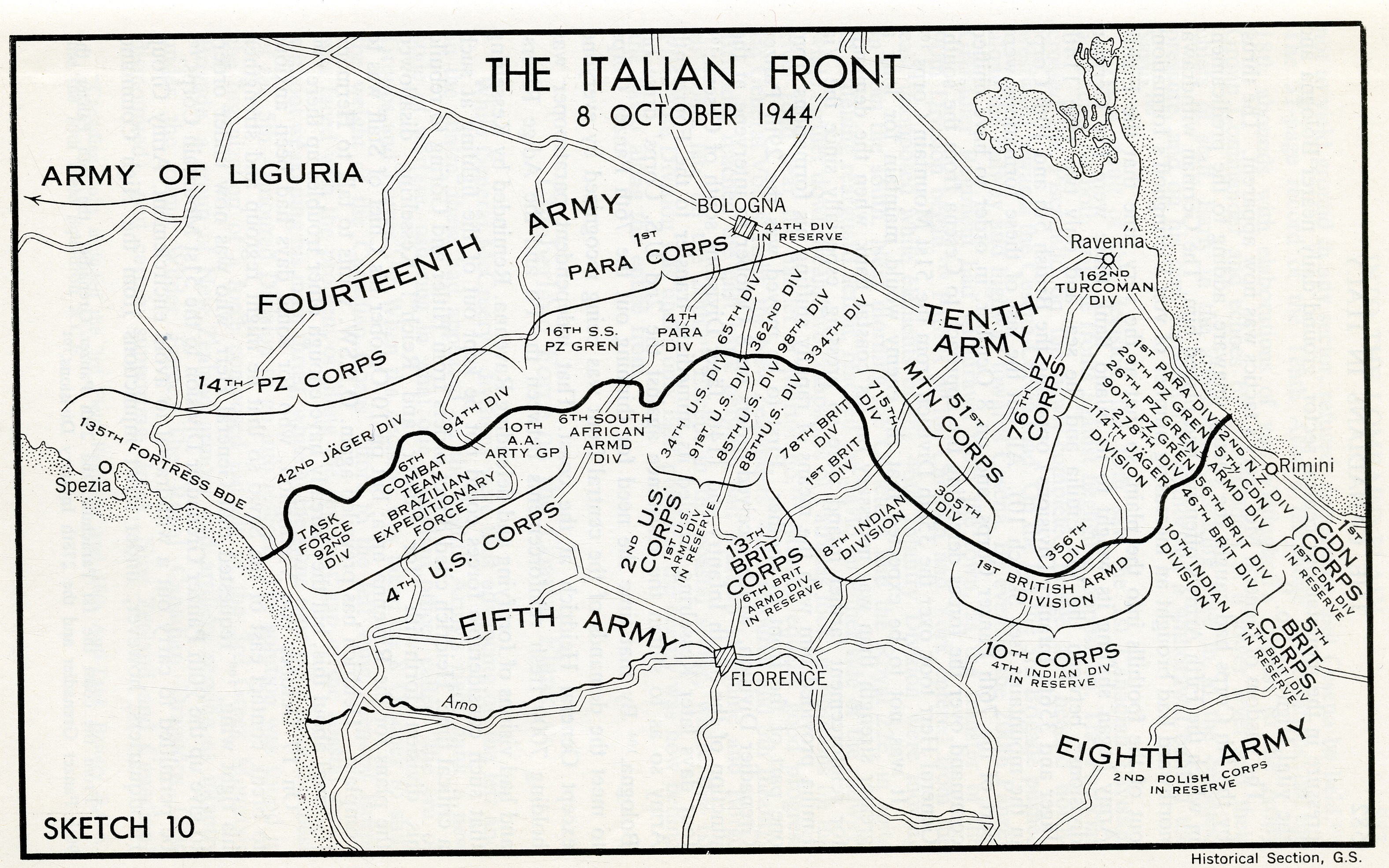
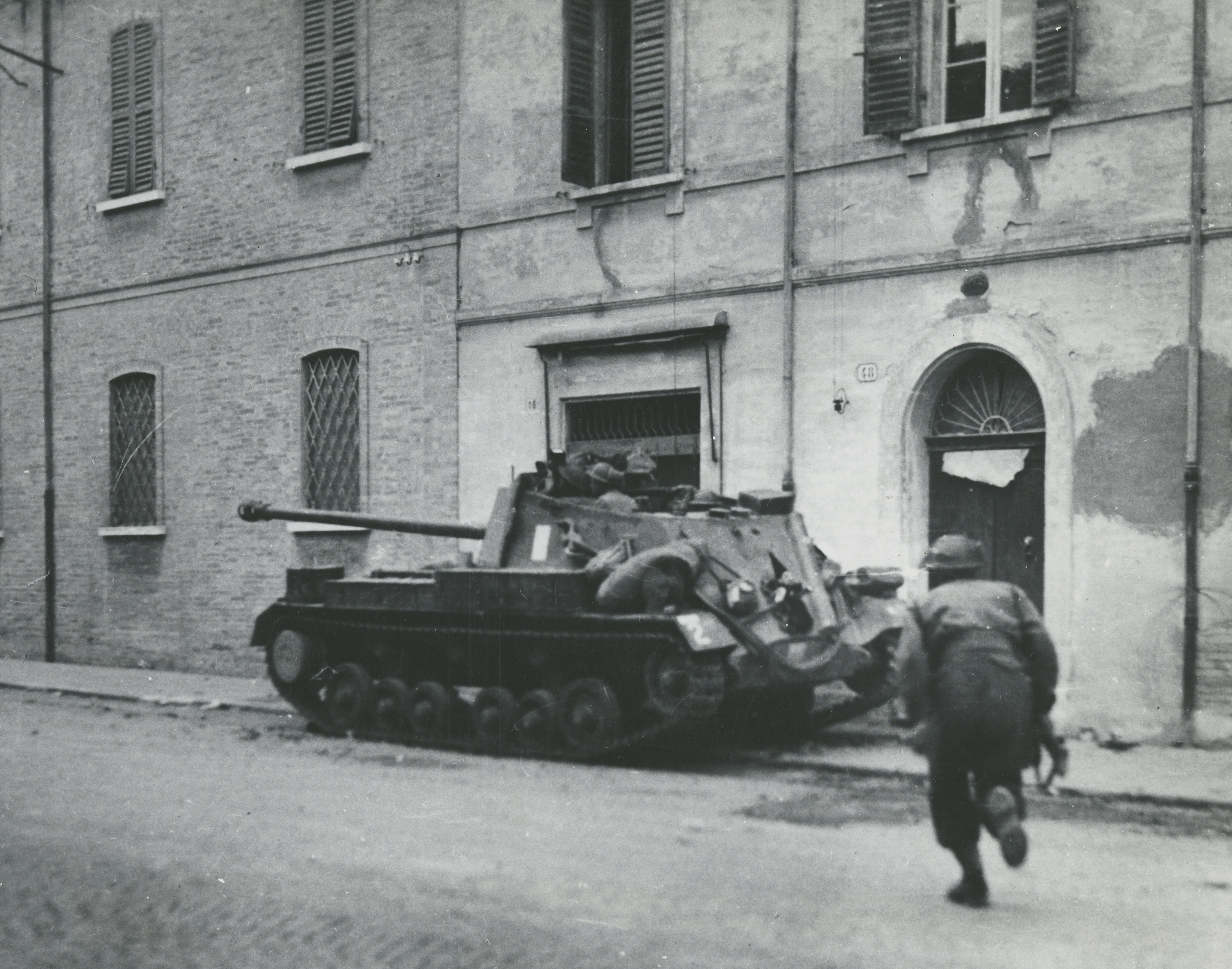


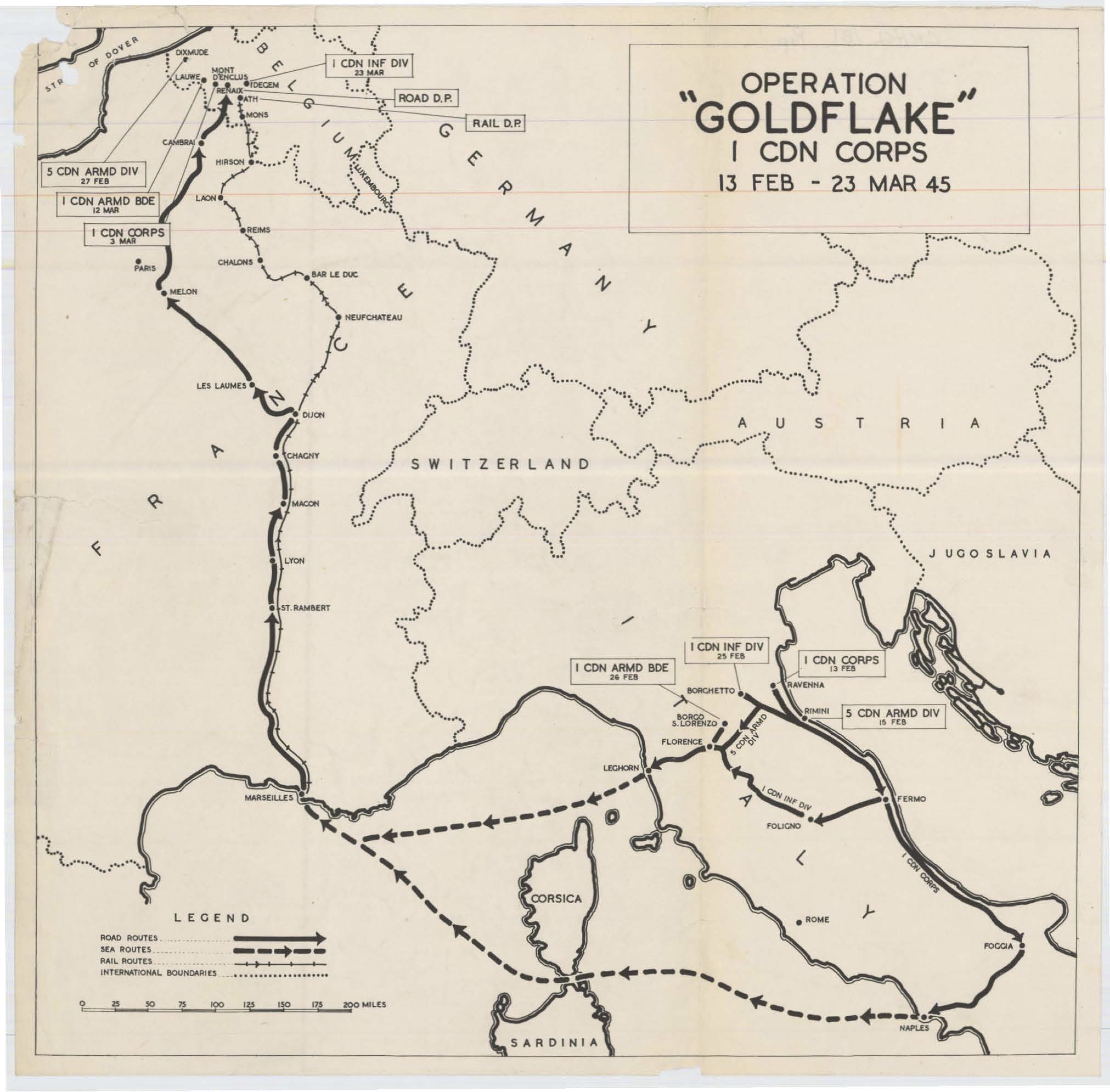
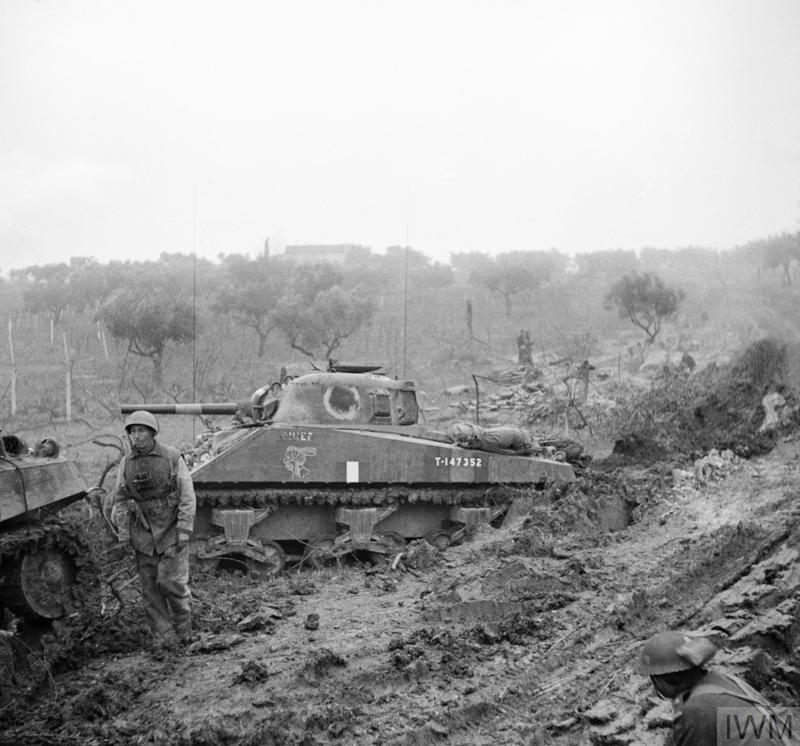
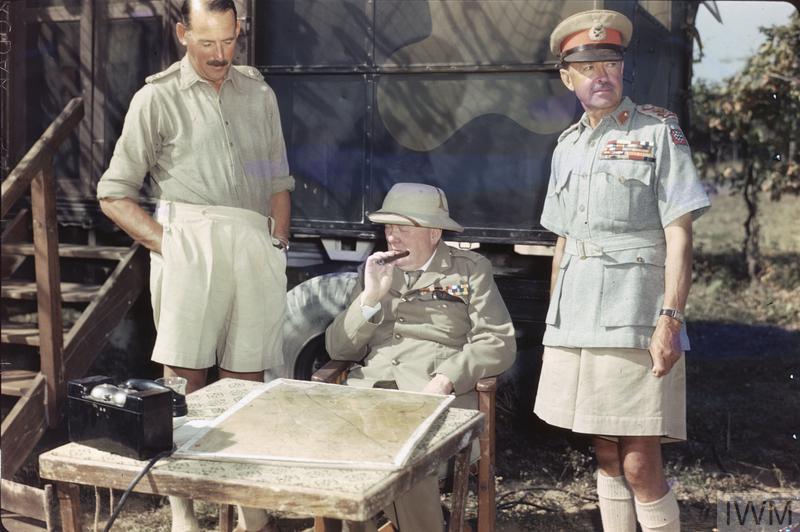


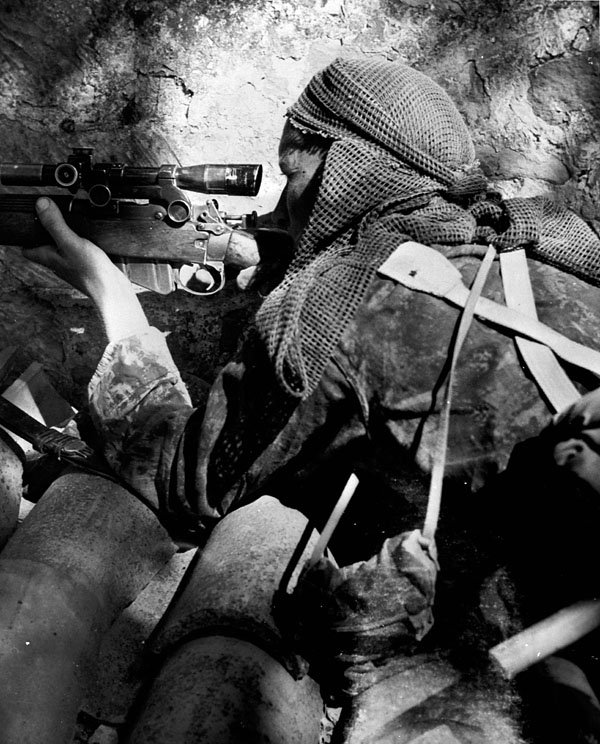
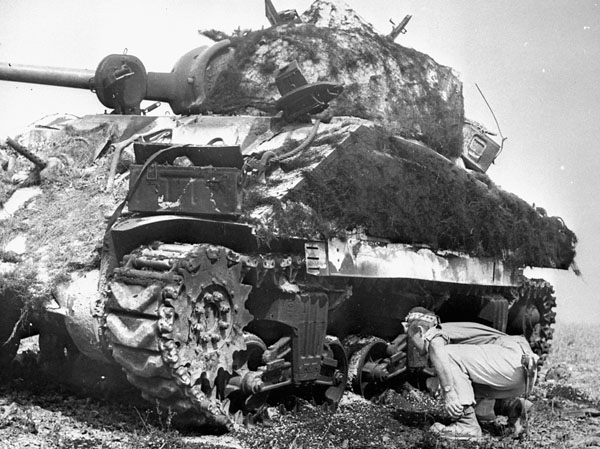


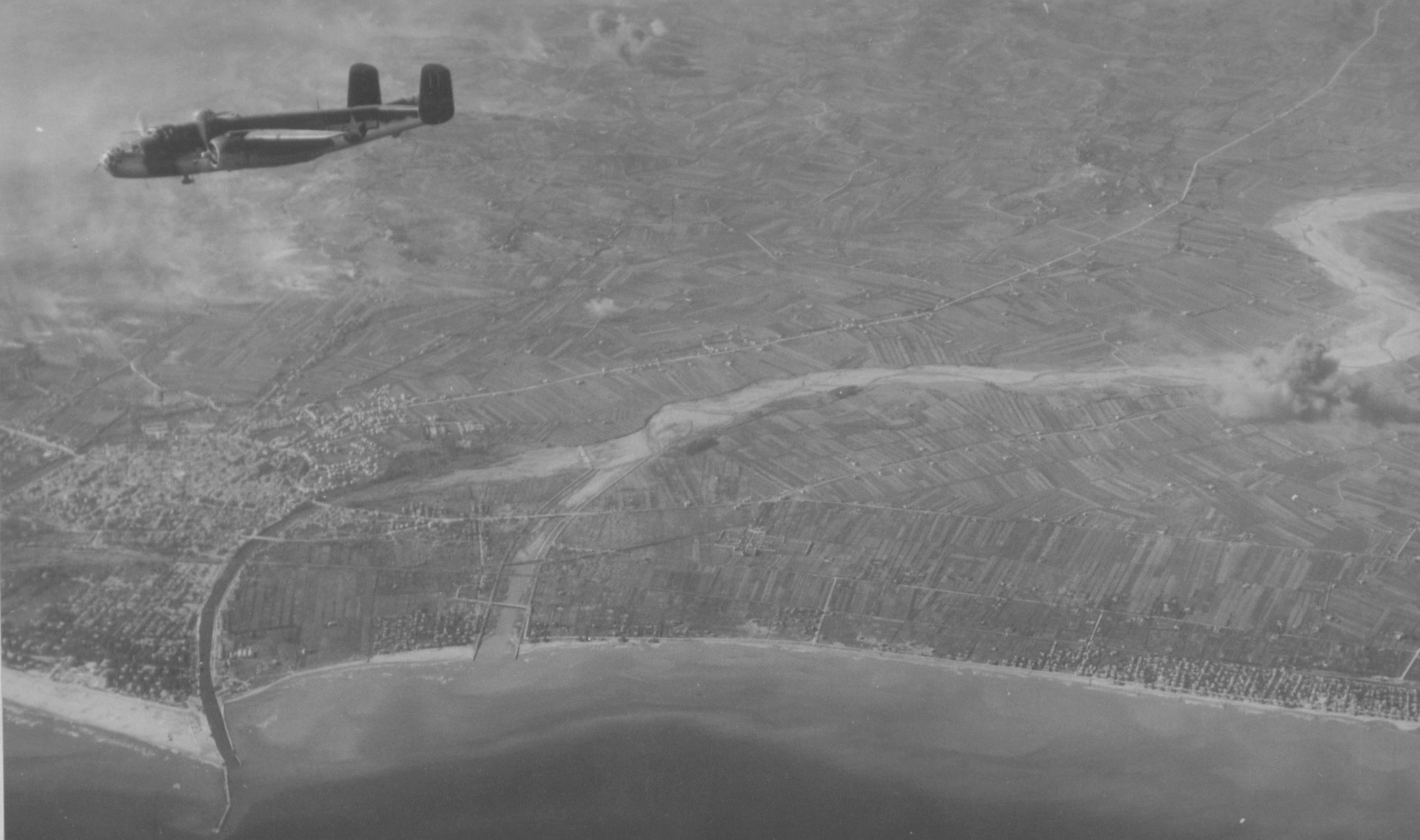
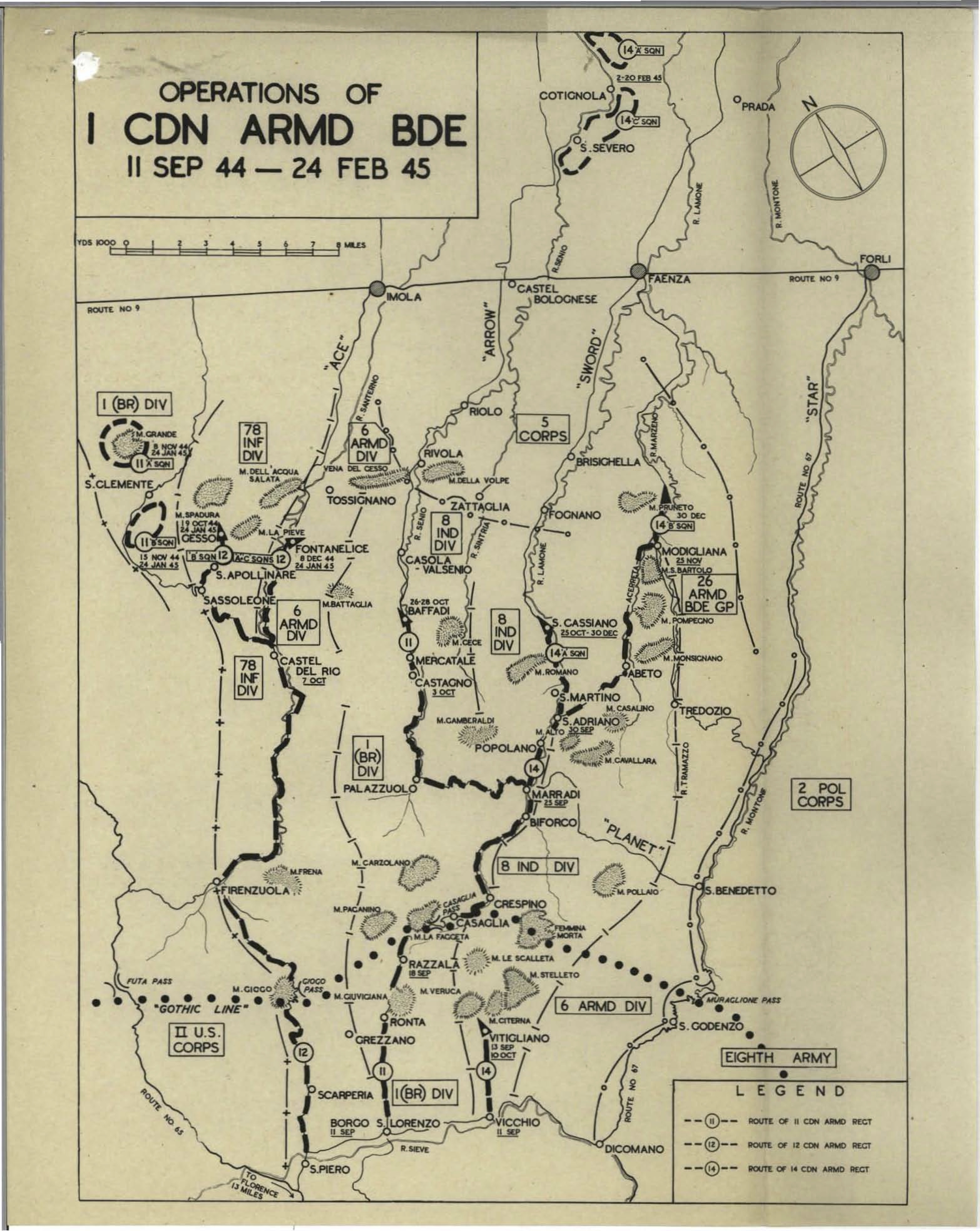
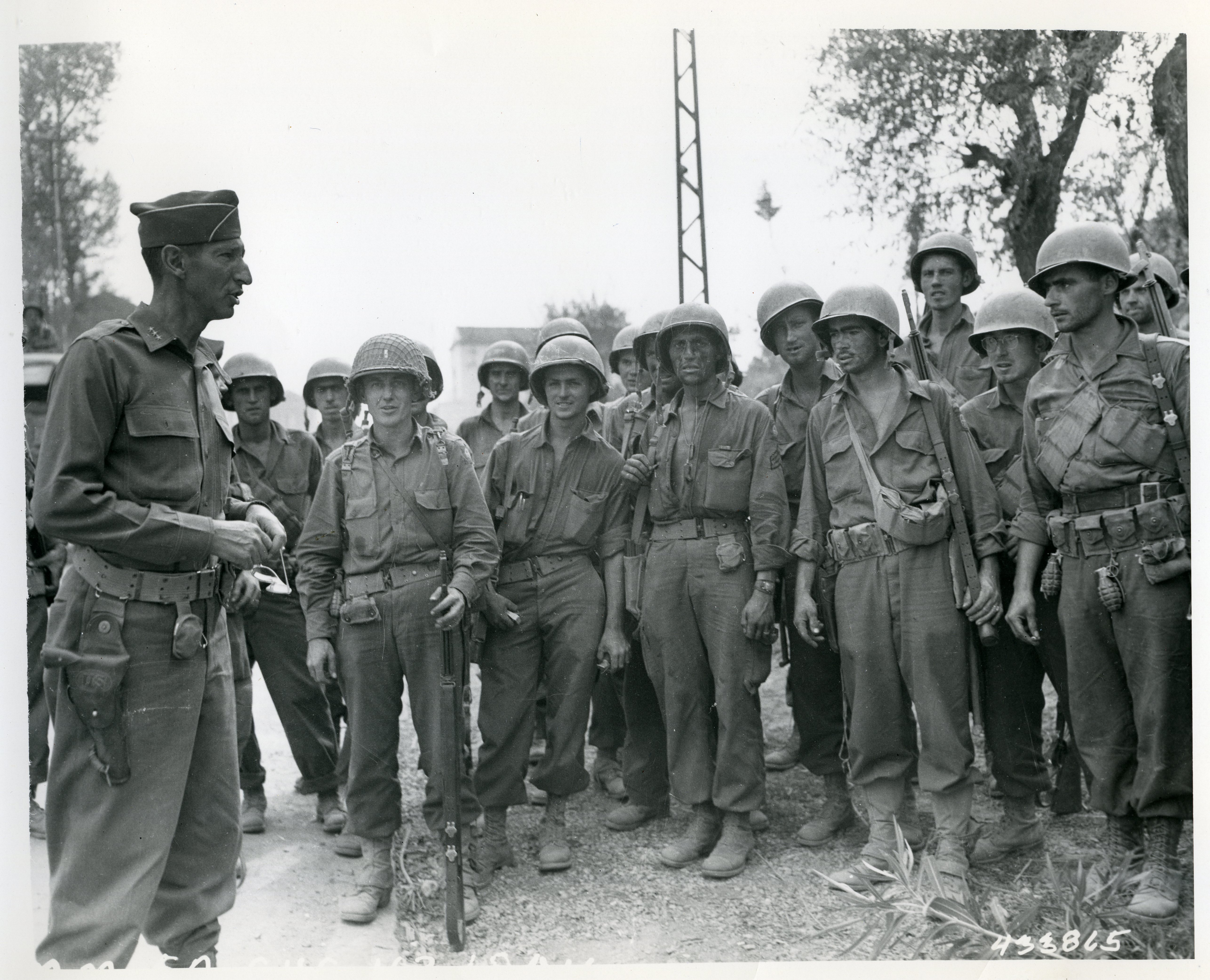

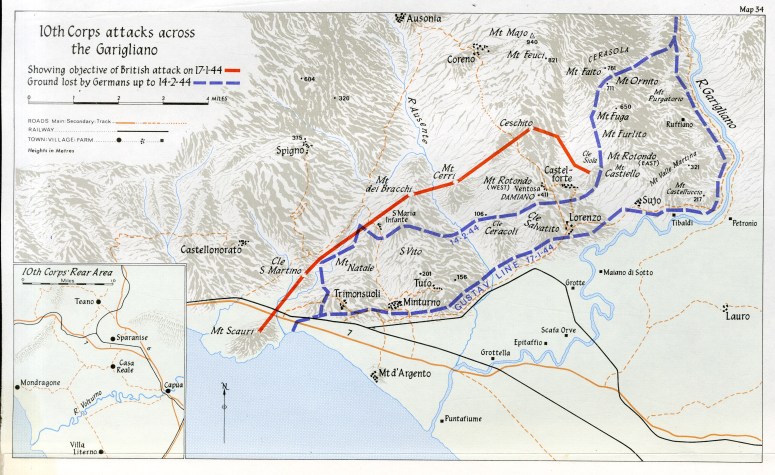
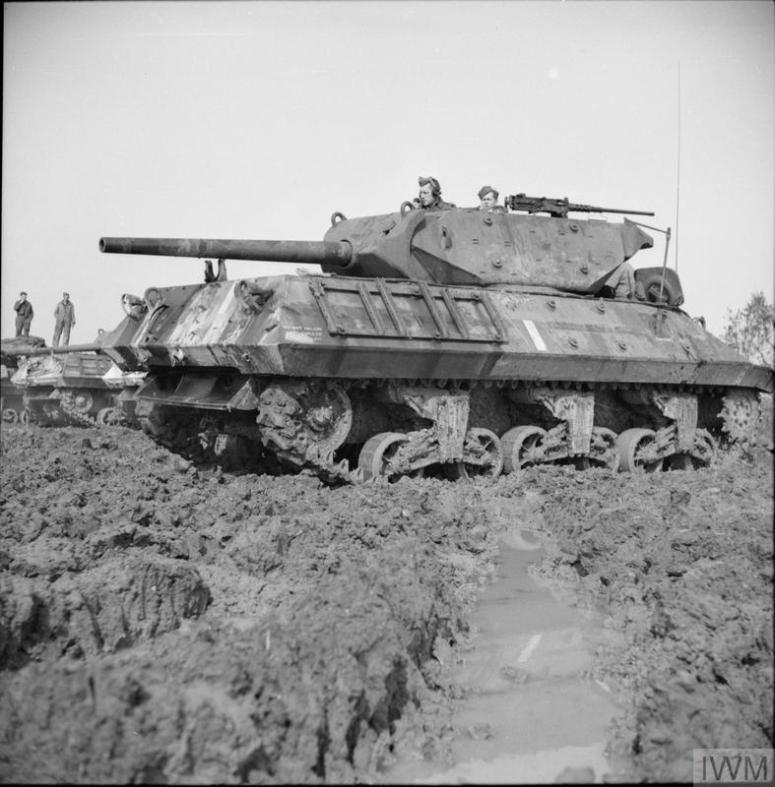
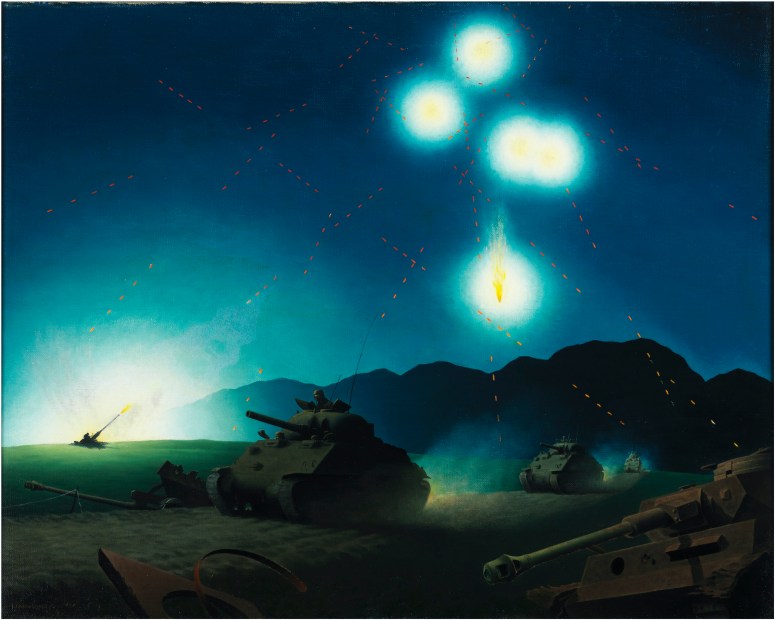


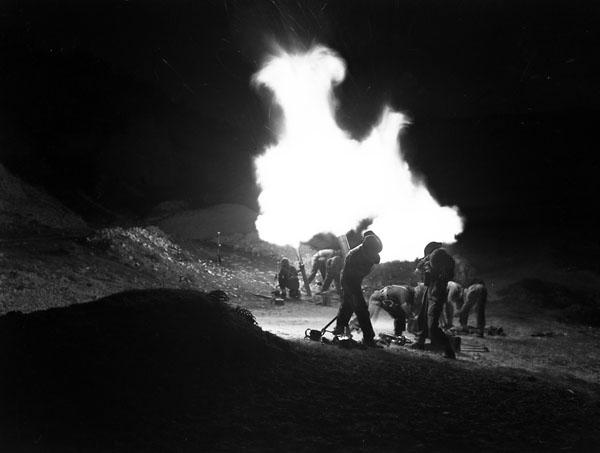
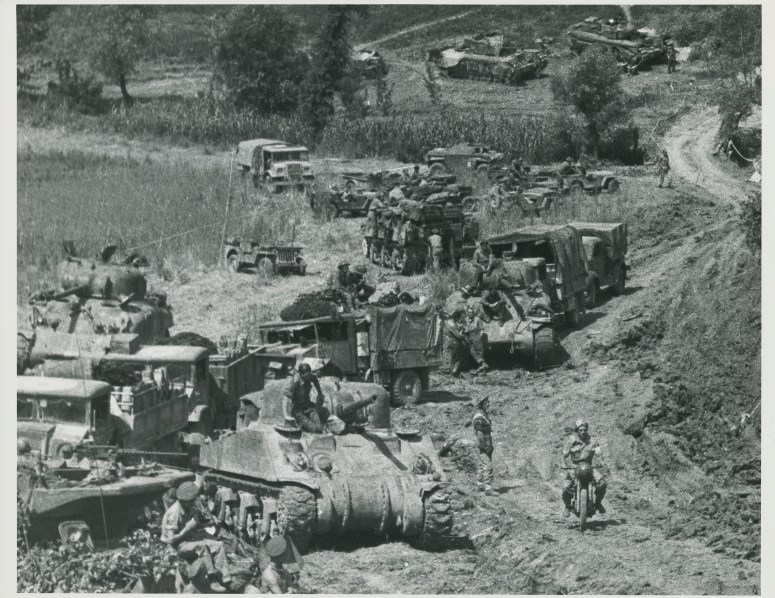
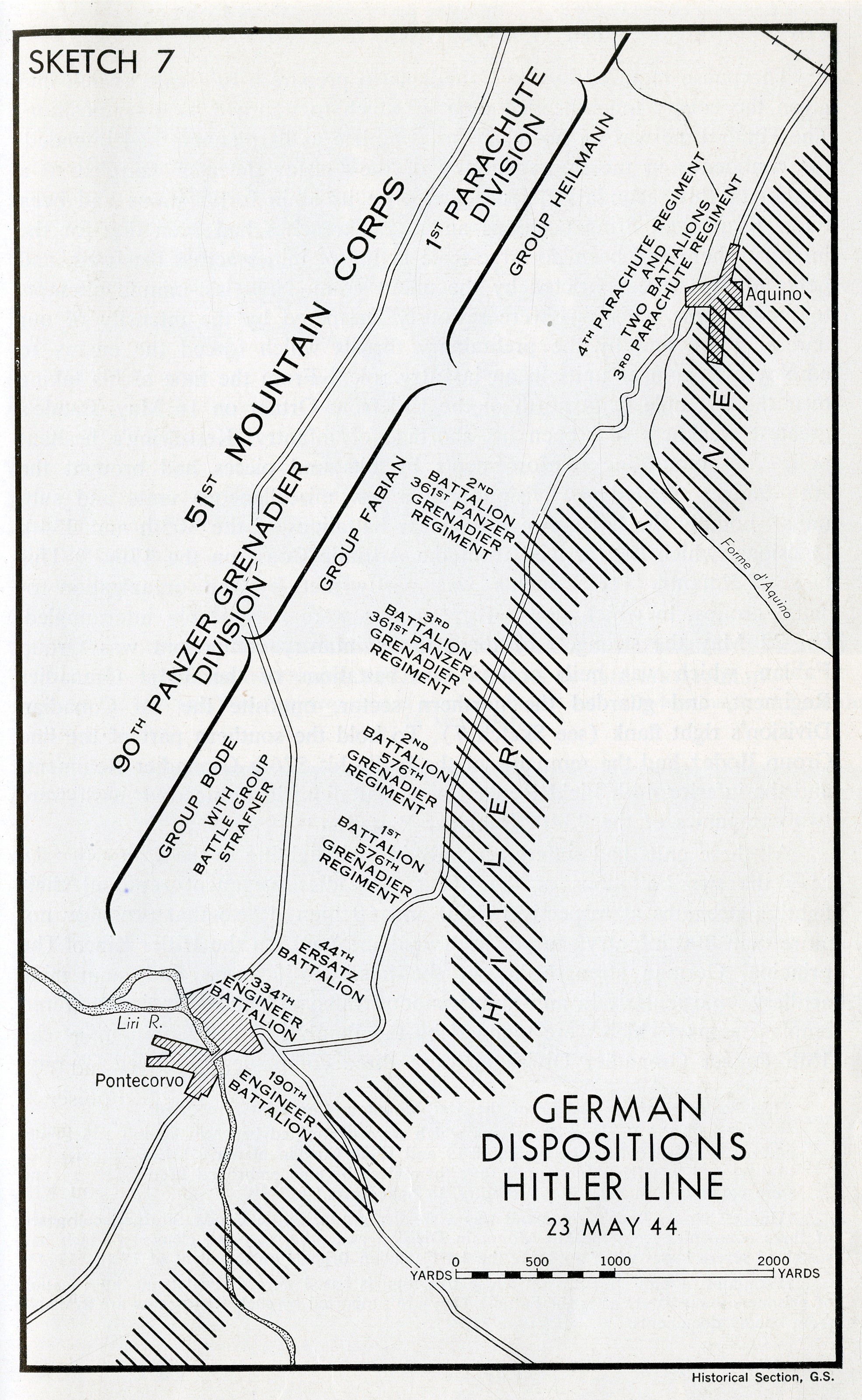


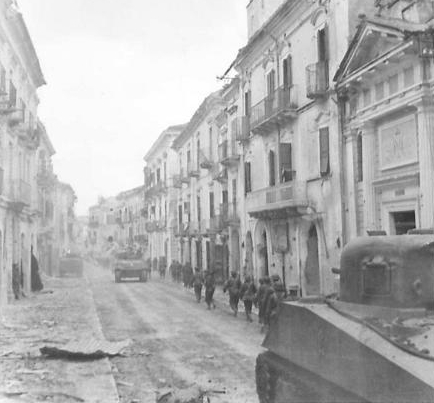
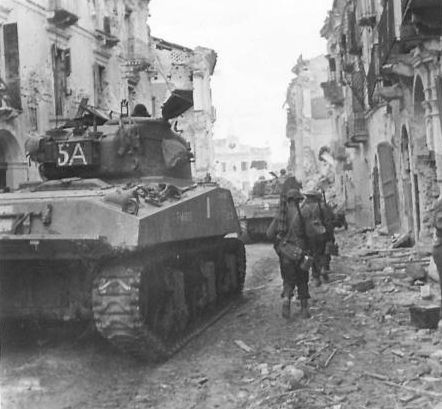

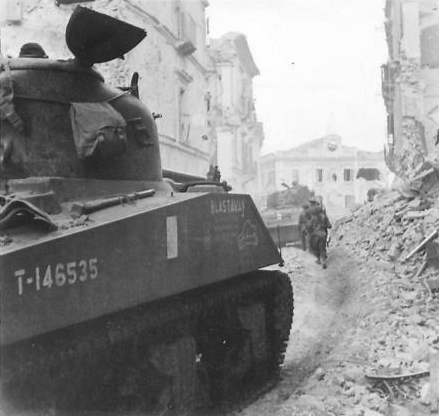
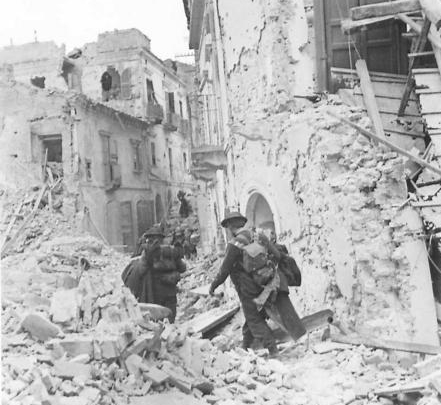
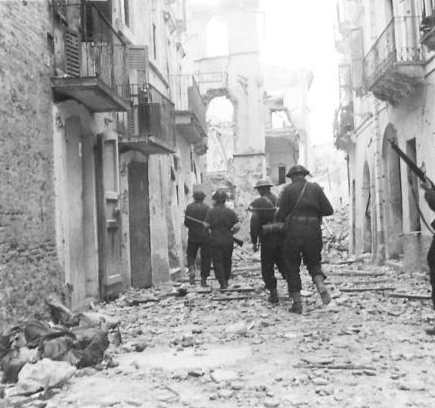
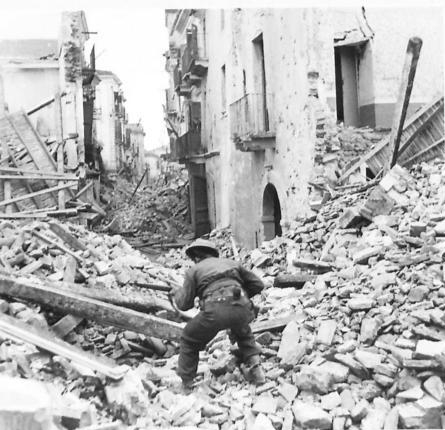


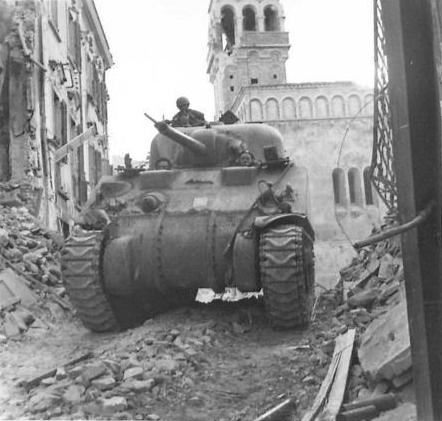


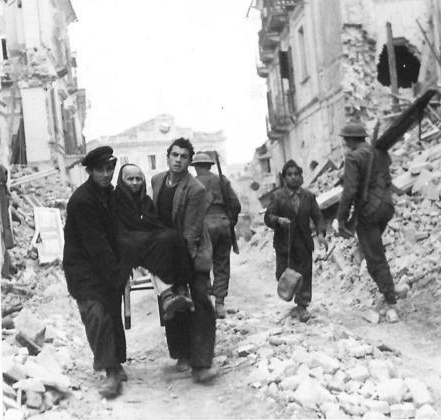


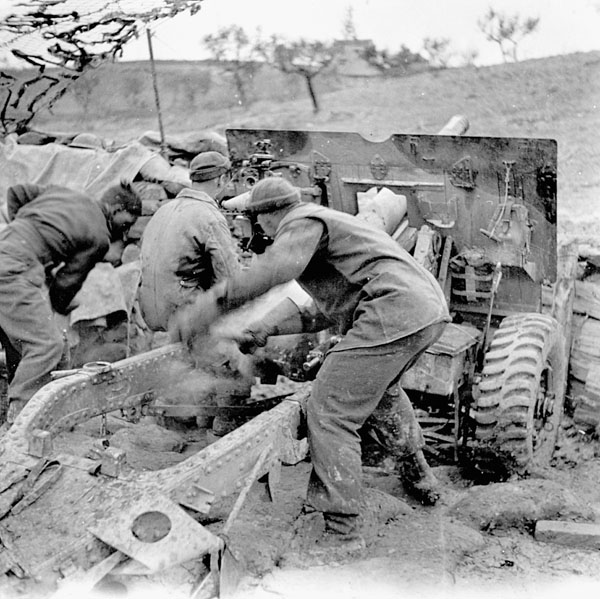




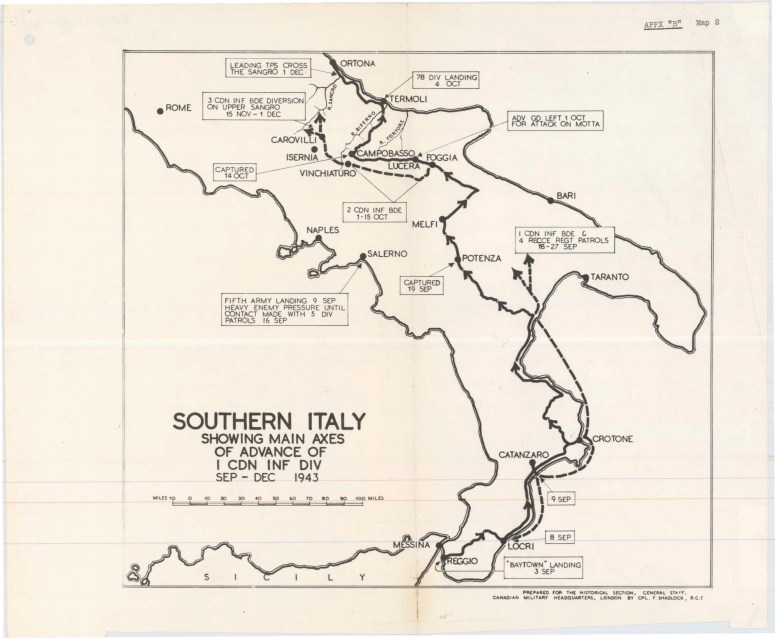


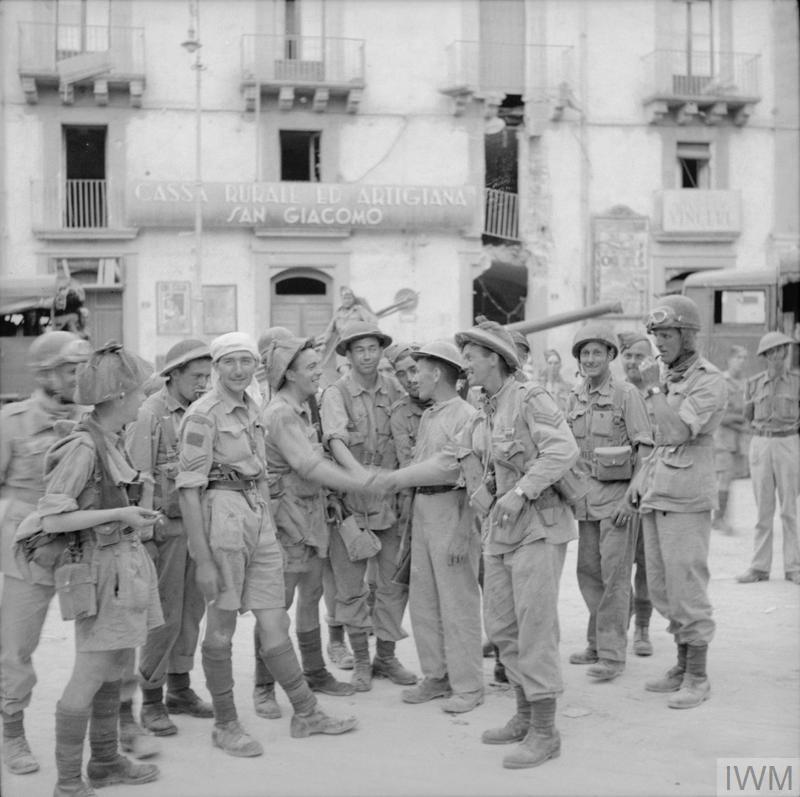

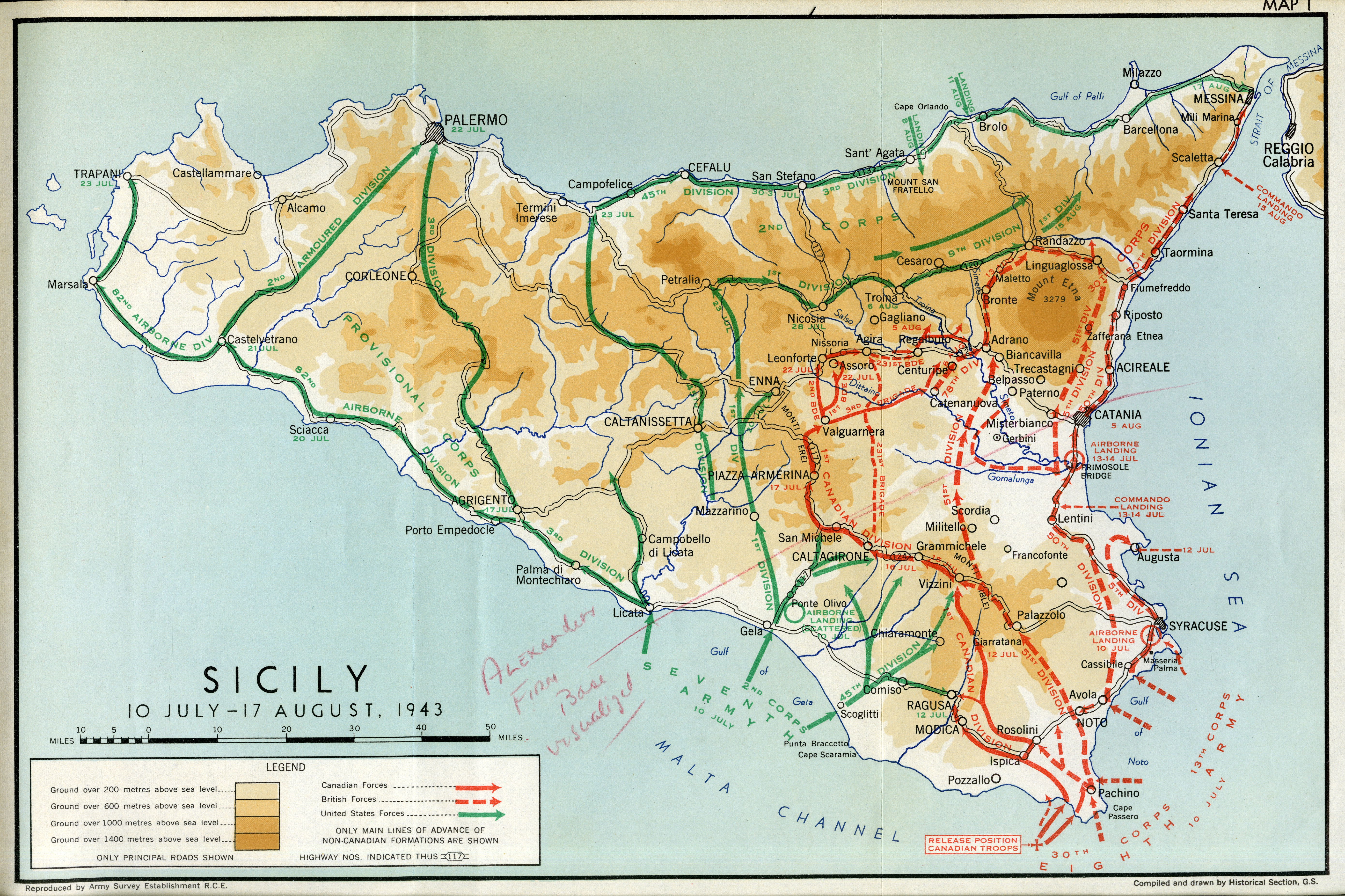
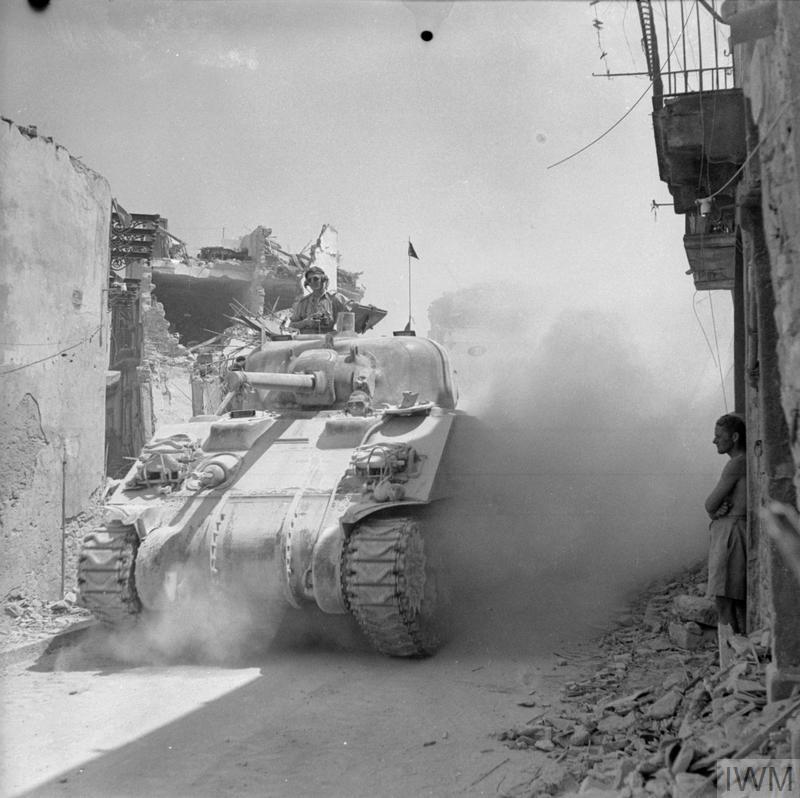
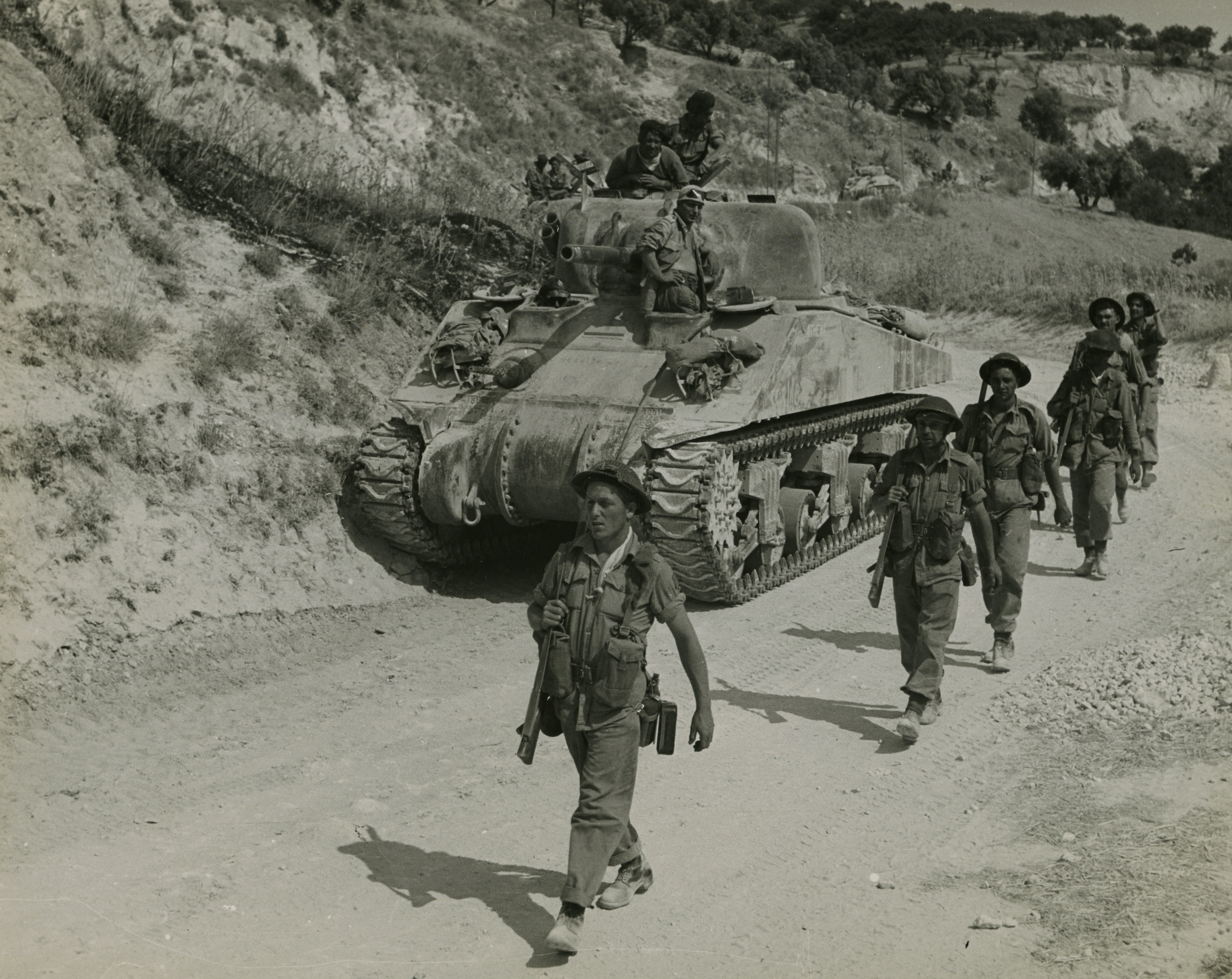


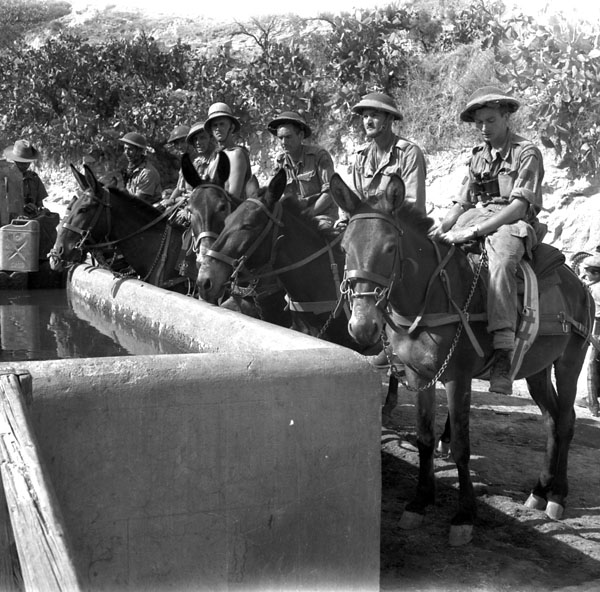
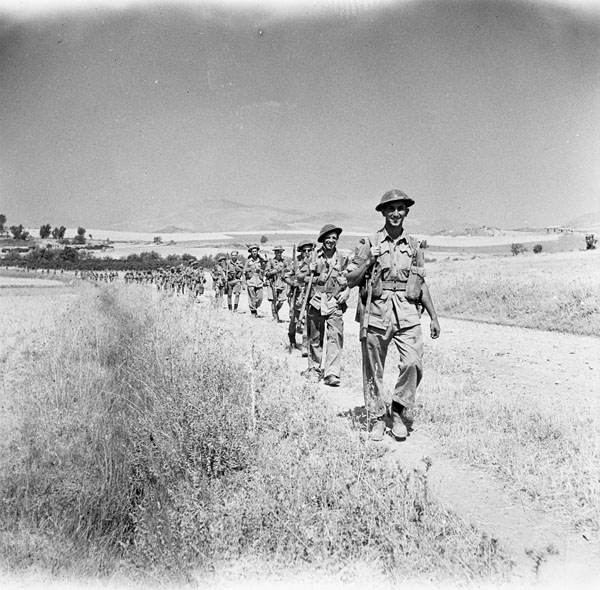


 Canada in Italy 1943-1945