
The Trasimene Line
The decision during the Italian Campaign to withdraw the Canadian Corps from the battle south of Rome and from the pursuit of the German forces retreating to Florence allowed for a lengthy rest and training period in the Volturno Valley. According to the historical officer attached to 1st Cdn. Division, leave arrangements in June and July 1944 were “extensive and generous” with rest areas in Bari, Salerno and Amalfi.
Of course it was not all rest and relaxation. The lessons of combat in the Liri Valley were studied with special attention given to better methods of controlling artillery fire, and improving tank-infantry co-operation. The 21st British Tank Brigade was made available to work with 1st Div. because 1st Cdn. Armoured Bde. was with XIII British Corps, leading the advance to Florence.
Criticism of the Canadian effort in the Liri Valley focused on higher command. Senior British officers were lavish in their praise of Canadian combat units and regarded 1st Cdn. Div. and 1st Cdn. Armd. Bde. among the best and most experienced troops in Italy. While it was politically impossible to break up the Cdn. Corps or place it under a British officer, Leese was determined to retain control of 1st Cdn. Armd. Bde.
The brigade was formed in 1941 in response to British requests for a larger Canadian commitment of armoured units. Winston Churchill had already told his cabinet colleagues that the Allies “cannot hope to compete (against the Germans) in numbers of men and must therefore rely upon an exceptional proportion of armoured vehicles.”
Churchill wanted 10 armoured divisions by the end of 1941. As part of this, Canada was asked to send both an armoured division and an independent infantry-support tank brigade to the United Kingdom. And this was to be done as soon as possible. The Ontario Regiment (11th CAR), the Three Rivers Regt. (12th CAR), and the Calgary Regt. (14th CAR) arrived in England in July 1941 to form what was then called 1st Cdn. Army Tank Bde.
The Calgary Regt. was selected to provide the tank component of the August 1942 Dieppe Raid and its fine performance validated the intensive training each regiment had undergone. The brigade, commanded by Brigadier Robert Wyman, participated in the invasion of Sicily in July 1943, though only the Three Rivers Regt. fought continuously in support of 1st Cdn. Div.
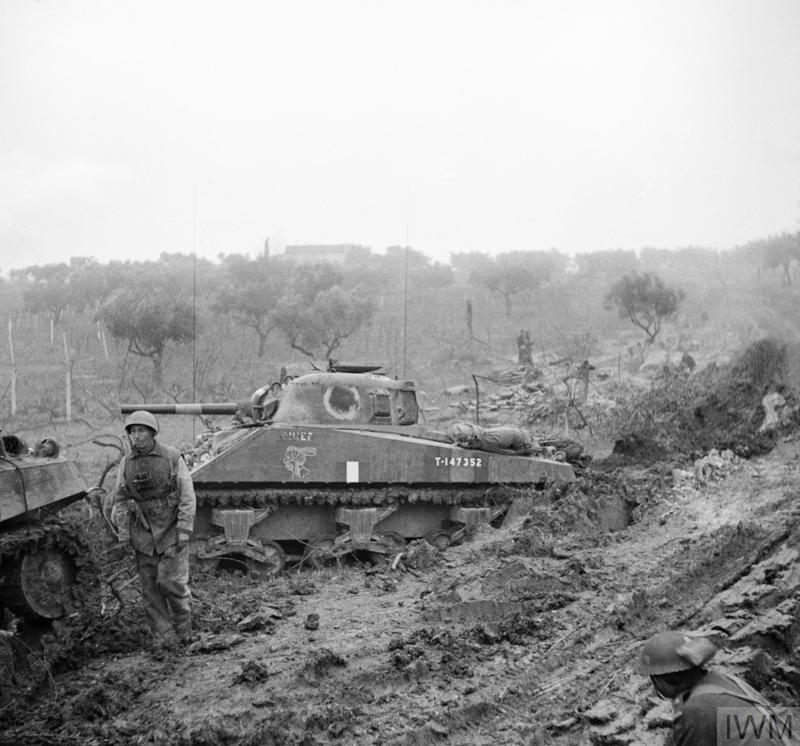
All three regiments had extensive battle experience by the spring of 1944 and were highly regarded throughout Eighth Army. The Three Rivers Regt., today the 12e Régiment blindé du Canada, earned particular praise for its role in supporting 78th British Div. at Termoli on the Adriatic coast. All three regiments fought with skill and effectiveness in support of 8th Indian and 1st Canadian divisions at the Moro River and at Ortona.
In late February 1944, Wyman left Italy to take command of 2nd Cdn. Armd. Bde. in preparation for the Normandy invasion. Lieutenant-Colonel Bill Murphy, the senior staff officer of 5th Armd. Div., was promoted to replace Wyman and he commanded the brigade for the balance of the war. Michael Boire, a Royal Military College of Canada historian and amoured corps officer who is the acknowledged expert on the brigade, notes that Murphy’s job was “to dish out his nine tank squadrons to British and Indian units,” rather than plan manoeuvres. He and his staff, “largely scientists and university people,” were required to anticipate future moves and keep “a close eye on the battle to make sure replenishment and repair of each regiment’s tanks was as rapid as possible.” Boire describes the brigade headquarters as a “finishing school for regimental officers lucky enough to be selected for a great learning experience.” Murphy’s liaison officers, “a constantly changing group of lieutenants and captains, were responsible for everything from finding harbour areas and accommodations to collecting new maps and delivering and explaining orders up and down the chain of command.”
Brigade headquarters also encouraged the armoured regiments to share their experiences. Captain R.I. Currelly, the historical officer attached to the brigade, interviewed commanding officers and squadron commanders and produced a summary of “lessons learned in the Gustav and Hitler operations.” Among the key points was the need for infantry to precede tanks while operating in close country. The tanks would be used to blast houses or machine-gun enemy positions or likely enemy positions. This required the closest possible infantry-tank co-operation. The use of the light Honey tanks to bring supplies forward had worked well, but the threat of enemy shelling meant that during resupply, smaller units had to be well spread out. Most crew casualties occurred when men were outside their tanks, when much greater caution was required.
Infantry-tank co-operation was only part of the story. When artillery observers were forward with the tank squadrons, quick fire could be used to destroy the enemy. The Three Rivers Regt. suggested that “our own field artillery could lift practically on top of advancing armour. This could develop a ‘steamroller’ effect which would be invaluable in overcoming a tough pocket of resistance.” Infantry would then exploit any initial success.
The “best armoured brigade in Italy” began to play its part in the long pursuit on June 11, 1944, when it was ordered north to support 4th British Infantry Div.’s advance to Arezzo, roughly 30 miles south of Florence. Before the move could begin, the Calgary Regt. lost the services of its exceptional commander, Lt.-Col. C.H. Neroutsos, a recipient of the Distinguished Service Order.
The brigade’s war diary provides a glimpse into the mindset of those who served. Neroutsos, a Canadian of Greek ancestry, had joined the Three Rivers Regt. and by 1943 was second-in-command. Promoted to lead the Calgaries, he soon earned the affection and respect of the westerners. During the previous battles in the Liri Valley, Neroutsos had continued in action despite having “to wear a steel brace on his leg.” The brace allowed him to walk well enough to command his regiment but he was forced to leave due to illness. Major (later Lt.-Col.) C.A. Richardson took over the Calgaries in time to begin training in tank-infantry co-operation with 4th British Div. Each Canadian regiment was assigned to work with one of the three infantry brigades.
Before examining the battles of late June 1944 it would be best to establish the strategic and operational context of that time. Alexander, the overall commander of what was now called the Allied Armies in Italy, was distracted over Operation Anvil, the amphibious invasion of the South of France.
Alexander, with the strong support of Churchill and the Chief of the Imperial General Staff, Alan Brooke, opposed Anvil arguing that the battles for Cassino and the Anzio bridgehead had exhausted the German armies in Italy. Anvil, or Dragoon as it was later renamed, would involve ten Allied divisions including two which would carry out an assault landing on 15 August. The Americans believed Anvil would offer immediate assistance to Overlord and the Battle for France. Marshall and Eisenhower insisted that employing ten Mediterranean divisions for Anvil left Alexander with twenty divisions, enough to fulfill the primary mission to tie down the Germans in Italy.
Alexander citing evidence from Ultra that the Germans had lost 38,624 men killed, wounded and missing in May, which together with equipment losses, especially tanks, meant that on average the German divisions were rated at least 70% of their full fighting power. Ultra also revealed that in mid-June German losses in Italy were being made up with tanks, infantry replacements and additional divisions. The British believed the best support for Overlord was to continue to press forward in Italy but Eisenhower was now adamant.
The Normandy campaign appeared to be stalemated in mid-June and Anvil would provide direct assistance as well as bring the French divisions to their own country. Three U.S. divisions left the Allied Armies in Italy in June to join Seventh U.S. Army for the Anvil Landings.
Alexander’s preoccupation with the British effort to cancel Anvil may help explain his failure to co-ordinate the advance of Fifth and Eighth armies north from Rome. Each operated in separate corridors throughout the pursuit. Because Fifth U.S. Army, which was advancing in more favourable terrain along the west coast, was always some miles ahead, the possibility of trapping the German Tenth Army—by enveloping it from the west—seemed obvious. The Germans, under pressure from Hitler to stop the Allies as far south as possible, were desperately afraid of this. But as the British official history notes, Alexander settled for a “partridge drive” that allowed the enemy to withdraw to a series of delaying positions.
Both German armies were ordered to try to stop the Allied advance at the Albert Line which ran from Ancona on the Adriatic coast to the Tyrrhenian coast, opposite the island of Elba. As part of XIII Corps, the Canadian armoured brigade was committed to the section of the Albert Line to the west of Lake Trasimeno. Known to the British as the Trasimene Line, it consisted of a series of hastily prepared positions that might be better described as a defensive zone five miles wide and 15 miles deep. As one historian wrote, “the great difficulty about the Trasimene Line is that nobody knew where it was supposed to be, not even the Germans!”
In the summer of 1944, the rolling country between the lake and the mountains, known as the Chiana Valley, was covered with olive groves, vineyards and small fields of grain. Much of the valley had been a malaria-ridden swamp until drained in the 15th century. The scattered villages and sturdy farmhouses were transformed into fortress-like positions while the small stream beds and drainage ditches became—with the assistance of engineers and explosives—anti-tank barriers. Apart from Highway 71, which borders the lake, the unpaved roads were little better than dirt tracks that three days of rain and tank traffic turned into stretches of churned mud. On a visit we were able to gain an overview of the battlefield from the ancient Etruscan town of Chiusi and from the shores of Lake Trasimene. It was evident that only the closest co-operation between armour, artillery and infantry could unlock such defences.
The Tenth German Army ordered three of its best divisions, the Hermann Göring Panzer Div., 1st Para Div. and 334th Inf. Div. to defend the sector. However, no one beyond Berlin believed it could be held unless resources could be found to stop the advance of Fifth Army along the coastal plain.
General Sidney Kirkman, commanding XIII Corps, decided to wait and organize a co-ordinated attack with 6th South African Armd. Div., 4th Inf. Div. and the veteran 78th Div. Kirkman had been told that 78th Division was to be withdrawn to Egypt at the end of June because it was understrength, exhausted from long months of combat and destined for garrison duties in Palestine. He decided to reinforce its lead brigade with Canadian armour, sending the Ontario Regt. to work with old friends in the 38th Irish Bde.
Classically educated British and German officers recalled the story of Hannibal’s destruction of an entire Roman army on the shores of Lake Trasimeno in 217 BC. The example of one of the most famous envelopments in military history may have inspired Major-General Charles Keightley to propose using the lake to stage an amphibious attack by landing a battalion 10 miles behind German lines. The unit that would supposedly carry out this too-clever manoeuvre was the London Irish Rifles. Its commanding officer pointed out that the available transport—DUKWs (amphibious vehicles)—had a “noise like a traction engine” and a top speed of 10 miles an hour, offering the enemy several hours notice to arrange a reception committee. Such a venture, he suggested, would “likely end Charles Keightley’s career as well as mine.”
The actual battle for Route 71 began at the villages of Sanfatucchio and Pucciarelli where the Irish infantry and Ontario tanks “worked in tandem; the 75-mm guns would blast a house at close range and then the riflemen would storm the building.” Beyond Sanfatucchio, the Germans had created a more formidable defensive position using a solidly built church and advantageous high ground. The church, which is now abandoned, and its graveyard sit on ground that overlooks all approaches. It is not difficult to understand why Sanfatucchio is a battle honour well remembered by veterans of the Ontario Regt. Once again the tanks and carefully observed artillery fire assisted the infantry forward. By evening on June 20, the enemy, less scores of prisoners and many casualties, had withdrawn north, pursued by the reserve battalion, the Royal Irish Fusiliers and Canadian armour. This force faced a series of disjointed counter-attacks, but in the process destroyed a number of enemy tanks which were badly employed in ones or twos without support.
While the Irish and Canadians secured Pescia and Ranciano, the Three Rivers Regt., supporting 4th British Div. began a seven-day battle which “from beginning to end was essentially a failure.” On this section of the front the enemy was able to withdraw intact, inflicting more casualties than they suffered. According to the Canadians, the 28th Inf. Bde. was “totally green” and unable to work effectively with armour. This contributed to the loss of 94 men and 26 tanks, one of the heaviest weekly casualty tolls to an armoured regiment in the Italian Campaign.
The 28th Bde. had spent most of the war on garrison duty at Gibraltar. It was brought to Italy as a replacement brigade due to a shortage of reinforcements and it suffered heavy casualties in its first battle at the Gustav Line. The decision to commit an inexperienced, and understrength brigade to such a battle suggests just how serious leadership problems were in Eighth Army.
The Canadians were given a brief period of rest in July. Many spent Dominion Day 1944 bathing in the warm waters of Lake Trasimeno. On July 5, Kirkman, whose XIII Corps was pressing north to the Arezzo Line, ordered the Canadians back into action to protect the mountainous left flank of 6th British Armd. Div.’s advance. Kirkman, who claimed that his corps “had learned all it knows about armoured fighting from 1st Cdn. Armd. Bde.,” needed the Canadians to support 4th Div.
The narrowing valley, now divided by the A-1 auto route to Rome, was held by small enemy detachments in the process of drawing back to Florence. Hitler claimed his delaying tactics worked, allowing time for the development of field fortifications at the Gothic Line. Field Marshal Albert Kesselring and his generals in Italy were much less confident. The Germans had lost more than 100,000 men from all causes since early May, an average daily loss of 1,260 men—a very high price for a fighting withdrawal.
The Arezzo Line, which the Canadians were now attacking, was the last serious blocking position south of Florence. The Germans held it until July 15 when XIII Corps, reinforced by the 2nd New Zealand Div., stormed Mount Lignano, the high ground controlling the roads to Arezzo. The Canadian brigade was then assigned to 8th Indian Div. for the pursuit along the Arno River through Chianti wine country.
When the full story of 1st Cdn. Armd. Bde. is written, it will no doubt quote the words of Leese who described the brigade as “the hardest hitting and finest armoured formation that I have ever had the pleasure to command.” Generals offer such words of praise far too freely, but in this case Leese was speaking the plain truth.
The Gothic Line
During any trip to the region between the Metauro River and Rimini along the Adriatic coast, it is possible to visit many of the most important battlefields fought by I Canadian Crops during the late summer and fall of 1944 and appreciate the challenges imposed by the terrain. Beginning at the church in the town of Montemaggiore which, at an elevation of 197 metres, is perched on a hill just south of the Metauro. The church square is known as the Belvedere Churchill because the British prime minister came here on Aug. 26, 1944, to watch the first stage of the battle. Churchill insisted on going further forward and ended up near the headquarters of the Royal Canadian Regiment beyond the river where he could hear “the rat-tat-tat-tat” of machine-guns, and watch the tanks manoeuvre a kilometre away. It was the closest Churchill ever got to the front in the Second World War.
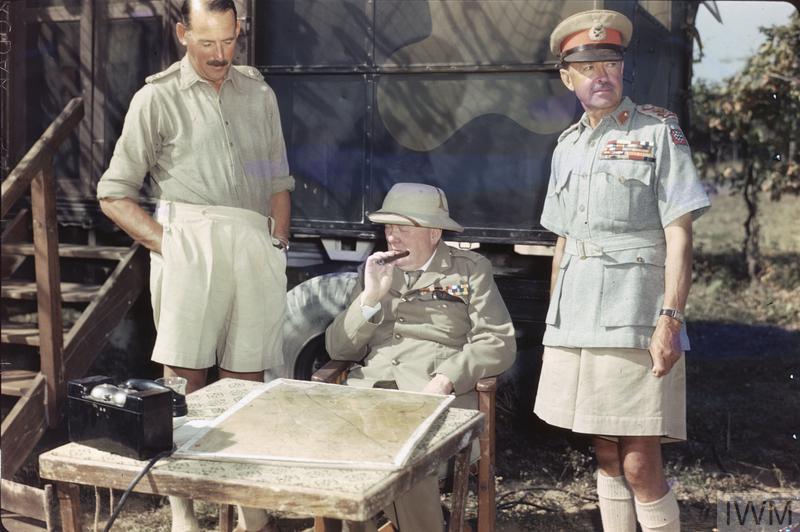
To the east, one can see the narrow coastal plain where, in August 1944, General W.A. Anders’ Polish Corps was waiting to resume the advance. The Poles had pushed the Germans back to the river in a series of sharp battles fought over the previous month and captured the port of Ancona. To the northwest, near the ancient university hill town of Urbino, the mountains are higher and more rugged, features that the British V Corps faced. Straight ahead from the top of the hill one can see the route followed by the 1st Cdn. Division during its approach to the Gothic Line further north. The relatively open valley of the River Sale leads to a series of mountain peaks as high as 555 metres.
To a military historian who has written extensively about the problems posed by the gentle ridges in Normandy with their modest reverse slopes, this ground appears problematic. What were the generals thinking? To answer this question we need to review the strategic debate of the summer of 1944 and remind ourselves that the primary purpose of the entire Italian Campaign was to force the German high command into diverting resources away from Operation Overlord. Given this imperative, the Army Group Commander and his two army commanders were required to mount some kind of major offensive in July or August 1944.
Alexander was told his “task will continue to be the destruction of the German forces in Italy” by an advance to “seize the line of the River Po” in the north part of the country. This was to be done with the available troops in the Mediterranean, some 18 divisions and seven independent armoured brigades, including the Canadian Corps and its orphaned armoured brigade.

With clear, urgent and final orders, Alexander and his army commanders began detailed preparations for an offensive through the centre of the Apennine mountain range on the Florence-Bologna axis. Today’s traveller can use the E25 autostrada that tunnels its way through the mountains to reach Bologna in less than two hours, but in 1944 the roads followed narrow valleys before climbing to high mountain passes. To succeed in such a venture, the full weight of the 5th and 8th armies was required to push forward on all possible routes with enough divisions in reserve to exploit success.
The great advantage of this plan was that a breakthrough here would force a retreat or create conditions for an encirclement of German troops on the coastal flanks. The weakness was the growing distrust and animosity between Clark and Leese which made co-operation between their armies increasingly difficult.
This problem was solved when Leese proposed to scrap the plan and transfer most of Eighth Army to the Adriatic coast. Staff officers pointed out that while “the initial attack should be easier from all points of view,” the enemy could readily withdraw to a new series of lines using the lateral rivers and mountain spurs. They cautioned that “as we push the enemy back, we will enable him to reduce his front and easily transfer reserves along the Via Emilo,” the old Roman road from Bologna in the northwest to Rimini in the southeast. One other troubling factor was the effort that had gone into a deception plan designed to convince the Germans that the attack was to take place in the Adriatic sector.
Despite these disadvantages, Alexander agreed to the changes hastily authorizing a new deception scheme intended to persuade the enemy that the attack would come in the central sector. He explained his support for Leese as based on reasons “both military and psychological.” He recognized that Leese wanted a separate battlefield for Eighth Army, something that would free him from the need to co-operate with the Americans. Clark accepted the change providing that XIII British Corps, which still included 1st Cdn. Armoured Brigade, remained with his army. Clark believed that if Eighth Army’s attack began first and drew off German reserves, Fifth Army could penetrate the mountain passes and reach Bologna before winter.
The confidence expressed by both army commanders is difficult to understand. With less than six weeks left before the heavy rains of October began, realism required modest expectations, not heady optimism about a breakout into the Po Valley. It may be argued that generals need to use their leadership skills to engender enthusiasm and energy in subordinate commanders, but it is evident that Clark and Leese believed they were on the eve of a great victory. As J.M. McAvity, the historian of the Strathcona’s Horse has noted, “Army commanders use a wave of the hand over a map, corps commanders will point with three fingers, divisional commanders with two, brigadiers with one, while the junior commanders must go into more and more detail with an increasingly sharp pencil.”
Leese, who held a series of morale-building sessions with the senior officers of each division, told the Canadians that the mighty Eighth Army would “destroy the enemy standing between the 8th Army and Venice.” This was the equivalent of a wave of the hand which ignored the problems of attacking across a series of ridges and river lines. When Leese outlined Eighth Army’s strength—1,200 tanks, 1,000 guns and 10 divisions—he said little about the three divisions of the German Army’s LXXVI Corps or the reserves that could reach the battlefield in a matter of days.

However one evaluates Leese’s leadership skills, his failure as a commander in Operation Olive—the codename given to the Gothic Line offensive—is evident in the plan he developed. He ordered the Polish Corps to advance along the coast to Pesaro where it would be pinched out of the battle. The Canadian Corps—with one infantry and one armoured division—would attack on the Polish left flank and then crack the main Gothic Line defences while turning east to seize the town of Cattolica before advancing north to Rimini. British V Corps—to the left of the Canadians—was designated the “pursuit corps” despite the mountainous terrain along its line of advance.
Leese’s decision to allocate five divisions, two independent armoured brigades and the 43rd Gurkha Lorried Infantry Bde., to Gen. Charles Keightley’s V Corps reflected his admiration for Keightley and his lack of confidence in the Canadian Corps commander “Tommy” Burns, but made no military sense. Either the Canadians should have been reinforced or V Corps given the best axis of advance. The Canadians, Leese believed, could crack the Gothic Line, but the breakout into good tank country was a task he reserved for Keightley’s corps and especially the 1st British Armd. Div. He left the question of how the British were to get from their inland sector to the breakthrough point unanswered.
Before Operation Olive could begin, the troops had to cross the Apennines from Florence to a staging position near the port of Ancona on the Adriatic. For the Canadians, this involved a series of moves along routes the corps engineers had surveyed and improved. Tanks and other tracked vehicles were assigned to a one-way route over secondary roads that were reconfigured with diversions around choke points. In just five nights, the entire Canadian Corps “mushroomed into being on the Adriatic front.” A tremendous tribute to Canadian engineers.
The first phase of Operation Olive began on the night of Aug. 25. All three corps crossed the Metauro before an intense bombardment struck the known German positions. The quick seizure of bridgeheads was largely due to an earlier German decision to withdraw to the first ridge of hills, named the Red Line. This move accidentally coincided with the opening of the Allied offensive. The German Tenth Army had completely misread the situation and both the army commander and Gen. Richard Heidrich, 1st Para Division’s skilled leader, were away on leave.
The Loyal Edmonton Regt., the Princess Patricia’s Canadian Light Infantry and the 48th Highlanders led the advance, and met little or no opposition. When the Seaforths moved through the bridgehead to seize Monte della Mattera—also known as Point 479—heavy shellfire and the accidental strafing of forward troops by Allied aircraft inflicted numerous casualties. The 145th Regt., Royal Armd. Corps, which was part of the 21st British Tank Bde. supporting the Canadians, provided a squadron of Churchill tanks plus the light Honey tanks for the final assault on Point 479. “One company of Seaforths was placed on the tanks, and led by a troop of Churchills, quickly made the ascent,” noted a report from the 21st British Tank Bde. “…stiff resistance was met in a number of houses, but was successfully overcome.” The long period of training in infantry-tank co-operation was paying off.
A second instance of superb co-ordination occurred on the 1st Bde. front where the PPCLI, working with 12th Royal Tanks, encountered a battery of German 88s on Monte San Maria. The forward observation officer called for artillery support, corrected the fire and silenced the guns all in a matter of a few minutes.
The 48th Highlanders, continuing 1st Bde.’s advance, was pinned down on the slopes below a strongly defended convent located on an extension of the Monte della Mattera feature. Brig. J.A. Calder decided to avoid a costly frontal attack. Instead, he sent the Hastings and Prince Edward Regt. with a squadron of 12th Royal Tanks on a right hook, described accurately in Farley Mowat’s history of the Hasty Ps as “a small masterpiece of infantry and tank co-operation that won the hill.”
From the convent grounds the next ridge line, which included the village of Monteciccardo, is clearly visible. Shortly after midnight on Aug. 28, 1944, a company of the Loyal Eddies worked its way up the hill reaching the outskirts of the village. This occurred just before a company of German infantry—“marching in threes”—arrived to walk into a trap. The arrival of a German tank and additional infantry ended premature claims of victory. Clearing the village and the nearby monastery required armour and a day-long “slugging match.”
It is possible to retrace these battalion battles today and to visit the poignant memorial in the village of San Angelo, which was flattened by bombing and shelling. The plaque to those killed in the war simply notes that on Aug. 28 “il fronte di guerra passa a San Angelo.”
Once the Red Line defences were broken, the drive to the Foglia River gained momentum. On the Adriatic flank the Polish Corps, with its divisions reduced to the size of brigades, continued to advance assisted by the success of the artillery program that had caught the paratroopers in the open. On the left flank, 46th British Div. kept pace with the Canadians but elsewhere V Corps was “delayed by the lack of roads and problems with traffic control.” This was an ominous sign of trouble for a “pursuit corps.”
The terrain also affected the Canadian advance. It was relatively easy for German engineers to block roads, blow bridges and help their soldiers make the best use of the steep slopes, razor-backed ridges and gullies to slow the advance. The Canadian infantry could not always wait for the armour and since men on foot did not need to follow the roads with their disorienting switchbacks, they tramped up the hills making the best use of cover.
The capture of several Canadian soldiers spooked the German commanders who after Ortona and the Liri Valley saw them as shock troops signalling a major offensive. The Tenth Army chief of staff demanded more information because he said “everything would change if they really are Canadians.” Field Marshal Albert Kesselring, who knew that 1st Canadian Armd. Bde. was fighting under British command, demanded to know “which Canadians?” and was furious when told the first prisoner who was brought back for interrogation in daylight “was caught in a bombing attack and killed.” Orders were given that “under no circumstances were Canadian prisoners to be brought back until dark.” Later, when the first captives were interrogated, little could be learned because “they refuse to speak.”
Finally, on Aug. 28, Kesselring agreed that the fresh formations of Canadians and British had replaced the Poles with the objective of quickly passing through the main Gothic Line defences (the Green Line) overlooking the Foglia River. Reserves, including “three additional flak battalions for defence against constant air attacks,” a tank battalion and an infantry regiment were rushed to the Adriatic sector, but—as we shall see—not in time to prevent the Canadians from breaking through the Green Line.
The German Army’s Apennine defences, known to the Allies as the Gothic Line, stretched across the Italian peninsula. The strongest sections were in Fifth Army’s sector, guarding the direct approaches to Bologna, but the two-month delay between the capture of Rome and the beginning of Operation Olive allowed time for German engineers and Italian labourers to enhance the natural obstacles of ridge lines and rivers with prepared positions.
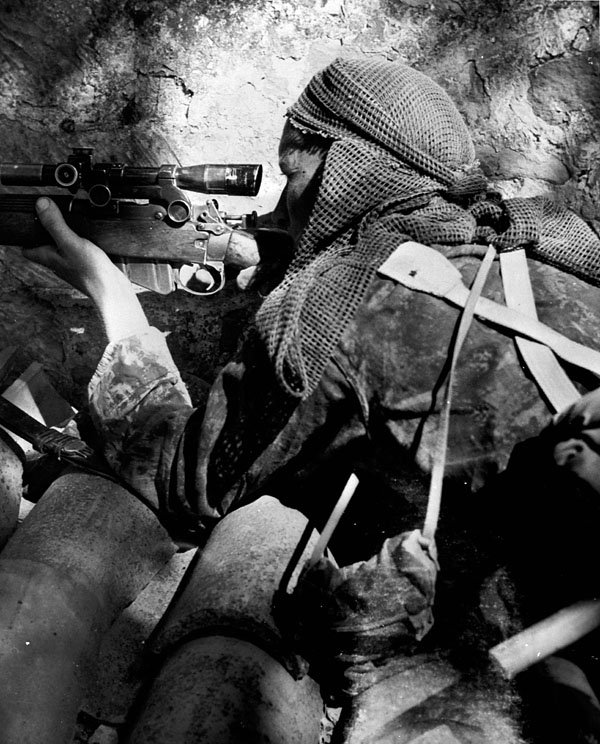
The work was concentrated on what the Germans called Green Line One, which on the Adriatic front was located on the high ground north of the Foglia River. It was here that most of “the 2,375 machine-gun posts, 479 anti-tank gun, mortar and assault-gun positions, 3,604 dugouts and shelters, 16,006 rifleman positions, 72,517 teller anti-tank mines and 23,172 anti-personnel mines” were placed. As the Canadian official historian G.W.L. Nicholson has noted, this impressive effort was supplemented by “117,370 metres of wire obstacles and 8,944 metres of anti-tank ditch.” Four Panther tank turrets and 18 smaller gun turrets had been added by late August.
At Eighth Army headquarters, intelligence officers studying air photographs drew the conclusion that Green Line One was the Gothic Line rather than the main position of a deeper defensive zone. This mistake contributed to the optimism of Army planners who seemed to believe, against all previous experience, that armoured divisions would be able to advance quickly once the Foglia defences were breached.
Lieutenant-General E.L.M. Burns and his divisional commanders, Chris Vokes and Bert Hoffmeister worked within a plan devised by Eighth Army. But once the operation began Canadian commanders at all levels would have to adapt, innovate and lead. Leese had outlined two possibilities, a set-piece attack after a brief pause, or an attempt to “gate crash” the defences after two days of softening up with medium bombers. Leese opted for speed and Burns ordered Hoffmeister’s 5th Armoured Division to take over the left flank of the narrow Canadian corridor so that both 5th and 1st divisions could control their own bridgeheads.
On the 5th Div. front, Hoffmeister gave Brigadier Ian Johnston freedom to plan the attack using his own 11th Infantry Brigade with the 8th New Brunswick Hussars and Princess Louise Dragoon Guards under command. The PLDG had been converted from a reconnaissance regiment to infantry, one of three “new” battalions formed to create an additional infantry brigade for the armoured division.
Johnston was faced with a difficult problem. His carefully prepared Appreciation document, which outlined a plan of operations, was based on a survey of the ground on either side of the village of Montecchio. The village sits between two hills known as points 120 and 129. With minefields between the river and the hills, the enemy had excellent fields of fire that would create a dangerous killing ground. Needless to say, both hills had to be secured prior to an advance. Johnston decided on a night attack with ample artillery support.
Many years later Hoffmeister recalled his first view of the Montecchio feature. It was “a real fortress in itself, a great rocky thing, with good approaches (for the enemy) from the back…we could pick out the odd concrete gun emplacement and we could see the barbed wire, and we saw minefields, but there was no life around the place at all.” Hoffmeister thought there “was something wrong” and suggested that Johnston do extra patrolling, but he did not protest Leese’s decision to rush the defences.
The decision to gate crash meant that the attack actually began in broad daylight without waiting for all units to reach the start line. Martha Gelhorn, who in 1944 was a well-known, respected war correspondent, watched the battle “from a hill opposite, sitting in a batch of thistles and staring through binoculars.” The battlefield included the Foglia and the Via Emilia, a road paralleling the river, where she noted “the Germans dynamited every village into shapeless brick rubble so that they would have clear lines of fire. In front of the flattened villages they dug their long ditch to trap tanks. In front of the tank trap they cut all the trees. Among the felled trees and in the gravel bed and low water of the Foglia they laid down barbed wire and sowed their never-ending mines, the crude little wooden boxes, the small rusty tin cans, the flat metal pancakes which are the simplest and deadliest weapons in Italy.” All of this in front of the Green Line fortifications.
The Cape Breton Highlanders advancing on the brigade, divisional and corps left flank found a route through the minefield and reached the slopes of Pt. 120, their objective before the enemy opened fire with machine-guns positioned to cover every approach. The Germans then counterattacked the Canadians, forcing the battalion to withdraw and wait for darkness. The Perth Regiment on the brigade’s right flank was stopped by mortar and machine-gun fire which devastated the lead platoon. Again common sense, prevailed and a further attack was postponed until dark when machine-guns—firing on fixed lines at set intervals—could be avoided through a series of quick rushes. The Perth Regt. reached a position known as Pt. 111 and seized the hill in a mad charge led by Captain Sammy Ridge. The Cape Breton Highlanders, facing “the anchored fortress of Montecchio” were less fortunate and despite supporting fire from tanks of the New Brunswick Hussars, artillery and much bravery, Pt. 120 would not be taken by direct attack.
A similar pattern developed on the 1st Div. front. The West Nova Scotia Regt., who like the Cape Breton Highlanders, advanced in daylight on the outside flank, found their objective, Borgo Santa Maria, protected by a wide belt of wooden-encased Schü-mines, each with an explosive charge large enough to severely damage a man’s leg. The much vaunted bombing program, 1,600 tons of bombs dropped in two days over Eighth Army’s front, could not possibly destroy such extensive minefields and so the West Novas were trapped in a killing zone under continuous mortar fire.
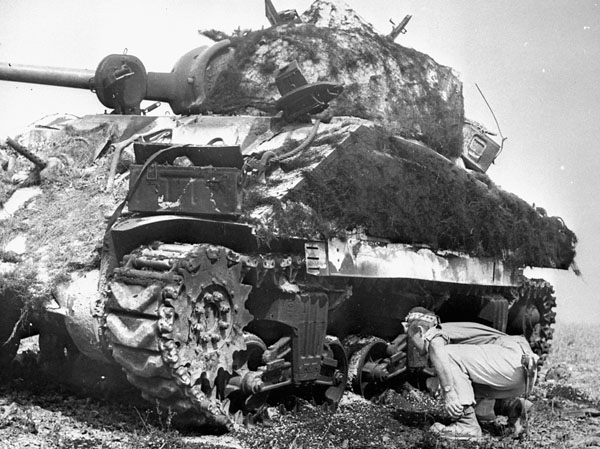
The regimental history describes the scene as “the Ortona affair all over again” with “nothing to do but dig in as quickly as possible.” Only the foolish optimism of generals could account for a daylight advance over such ground and “for the rest of the long summer evening the West Novas hung on, maintaining an energetic, but hopeless firefight with the enemy on the slopes—all that prevented a massacre was the fact that the Germans ran out of mortar ammunition. This limited the West Nova casualties to 90 men.
As the West Novas withdrew, the Princess Patricia’s Canadian Light Infantry was ordered to cross the river and seize the village of Osteria Nuova. They relied on full darkness to avoid mortar and machine-gun fire, but the band of Schü-mines and barbed wire were a major obstacle.
Major Colin McDougall, who was later to write the powerful Italian Campaign novel, Execution, commanded the lead company. “We moved off in single file,” he recalled. “11 platoon leading. We had to go down a path which like the area on both sides, was heavily mined. After we got through that with some casualties, we crossed the anti-tank ditch, also mined, which runs parallel with the river.…”
By first light, the company reached a pile of rubble that was once a village. It then went into action to clear the area assisted by the advance of 5th Div. armour on their left flank. A second breach in the Green Line was thus made secure. It was now up to the reserve battalions to exploit these tactical gains. Johnston was quick to commit the Irish Regt. with a squadron of 8th Hussars tanks. His new plan sent the battle group through the Perth Regt. to attack the Montecchio from the rear as well as both flanks. Working as mobile artillery, the tanks “threw a creeping barrage ahead of the Irish firing over open sights…the Irish were on the Germans with bayonets before they could stand up to fight.…” By the evening of Aug. 31, Montecchio was secure.
On the 1st Div. front, the Royal 22nd Regt. was able to exploit the Patricia’s initial success clearing the last enemy outposts in Borgo Santa Maria before waging a day-long battle for another hill, Pt. 131, situated immediately beyond the village. The Seaforths fought a similarly bitter struggle for Pozzo Alto and managed to secure the ruined hamlet on the third attempt. Somehow, Lieutenant-Colonel S.W. Thomson’s men still found the strength to continue the advance to Pt. 119, situated almost a mile further to the northeast.
Hoffmeister and Johnston decided to exploit the capture of Montecchio. They sent the British Columbia Dragoons, with the Perth Regt. under command, to capture Pt. 204, an extension of the Tomba di Pesaro ridge line where the enemy was reforming. There was not enough time for a proper orders group and Lt.-Col. Fred Vokes used his regimental radio net to brief squadron and troop commanders as they raced to the forming up place to meet the Perth Regt. The designated map reference, code-named Erindale, turned out to be held by determined German soldiers who destroyed several A Sqdn. tanks before they were overcome. Erindale—Death Valley to the British Columbia Dragoons—was still under fire and there was no sign of the Perth Regt. which was pinned down by observed artillery fire, “the worst they had ever experienced.” Vokes decided to send C Sqdn. to capture Pt. 204 “and hold it until relieved.”
As C Sqdn. advanced through Death Valley towards Pt. 204, Major G.E. Eastman ordered A Sqdn. to abandon the forming up place and follow them to the high ground. After knocking out an 88-mm gun they joined their comrades in reaching Pt. 204, but only after skirting one of the formidable Panther turrets set atop a concrete bunker that housed the crew. Apparently artillery fire or lack of will to fight kept the German soldiers safely underground. This allowed the British Columbia Dragoons to dismount and capture the position without firing a shot.
Today’s traveller can pause and visit Pt. 204 where a small park, monument, gun turret and explanatory plaques offer an account of the battle for the Gothic Line. The view towards Tavulla—the modern name for Tomba di Pesaro—and the surrounding countryside is breathtaking, and the vital nature of the position is quite evident. The calm security of the park is in sharp contrast to the events it commemorates. The British Columbia Dragoons had broken through a portion of the Green Line, but by late afternoon on Aug. 31 they were under continuous fire and suffered heavy casualties, including their commanding officer, Fred Vokes. The BCDs held until relief in the form of the Perth Regt. and a Strathcona Horse squadron fought their way to Pt. 204.
The action carried out by the BCDs has been viewed differently by historians. Doug Delaney has condemned the “bad decisions made by the Dragoon Commanding Officer” who “had grown impatient waiting for the Perths to link up with his tanks and decided to go without his infantry support.” Delaney is also critical of “Vokes’ failure to have artillery fire neutralize the German anti-tank guns on the ridge.…” Lee Windsor sees the action very differently, arguing that the seizure of Pt. 204, and the long battle to hold it, lured the Germans out of their dugouts to counter-attack the Dragoons. This allowed Canadian artillery to crush enemy counterattacks. Such a “bite and hold” approach had proven to be the most effective method available to the Allies, though most commanders adopted it only after their more ambitious plans had been frustrated.
Gelhorn, who watched these events unfold, wrote that “it was the Canadians who broke this line by finding a soft place and going through…. It makes me ashamed to write that sentence because there is no soft place where there are mines, and no soft place where there are the hideous long 88-mm guns, and if you have seen one tank burn on a hillside you will never believe that anything is soft again. But relatively speaking this spot was soft or, at any rate, the Canadians made it soft.”
While trying to make sense of the battle, Gelhorn followed the Canadians across the river. She described it as a “jigsaw puzzle of fighting men, bewildered, terrified civilians, noise, smells, jokes, pain, fear, unfinished conversations and high explosives.” At a regimental aid post she met the medical officer, a captain who told her the story of a Canadian padre who helped the stretcher-bearer when things got really bad in the minefields. “The padre lost both legs and though they rushed him out he died at the first hospital.” Gelhorn, who had heard the news of the German collapse in Normandy, shared the general view that the war would soon be over, so she found the Foglia battlefield unbearably sad. “It is,” she wrote, “awful to die at the end of the summer…when you are young and have fought a long time…you know the end of all this tragic dying is so near.”
Unfortunately, Hitler and the German commanders in Italy were determined to continue the war and prevent a breakthrough into the Po Valley. The 26 Panzer Div., the first reinforcements, was in action against the Canadians on Aug. 31, and 29 Panzer Grenadier Div. was on its way to the Adriatic sector. German determination to prevent a breakthrough in Italy has always puzzled historians as has the Allied insistence on pressing a costly campaign in a secondary theatre. Lee Windsor argues convincingly that by 1944 the industries of northern Italy were an important part of the German war effort justifying the relatively modest reinforcements sent to Italy. It is less clear why the Allied commanders were determined to turn a holding action designed to keep German divisions away from France into an attritional battle. All the Allied armies were desperately short of trained infantry in the second half of 1944, and in Northwest Europe, Montgomery was preparing to disband yet another division to provide replacements for his seven remaining infantry divisions. Leese was well aware it would be difficult to make up losses from the reinforcement pool in the Mediterranean, but on the evening of Aug. 31, 1944, he was convinced the Canadians were on the verge of a breakthrough and he was determined to press the attack.

Coriano to Rimini
The strategic purpose of the Allied attack on the Gothic Line in Italy in August 1944 was to engage the enemy and prevent the transfer of German divisions to France or the eastern front.
On Aug. 31, when the Canadian Corps broke through the main Gothic Line positions known as Green Line I, Field Marshal Albert Kesselring, the German commander-in-chief for Italy, was told all local reserves available to the German Tenth Army had been committed, but they were unable “to seal off enemy penetrations.” Kesselring agreed to transfer 29 Panzer Grenadier Division and other resources to meet the Allied thrust. It was clear to him that the Allied centre of gravity was the Adriatic sector, not the Florence-Bologna route.
However, before reinforcements could arrive, the Princess Louise Dragoon Guards, now fighting as infantry in the 12th Brigade, captured Tomba di Pesaro (Tavulla). “For a unit that had been raised as a reconnaissance regiment, and having just converted to infantry, the PLDG demonstrated tremendous courage and tenacity in its first infantry battle,” writes historian Doug Delaney.
German mortar fire on the forming up place delayed the attack and when the advance along the spine of the ridge began, the enemy directed mortar, machine-gun and anti-tank fire at the tanks of the supporting Lord Strathcona’s Horse. The Canadian battlegroup suffered more than 100 casualties, but the enemy withdrew once the high ground above the village was taken.
Lieutenant-Colonel W.W.G. Darling, who had recently assumed command of the battalion, was awarded the Distinguished Service Order for his leadership and example in leading his men onto the objective.
The PLDG was not the only battalion to win vital ground on Sept. 1, 1944. On the 1st Canadian Div. front, 2nd Bde. continued to filter though the Green Line. The Princess Patricia’s Canadian Light Infantry—with support from British tanks—won control of Point 115 in a textbook example of tank-infantry co-operation. It then pressed on to the next hill, “a long bald slope” repeatedly stonked by enemy mortars and artillery. The Seaforth Highlanders of Canada, with 145 Regt. of the Royal Armoured Corps, reached the edge of Pozzo Alto on Aug. 31, but found the village strongly defended. After two failed attempts to rush the defenders, Lt.-Col. Thomson decided to wait until daylight. The next day the village was secured. The PPCLI and Seaforths were now well beyond the forward positions of the Green Line. This left the Germans with one isolated position overlooking the Foglia River.
The German paratroopers holding Pt. 131 ought to have withdrawn or surrendered, but their orders, and their mystique as elite troops, kept them fighting. Lt.-Col. Jean Allard’s Royal 22nd Regt., with an attached company from the Carleton and York Regt., was assigned to take Pt. 131. No tanks were available and after a failed attempt at dawn on Sept. 1, Allard used his Bren gun carriers to attack the enemy pillboxes. By evening, the strongpoint was in Canadian hands.
Allied intelligence officers who had plotted the Green Line defences concluded that since no other prepared positions were evident in the air photographs, a breakthrough would quickly be followed by a breakout to the town of Rimini and the Po Valley. The corps commander shared this view. He ordered his divisions to continue the advance on Sept. 2. The 5th Armoured Div. was to cross the Conca River, and then angle northeast toward the town of Cattolica on the Adriatic. Major-General Chris Vokes and 1st Div. were to parallel this move, employing an armoured brigade group commanded by Brig. D. Dawnay, the officer commanding 21st (British) Tank Brigade, in order to trap the Germans defending Pesaro. Dawnay employed his three tank regiments, each with a battalion of Canadian infantry, plus the divisional armoured car regiment, the Royal Canadian Dragoons.
The RCDs, with a company of the Royal 22nd Regt., were told to use the cover of darkness to cut the railway and coastal road, Highway 16, south of Cattolica. A squadron of British tanks was to follow this daring left hook. The RCD regimental history notes that “night movement was not an armoured car regiment’s strong point” and since there was no opportunity for reconnaissance and little time to marry up sub-units, distribute loads, tune and net radios, form an order of march—in the dark and under harassing mortar and shell fire—some delay was inevitable. When the RCDs reached the coastal road, only German rearguards remained south of Cattolica.
The successful battles fought by both divisions of the Canadian Corps were in marked contrast to the difficulties encountered by the British divisions on the inland flank. The more mountainous terrain and the arrival of a Panzer Grenadier Div. on the British front no doubt explains the problems encountered by V Corps, but British national pride must account for Eighth Army’s decision to try and exploit the Canadian breakthrough by ordering V Corps to lead the advance. Lt.-Gen. Charles Keightley, V Corps commander, prefaced his orders for the pursuit with the words: “The enemy has been badly mauled by I Canadian Corps and there is a possibility of a breakthrough on that front during 2 September.”
Keightley proposed to capitalize on the Canadian victory by attacking on the corps’ right flank, squeezing the Canadians who were assigned the more modest task of securing the coastal town of Cattolica.
During a visit to these battlefields, we tried to understand whether Eighth Army realized what it was asking V Corps to do. The road from Montegridolfo to the Conca River that was to serve as the centre line for both 46th Div., tasked to seize a crossing of the Conca, and 1st British Armd. Div., which was to advance to Coriano and beyond, is much improved today compared to 1944. However, the challenges of this winding, narrow roadway through the mountains are still evident. The lead brigade of 46th Div. did reach the river by dawn on Sept. 3, making contact with the Canadians and securing two intact bridges. This rapid success must have tempted Keightley to order the infantry battalions forward to Coriano, but 46th Div. was slated to go into reserve, making way for the favoured 1st British Armd. Div. which would, according to Eighth Army intelligence reports, fight a “fluid battle” against light enemy resistance until a new defensive position—the Rimini Line—was reached. Unfortunately, the terrain, the weather, and the Germans did not co-operate.
The problems began well before the armour reached the Conca. The British official history blames “unrealistic staff estimates” for a frustratingly slow night advance over “a bulldozed mountain trail with sharp bends and steep gradients.” It would have been difficult in daylight, “but at night, in choking dust, it put too heavy a strain on both drivers and tanks, many of which broke down.” Once the Conca was reached, traffic congestion added to the misery.

Major-General R.A. Hull, an experienced armoured corps officer, had accepted the available intelligence estimates that predicted a fluid battle beyond the Conca. He sent his armoured brigade forward without additional infantry. The German commanders read the situation differently. Inland from the narrow coastal plain, a series of distinct low ridges, comparable to the fingers of a widespread hand, ran in a northeasterly direction. The Misano-San Clemente ridge north of the Conca was selected as a temporary position for the Germans withdrawing from the Green Line, but a new main position was to be created on Coriano Ridge where 29 Panzer Grenadier Div. prepared to block any further Allied advance.
The British tank regiments trying to advance in broad daylight were quickly brought to a halt “by high velocity fire from the ridge in front of them” and artillery fire “from their left rear.” By nightfall, the brigade’s tank strength had been cut in half through accidents more than enemy guns. The brigade had been pressed into action despite three nights with little sleep and was still in poor shape the next morning, Sept. 4, when corps headquarters insisted they attack Coriano immediately. The lead squadrons reached the foot of the ridge, but could go no further.
The 56th British Div., attacking on the corps’ left flank, was also checked. The first battle for Coriano Ridge should have ended when the first heavy rains of the season began on the night of Sept. 6. The rain turned the clouds of dust into clinging mud, but the struggle for the southern end of the ridge continued for another week. Eleven separate attacks were beaten back by German mountain troops before the area fell to 4th Indian Div.
The attritional battles in and beyond the Green Line had cost both sides numerous casualties. Since the Germans were rushing replacements forward and adding divisions to their order of battle, the Allies had already won the containment victory they were seeking. This did not satisfy Alexander or his two army commanders who were unwilling to accept strategic victory through operational “failure.” On Sept. 8, Alexander met with Leese and agreed to a pause and regrouping of Eighth Army before renewing the battle. In addition, Alexander wrote: “I have decided to unleash Fifth Army.”
The next day, Clark’s Fifth U.S. Army, which included British XIII Corps and 1st Canadian Armd. Bde., began advancing on a broad front. It met light resistance until it arrived on the crests of the Apennines where the mountain passes were strongly defended. Both the American and British formations in Fifth Army were soon locked in a violent struggle over some of the most difficult terrain in Italy. There would be no rapid breakthrough to Bologna.
On the Eighth Army front, Leese grudgingly accepted the evidence that his “pursuit corps,” the British 5th, was unable to make progress in what he described as “the difficult country on the corps front.” Leese reinforced the Canadians with 4th British and 2nd New Zealand divisions, as well as the 2nd Greek Mountain Bde. The Canadians were now to become the pursuit corps.
First, however, there was the problem of Coriano Ridge and 29 Panzer Grenadier Div. Leese ordered 5th Canadian and 1st British Armd. divisions to attack from separate directions using the artillery of both corps, 700 guns. Hoffmeister gave this unpleasant task to Brig.-Gen. I.S. Johnston’s 11th Infantry Bde. with the Westminster Regt. and the New Brunswick Hussars under command. The British used the 43rd Gurkha Bde. with similar armoured support.
Today, the town fathers describe Coriano as a refuge from the hectic tourist triangle of Rimini-Riccione-San Marino. They say it “offers the tranquility of a township that is off the beaten track. The countryside, which surrounds the town, is rich in rustic hamlets and isolated cottages, set in the midst of ripe golden wheat and vineyards which produce some of the best wines in Romagna.” The colourful tourist brochures make no reference to the nearby Coriano Ridge War Cemetery with its 1,940 graves, 427 of them Canadian. Nor do they mention the scores of civilian casualties.
The second battle for Coriano Ridge began Sept. 13 when the 43rd Gurkha Bde. began the assault from the south. The Allied artillery had struck the obvious targets with what the German soldiers called “continuous drumfire” and the Gurkhas were able to capture Passano, one of the rustic hamlets on the ridge, well before the Canadian attack began.
The success by the Gurkhas helped the Perths on the left flank of the Canadians gain their objective—3,000 yards south of Coriano—within 30 minutes. The Cape Breton Highlanders, who were to reach positions north of the town, had a much tougher time as they had to provide their own flank protection. Accurate German defensive fire inflicted numerous casualties, but the battalion pressed on to its objective.
The regimental historian of the 8th Hussars who watched the early stages of the battle wrote a powerful description of the “dark autumn night” which “leaped and vaulted with sights and sounds, flickered, jumped and rolled with the clash of heavy weapons.” At times, “there could be heard the human cries of the wounded. Tracers stitched across the sky. Explosions tore it apart. German spandaus burped. The more deliberate Brens answered them… the wounded were taken back as soon as they could be. The dead were left for a quieter time. The living kept on….”
With daylight, Allied airpower limited the enemy’s ability to mount the kind of counterattacks their doctrine and training called for. Meanwhile, smokescreens created by the field artillery and mortars help ‘blind’ the German guns. Air observation pilots, linked to the counter battery medium regiments, silenced long-range enemy fire whenever they were in sight.
With two battalions firm on either side of Coriano, the Irish Regt. and a squadron of Hussars began to clear the town. The Panzer Grenadiers had fortified many of the houses, linking them with tunnels. Tanks and self-propelled guns were hidden in the shells of buildings. It was a small-scale version of the December 1943 battle in Ortona. “The square of Coriano, already torn and cracked from days of shellfire, began to crumble…the Irish began to fight house to house in a deadly game of hide-and-seek. At nightfall the Canadians withdrew to prepare a new assault, but at dawn the Germans were gone.” The Westminster Regt., working with a squadron of Strathcona tanks, had cleared the north end of the ridge in a tank-infantry action which had involved “tanks shooting up houses and the infantry moving in and flushing out the enemy.” Once this task was accomplished the enemy had to abandon Coriano and withdraw to their temporary fall-back position on the low ridge line north of the Marano River.
Field Marshal Albert Kesselring, Hitler’s commander-in-chief for Italy, was now facing a new offensive by the Fifth Army as well as the seemingly endless battle with Eighth Army. He approved the withdrawal from Coriano, explaining his decision as necessary because, “we cannot permit the troops to reach the point where moral resistance collapses….” Both 29th Panzer Grenadier Div. and 1st Parachute Div., which had borne the brunt of the Coriano battle, had suffered heavy losses.
German corps commander General Heinrich von Vietinghoff attributed their defeat to the Allied use of “smokescreens which prevented aimed fire; the enemy’s policy of destroying all daylight counterattacks from the air, so that reserves suffered great casualties, and the impossible concentrations of artillery fire.”
From Aug. 26, when the Allied offensive began, to Sept. 15, Vietinghoff’s LXXVI Corps suffered 14,604 casualties of whom 7,000 were listed as missing and presumed killed or captured. This number represented more than a third of the corps’ combat strength.
Kesselring ordered a vigorous defence of the low ridgeline beyond the Marano River to allow time for new divisions to arrive and man the Rimini Line, the higher ground between San Fortunato and the Republic of San Marino that formed the last mountain barrier before the plains of northern Italy. Germany’s 162nd (Turcoman) Div., brought down from Ravenna, and the 356th Infantry Div., brought in from the Franco-Italian border, were to help prepare the Rimini Line. The 20th Luftwaffe Field and 90th Panzer Grenadier divisions, the last reserves in northern Italy, were also committed.
The Supreme Allied Commander in Northwest Europe, Gen. Dwight D. Eisenhower, must have been pleased to read the top secret Ultra intercepts that revealed these movements only 24 hours before the airborne army began Market Garden, the Allied operation to establish a bridgehead across the lower Rhine at the Dutch city of Arnhem. Kesselring’s determination to reinforce and hold the Rimini Line meant a new series of battles, which would further strain the shrinking manpower resources of Eighth Army, would have to be launched if the Allied offensive was to continue. Generals Alexander, Clark and Leese refused to consider the option of recalibrating their operations to hold the enemy in place instead of attempting to overcome what was yet another well-prepared German defensive zone.
Today’s visitor to the battlefields beyond Coriano Ridge will have no difficulty understanding the challenges the terrain posed for the attackers. The Marano River is usually no wider than a creek, though much of it was a tank obstacle after the rains began in September 1944. The first low ridgeline, with the stone buildings of San Lorenzo in Correggiano, is less than two kilometres beyond the river. Today, a highway cuts through the Canadian sector and this can create confusion for those attempting to familiarize themselves with the old battlefield. However, from higher ground one can ignore the highway and read the landscape. The Republic of San Marino, with spot elevations of 450 metres, looms over the battlefield to the west while the lower part of the feature, the San Fortunato Ridge, marks the 1944 Rimini Line. East of the highway or autostrada are the sprawling, chaotic Adriatic coastal resorts of Riccione (to the south) and Rimini (to the north). In between them was the airfield that 3rd Greek Mountain Brigade would capture at great cost on Sept. 16. Crossing this contested ground under observation and fire was not going to be easy.
Leese was forced to recognize that the Canadians, not Lieutenant-General Charles Keightley’s powerful V British Corps, had broken through the German defences. He reinforced this success by transferring 4th British Infantry Div., 2nd New Zealand Div.—with its integral armoured brigade—and 3rd Greek Mountain Bde. to I Canadian Corps. The Greek soldiers, some 3,500 infantry from disbanded Greek units in Egypt, had been brought into Italy and trained by New Zealanders who regarded them as an extra infantry brigade.
The corps commander, Lt.-Gen. E.L.M. Burns, developed a complex eight-stage plan which he admitted was “rather elaborate” but “based on our experience after the breakthrough of the Gothic Line which showed that we would have to fight our way forward against continued and effective enemy opposition. Without careful co-ordination of the moves of two divisions and clear orders as to their objectives…momentum could be lost.” In fact, momentum was lost in the first hours of the advance beyond Coriano and never recovered. Once again, 1st British Armd. Div. sent its armoured brigade forward without sufficient infantry. The move began in the early evening but was stopped by the difficult inland terrain and the rain that created swollen creeks. Other significant and deciding factors were minefields and German guns.
On the Canadian front, 4th British Division’s lead brigade began to descend into the Marano River valley on the afternoon of Sept. 13 while the battle for Coriano raged. However, the troops were forced to seek cover from accurate, heavy shellfire.
The next day, 1st Canadian Div. moved forward on 4th Division’s right flank. The densely built-up coastal strip along Highway 16 was assigned to the Greek brigade with assistance from 1st Anti-Tank Regiment, Royal Canadian Artillery, the armoured cars of the Royal Canadian Dragoons, mortars, and machine-guns of the Saskatoon Light Infantry. A New Zealand tank regiment was also made available.
The Greek infantry began the advance by clearing a group of enemy-held farmhouses in an attempt to secure the Canadian flank before the Royal 22nd Regt. and West Nova Scotia Regt. began to cross the Marano. The battalions of 3rd Bde., supported by British tanks, were supposed to seize the village of San Lorenzo with the help of artillery shooting them on to the objective. The Canadian official history records the result: “The enemy replied vigorously with all his guns and mortars. The deadliest fire came from his armour and anti-tank guns, some concealed on the high ground ahead, some lurking in positions at the bends of the Marano River to the east of the Canadian crossing place. It took the leading sections of the Royal 22nd Regt. two hours to cover 200 yards through the fields.… Three times the Van Doos assaulted, but each time they were driven back with heavy casualties.… The battalion’s blackest day of the war had cost it 32 killed and 61 wounded.”
The West Novas found that the enemy was holding positions on both banks of the river with—as the regimental history describes—“machine-guns, mortars and several self-propelled cannons concealed amongst the wrecked houses.” When the acting brigade commander, Lieutenant-Colonel Pat Bogert, came forward “to see how things were going…the forward area was a bedlam of dim struggling figures, bursting shells, bombs and smoke. Battalion headquarters itself was under a vicious fire from machine-guns and self-propelled cannon.”
The Germans had left a single bridge intact to allow the rearguards on the south bank an escape route. The bridge was rigged with explosives, but “Lieutenant G. M. Hebb (later killed in action), with magnificent courage and initiative, sprinted across and tore out the demolition charges.” By mid-afternoon the West Novas and Van Doos had been forced back to shallow, isolated bridgeheads. Fourth British Div. had encountered similar problems and was temporarily stymied by enemy control of the high ground towards the San Marino Republic.
The next day, after several fruitless attempts to take San Lorenzo, the 21st British Tank Bde. committed much of its remaining strength to the battle. The West Novas and a squadron of the 12th Royal Tank Regt. reached the edge of the village “despite the attentions of a Tiger (tank) which was engaged and set on fire.” It was also noted that “the confused and bitter fighting” that marked the day continued until just before dark when “a goodly bag” of paratroopers who had been holding the stone church surrendered.
The Van Doos, with a composite squadron of 12th Royal Tanks, launched its attack at 2:30 p.m. Rimini airfield had not yet been taken by the Greek brigade and the leading troop of tanks was caught in a crossfire from the ridge and the airfield. Despite the loss of six tanks and the squadron’s commander, the armour and infantry pressed on and after clearing the eastern end of the ridge they wheeled right towards San Martino, another fortified village beyond San Lorenzo. Today, San Martino is part of the Rimini industrial zone and the noise of battle has been replaced by the sounds of traffic on the autostrada, but the high ground and reverse slope the Germans used to repel the first attack is still evident. Once again the tanks, especially the heavily armoured Churchills, were decisive and the village was secured.

Third Canadian Bde. was then ordered into reserve and 2nd Bde. came forward to continue the advance to San Fortunato. Unfortunately, the company holding San Martino was withdrawn before the Seaforth Highlanders arrived to effect their relief, and the Germans quickly regained the village. In his memoirs, Burns claims that, “This unlucky slip-up was the principal cause of several days delay in attacking Fortunato Ridge, the key to the hoped for breakout.”
The loss of San Martino and its commanding location may have delayed the Canadian advance to San Fortunato, but all across the Allied front the lead elements of I Canadian and V British Corps were meeting well-organized resistance. 4th British Div., still under Burns’ command, was stymied by the failure of V Corps to keep pace and on Sept. 17 the corps boundary was changed to allow 4th Div. to clear the Germans from a ridge on their flank. That evening, Alexander’s report to London clearly expressed his frustration. “The enemy continues to put in reinforcements,” he wrote. “There is not the least sign of any intention on his part to withdraw: on the contrary…he intends to fight it out where he stands.”
One indication of Kesselring’s determination to impose a stalemate on Eighth Army was the commitment of an additional heavy 88-mm anti-tank gun battalion to assist the paratroopers facing 1st Canadian Div. Both the Seaforth Highlanders and Loyal Edmonton regiments learned first-hand just how determined the enemy was. Lt.-Col. Thomson, who always insisted on seeing things for himself, rejected brigade plans to attack San Martino on Sept. 16 because, in the words of the regimental history, “there are times when a battalion commander on the spot may question such orders and this was one of them.” Thomson explained that earlier attempts to storm across the open ground had been met by such heavy fire that “the opposing enemy forces must have had a priority on the output of German munitions.” The Seaforths probed the defences with fighting patrols but any close approach to the village was met with intense machine-gun fire. A company-strength attack attempted that night also failed. Years later, Thomson, in reflecting on the battle, wrote that “four companies attacking might have succeeded, but only half would have survived. The art of war,” he insisted, “is to win and live.”
The next day the Seaforths and 48th Highlanders, with strong tank and artillery support, launched another attempt. The Seaforth history notes that “if capturing the miserable group of houses which constituted San Martino was only a matter of courage, the Seaforths would have had the village in their pocket, but…courage alone was not sufficient.”
The 48th Highlanders remember San Martino as blood-soaked Kestrel, their code name for the ridge. They endured a series of costly attempts to advance beyond it on the coastal flank. However, enfilade fire from the high ground checked every attempt. The 48th regimental history is especially critical of the persistence of higher command who “did not appreciate the terrain.” The battalion was “being asked to fight in a virtual German killing ground” until Kestrel was captured.
Finally, on Sept. 19, reason prevailed and San Martino was outflanked from the west, forcing the paratroopers to withdraw to San Fortunato.
Perhaps the most disturbing element in the story of the battles for San Lorenzo, San Martino and Rimini is the comment by Burns who in his memoirs recalls a conversation on Sept. 17 when he talked with Gen. Chris Vokes about “the state of 1st Div. troops.” They had suffered heavy casualties, particularly in officers and non-commissioned officers in recent battles, so Burns suggested that if Vokes “had any doubts about the continued offensive power of his battalions” the New Zealand Div. together with 5th Armd. Div. could relieve the Canadian and British infantry. However, Vokes was confident his men were still able to carry out the task assigned to them. He gave the officers a fiery pep talk and sent them back into battle. Armies are not democracies, so no one asked the soldiers.
San Fortuanto
Operation Olive, Eighth Army’s offensive of September 1944, had been promoted as the “last lap” in a long and bloody battle to break the enemy’s Gothic Line defence. “Breaking the Gothic Line,” General Oliver Leese declared, promised to be “the beginning of the end of the German armies in Italy.” The operation itself was expected to take one or two weeks.
The Gothic Line turned out to be an in-depth defensive zone protected by artillery and mortar positions located on the reverse slopes of a series of ridges. Long after the battle, war veterans would disagree over whether the worst fighting occurred at the Foglia River or in the towns Coriano or San Martino. However, everyone who survived remembered the anxiety that was felt on the morning of Sept. 19 when the last German rearguards withdrew across the Ausa River to dig in on San Fortunato Ridge, southwest of the city of Rimini on the Adriatic coast.
From the perspective of senior Allied commanders, the ridge and so-called Rimini Line were the last obstacles before the open Romagna plain and the Po River Valley further north. To the soldiers of 4th British and 1st Canadian Infantry divisions, with their half-strength battalions worn down to the point of exhaustion, the river and the ridge seemed proof that the nightmare would never end.
Today, the A14 Autostrada and the Rimini-San Marino highway have greatly altered the landscape. However, approaching the river and then the ridge from the south—from Coriano and San Martino—gives visitors today a better view of what was once a formidable enemy position. Much of the ridge was too steep for tanks to traverse, and attacking it with soldiers who had just experienced the bloody struggle for San Martino seemed like a dubious decision. Fortunately, the German Army’s LXXVI Corps was in even worse shape and this may have been the key factor in the battle.
On paper, German General Traugott Herr had eight battalions from 1st Parachute, 29 Panzer Grenadier and 162 (Turcoman) divisions, but the fighting strength of these forces was less than 2,000 men. The defenders would try to rely on firepower, especially the artillery. It had withdrawn behind the next river, but was still within range.
German morale, meanwhile, had not collapsed, but on the night of Sept. 18, the Allies began employing searchlights—out of range of the artillery—to illuminate the battle area. The war diary of Germany’s LXXVI Corps reported that this technique produced a “psychological effect” on their troops who had previously used hours of darkness for free movement as well as relief and supply operations. It concluded that the challenge of the “battle of materiel is itself heightened by the feeling of helplessness against this new technical weapon.”
The operational research section that had suggested using searchlights was also trying to persuade Eighth Army that there were ways of using artillery to demoralize rather than neutralize the enemy. The section obtained permission to employ a battery of 25-pounder field guns against an identifiable sector in a defended area. This involved firing individual guns according to a random time schedule. For example, two shells from each gun would be fired in quick succession followed by a lull and then a different firing pattern. The section’s scientists believed that the uncertainty created by this technique would immobilize the enemy and prey upon its nerves. When the sector was assaulted by ground forces there was virtually no resistance. However, for the generals who constantly planned for breakthroughs, such methods were too slow and uncertain, but the Royal Artillery did agree that trial results for random shooting were impressive.
Leese was unwilling to consider a pause before attacking San Fortunato Ridge, and on the night of Sept. 17-18, 4th British Div., still part of I Canadian Corps, seized bridgeheads across the Ausa River. During the next morning British and Canadians launched attacks towards the ridge. In the Canadian sector, Major-General Chris Vokes ordered a two-brigade attack to begin at 4:30 a.m. The artillery of the New Zealand Div. and 5th Armoured joined in a “heavy bombardment” that kept the enemy in shelters until it lifted.
Kittyhawk fighter bombers of the Desert Air Force joined in at first light. The air plan called for bombing and strafing on the ridge’s forward slope. This was to last until the infantry arrived. At that point, the pilots would switch to aerial attacks on the ridge’s reverse slope. This turned out to be a very difficult task because the ridge was barely discernable from the air on account of the vast clouds of dust caused by the morning’s artillery bombardment. In fact, leading troops on the ground reported a number of “friendly fire” incidents.
The Carleton and York Regiment managed to reach the Ausa River but “the area could not be cleared without 75 per cent casualties” because most of its supporting armour had been knocked out. The Carletons decided to dig in and wait until dark. Meanwhile, the Princess Patricia’s Canadian Light Infantry reported a similar situation. By 10 a.m. “the known strength of the two lead companies was 60 and they were still being engaged by enemy anti-tank guns and medium machine-guns from behind the Ausa. No tanks remained of the force with the forward companies.”
The British infantry had also gone to ground in the face of relentless and well-aimed fire, and by midday both the division and corps had recognized that any further advance would have to wait for darkness.
Colonel Syd Frost, then a lieutenant recovering from malaria which had hospitalized him in England, arrived to find his beloved Patricias dug in under intense shellfire. The regiment had secured a crossing of the Ausa, but further movement was impossible. That evening he reached the platoon he was to command by “stumbling over Patricia slit trenches…dug into the railway embankment and craters from large enemy shells.” He expected to see fallen soldiers, but noted the padre had done his work quickly and well.
Continuing along the track, Frost noticed that San Fortunato Ridge rose abruptly. “The whole feature (was) aglow with tracers, bursting shells, Verey lights (a type of flare) and parachute flares.” The ridge seemed impenetrable to Frost who arrived at the front without a rifle or a Tommy Gun. He was warned at the time not to use a discarded German weapon because the distinct sound would draw immediate fire from his own soldiers.
Burns organized a new attack with 10th British Bde. (4th Div.) and 3rd Cdn. Bde., reinforced by the Hastings and Prince Edward Regt. which took the lead. Tank squadrons from the 51st and 48th Royal Tank Regt. were allocated and the night advance began.
Searchlights bounced low-level illumination off the clouds, creating “artificial moonlight” which the Carletons pronounced to be “excellently useful” as they fought their way forward to the Ausa River. The engineers moved in behind the infantry with a bulldozer and an Ark—a turretless Churchill tank with attached bridging spans. The Ark was driven into the riverbed and the resulting bridge was strong enough to hold the weight of a heavy Churchill tank.
The West Nova Scotia Regt., with C Squadron of the 48th Royal Tanks Regt., passed through at 5 a.m. but it was full daylight when a creeping barrage lifted to the top of the ridge. In the dust and smoke the lead platoons of the West Novas saw small groups of enemy emerge from shelters and dive into their slit trenches. “Only a few steps—a matter of seconds—lay between the attacking infantry and success, but the interval was fatal.” The West Nova Scotia Regt. was pinned down and unable to move. The Hastings and Prince Edward Regt., attacking to the right, suffered a similar fate as anti-tank guns knocked out the armour while the enemy infantry made good use of the higher ground to block any advance with direct fire. It was time for a new plan.
Vokes and his brigade commanders decided to commit their last reserves to the battle. Third Brigade’s task would be to outflank the main defences on the left while 2nd. Bde. would launch a daring night infiltration designed to penetrate the German position on a narrow front where it would advance across the ridge to San Lorenzo situated well behind enemy lines.
Brigadier J.P.E. Bernatchez ordered his reserve battalion, the Royal 22nd Regt., to attempt the left hook but he told them to wait for darkness. This gave time for careful preparation. The regiment’s Major Henri Tellier described the scene to the divisional historical officer a few weeks after the battle. He had been able to show every man the objective—the hamlet of Villa Belvedere—as well as the route each platoon would take. It was also possible to observe and thus avoid the enemy’s defensive fire tasks. The Van Doos asked the British armour to stay put and fire on the objective “until they saw a white Verey Light.” At that point they were to target the area immediately behind the Villa Belvedere. Tellier recalled telling his men “speed, speed, get through his DF (defensive fire), get close to him. Run until you are exhausted.”
The race began just before last light, and the objective was almost a mile away, “mostly up.” They ran, stopping every 300 or 400 yards to draw breath. “We went up so fast that we kept ahead of the enemy fire which chased us all the way up…the last 250 yards or so every man was firing on the run and yelling like mad,” recounted the company commander of the Royal 22nd Regt. The Vandoos had read the ground and the situation, and by ignoring doctrine they had improvised a swift and sure attack.
The Loyal Edmonton Regt., meanwhile, had been brought forward to lend help to 2nd Brigade’s attack. Lt.-Col. H.P. Bell-Irving selected D Co. for the first bound up to a group of ruined houses—codenamed Bovey—1,200 yards from the start line. If 80 men could establish a firm base, B Co. could pass through to an objective codenamed Moire. Shortly before midnight, D Co. climbed the slope and “went into the blue” as wireless contact was lost and no runners made it back to report. B Co. was sent forward making contact with Maj. F.H. McDougall who with a single platoon had secured the intermediate objective. G.R. Stevens, the historian of the Loyal Edmonton Regt. described what happened next. “Soon after arrival at Bovey, a Mark VI Tiger (tank) passed through B Company’s position. It had a tail of infantry behind it. The Edmontons laid low…then pounced upon its escort, killing, wounding or capturing the entire party. The German tank came lumbering back. Sergeant H.O.W. Powell laid a bracelet of 75-mm grenades in its path which blew off a track. Its crew, however, continued full of fight, searching for its assailants in the darkness with its main armament. Powell, manning a PIAT gun scored a hit which glanced off. Closing to a range of 15 feet, he put paid to the panzer with a second bomb.”
Bell-Irving decided to keep B Co. at Bovey and ordered C Co. to press on to the battalion objective. After some tense moments and an intense fire fight with a column of German infantry, Captain J. A. Dougan and his men reached San Lorenzo, dug in and called down artillery to break up a counterattack. Shortly after dawn, tanks and anti-tank guns arrived to firm up the position.
The Seaforths followed the Loyal Eddies through the infiltration gap, but the lead company commanded by Maj. E.D. “Davey” Fulton, a future justice minister, alerted the enemy. Remembering his orders and military training with its insistence on “maintenance of the objective,” Fulton moved his company to the north before turning east to seize the ruins of the village of Covignano. The second company of the Seaforth Highlanders ran into more determined opposition “but by a judicious use of artillery fire as well as its platoon weapons” it reached the objective, Le Grazie, overlooking Rimini before dawn. Lt.-Col. Thomson re-directed his third company to a road junction south of Le Grazie where Major H.L. Glendinning used textbook battle drill tactics to clear and hold the area until the tanks arrived to force a final German withdrawal.
The torch now passed to the Patricias who were to pass through the Eddies and sieze a crossing of the Marecchia River northwest of Rimini. Steady autumn rains, that the Germans had been praying for, finally began on the night of Sept.19-20 and so the “ground was very sloppy.” The lead Patricia companies were held up by German rearguards, including tanks and self-propelled guns. Despite severe difficulties with communications, Lt.-Col. R.P. Clark, using radio relay stations, was able to maintain control, ordering the reserve companies to bypass the firefight and gain the river crossing while the lead Patricia company, working with B Sqdn. of the 48th Royal Tanks, figured out how to deal with the panzers.
The German version of the collapse of the Rimini Line blamed “the Turcoman battalions” which 29 Panzer Grenadier Div. had placed in the front line. This fits with the general reluctance of German generals to admit that their soldiers ever lost a battle due to superior Allied tactics and leadership, as was clearly the case at San Fortunato. The Royal 22nd Regt., the Loyal Edmonton Regt. and the Seaforth Highlanders of Canada had skillfully exploited the gains made by their sister battalions and improvised one of the most brilliantly executed tactical victories of the Italian Campaign.
The German high command briefly considered holding Rimini “so that the paratroopers might do their house-to-house fighting,” but the determination of the Greek Mountain Bde., which was clearing the southern part of the city, coupled with the aggressive advance of the 48th Highlanders of Canada who crossed the Marecchia River north of the city, persuaded the remaining paratroopers to live to fight another day.
Leese sent a congratulatory message to Burns and the Canadian Corps, describing the fighting as “the bitterest since El Alamein and Cassino.” But this victory was not enough and so Leese insisted that “we must now hit hard day and night and force them back over the Po (River),” a task assigned to 5th Cdn. Armd. Div. and the New Zealanders.
The battle for the town of Rimini and the San Fortunato Ridge, the last mountain barrier before the plains of northern Italy, ended on Sept. 21, 1944. With Canadian infantry established across the Marecchia River and the Greek Mountain Brigade clearing the last rearguards in the ruined streets of Rimini, Operation Olive, the most difficult and costly operation carried out by Eighth Army in Italy, was finally over.
The Greeks asked for a Canadian flag to fly alongside theirs in the Rimini town square and a red ensign, borrowed from auxiliary services, was supplied. Messages of congratulation, friendship and mutual respect were exchanged and 1st Canadian Division moved into reserve for some much needed rest and relaxation.
The price of Eighth Army’s achievement in Operation Olive was extraordinarily high. Throughout September, Eighth Army’s casualties averaged 300 a day, 80 per cent of them in the infantry. British divisions were faced with a worldwide shortage of replacements and this presented commanders with a difficult choice.
Alexander removed two infantry brigades and from his order of battle, but was still short of replacements. All British infantry battalions in Italy were therefore temporarily reduced from four to three rifle companies.
On the day Rimini was occupied by the Allies, Alexander offered an analysis of the situation in the Mediterranean to Gen. Sir Alan Brooke, the Chief of the Imperial General Staff. The battle of Italy, he noted, was being fought by the Allies “with about 20 divisions, almost all which have had long periods of heavy fighting this year and some for several years, against 20 German divisions.…”
The Canadian reinforcement situation was less severe. In late September, Defence Minister J.L. Ralston arrived in Italy to investigate reports of ill-trained replacements. He learned that whatever their level of training, there were not enough replacements to sustain operations into 1945. Ralston returned to Canada convinced of the need to send conscripts overseas. He was forced to resign over the issue, but his successor, General Andrew McNaughton, soon discovered Ralston was right and 16,000 conscripts were sent to Europe to provide the necessary combat replacements for the last months of the war. And they would be needed.
Alexander recognized his troops were “inflicting very heavy losses on the enemy…but our losses are also heavy and we are in a country in which it is generally agreed that a superiority of three-to-one is required for successful offensive operations. It will be a small wonder therefore if we fail to score a really decisive success when the opposing forces are so evenly matched.”
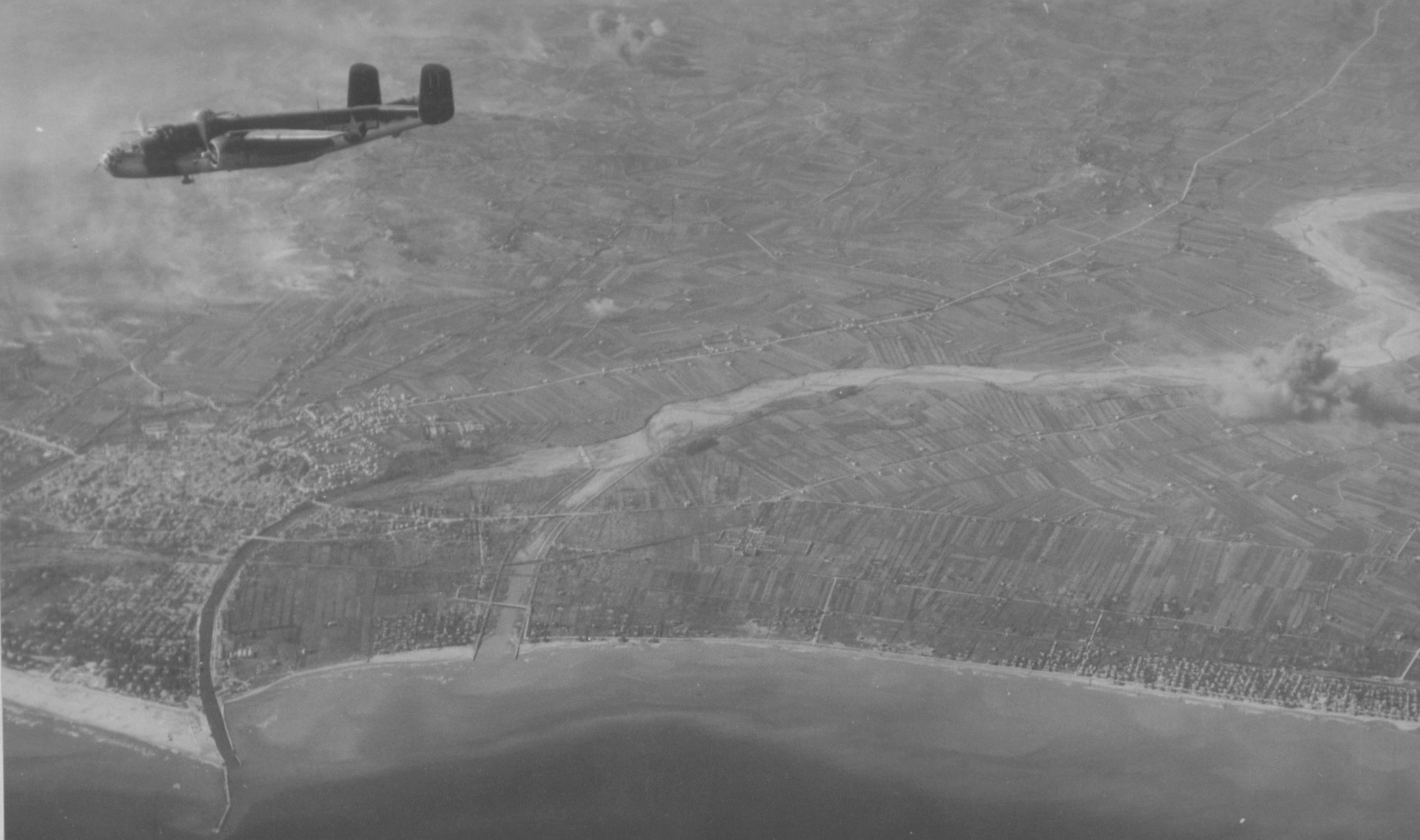
The Gothic Line battles had certainly worn down the enemy, especially Tenth Army on the Adriatic front. On Sept. 25, a report noted that only 10 of the 92 German combat battalions had a fighting strength of 400 men. There were 16 battalions with between 300 and 400 combat soldiers, 26 with 200 to 300 and 40 with less than 200. The fighting strength of Tenth Army was estimated at 21,500 men, less than half the number that had been available at the end of August. These figures do not include artillery units that provided the principle obstacle to the Allied advance, but without infantry to hold ground, the Germans could not continue to defend northern Italy. Replacements had to be found even as Hitler began preparations for the counter-offensive in the Ardennes.
Alexander knew just how difficult it would be to achieve success on the battlefield in the fall of 1944, but he did not communicate his doubts to his army commanders. By the time he wrote the letter to Brooke, he knew the results of the Second Quebec Conference, where British Prime Minister Winston Churchill had won another round in the Anglo-American debate over Italy. Churchill had insisted that despite victory in the Battle of Normandy and the subsequent liberation of France and Belgium, “It would never do for our armies [in Italy] to remain idle…. Our objective should be Vienna.” To enter the Balkans and reach Austria, Churchill proposed to give Germany “a stab in the Adriatic armpit” by an amphibious assault south of Trieste on the east side of the Gulf of Venice. But this could only happen if the cities of Bologna and especially Ravenna were in Allied hands. Alexander followed orders. Both 5th and 8th armies were to continue to fight beyond the Gothic Line.
At Eighth Army, Lieutenant-General Oliver Leese, who was soon to be kicked upstairs through an appointment to command an Army Group in Burma, was buoyantly optimistic. It was time, he told his corps commanders, to reap the rewards of the Gothic Line victory and “hit the enemy hard both day and night and force them back over the Po (River).”
Three relatively fresh divisions, 2nd New Zealand, 1st British Armoured and 5th Canadian Armoured were to attack to Ravenna and Bologna, taking advantage of a German withdrawal and the “good tank country” that was said to lie beyond the Apennine Mountains.
Looking back on these orders, it is difficult to understand why Leese and his staff were so confident the Germans, who had never before surrendered ground without a fight, would suddenly retreat. It is even more difficult to grasp the reasons for Eighth Army’s belief that armoured regiments could move rapidly through the Romagna plain, especially when this coastal plain north of Rimini was intensely cultivated with olive groves and vineyards surrounding solid farmhouses, villages and a few towns.
The whole area was intersected by thirteen rivers and creeks as well as countless ditches and canals. These watercourses, while sometimes dry in summer, turn into torrents when autumn rains begin. The threat of floods had forced the inhabitants to contain the most dangerous streams with dikes that rose above the landscape. Meteorological data, available to both armies, predicted recurring days of heavy rain from mid-September.
An intelligence summary, issued on Sept. 18 when the weather was still “fine and warm,” noted that the enemy holding San Fortunato and the Rimini Line “cannot at present allow us out of this passage onto the plains because we might easily turn a withdrawal into a rout.” Lieutenant-Colonel W.C. Dick, the divisional intelligence officer, suggested that, “In a very few weeks the weather will double his strength…the rain will bog down our tanks and vehicles; guns will be difficult to haul, the rivers will become obstacles….”
Perhaps Eighth Army’s optimism was influenced by the good weather that persisted well into September. This was a trend that led German staff officers to complain that the rains were late. On Sept. 21, a cold front moved through, bringing rain and orders to change back into battledress. This was followed by five days of good weather that encouraged senior Allied commanders to make ambitious plans.
The three divisions began their advance on Sept. 22, hoping the enemy, who had been forced to transfer formations from LXXVI Corps to deal with pressure from Fifth Army, would be incapable of prolonged resistance. Instead, trouble began almost immediately. The New Zealand Div. found no signs of a general withdrawal. Anti-tank guns and artillery zeroed in on the coastal highway and slowed the advance, inflicting a steady toll of casualties on men and vehicles. 1st British Armd. Div. found the going so difficult that it quickly gave way to an infantry division.
Major-General Bert Hoffmeister’s 5th Cdn. Armd. Div. was positioned between the British and New Zealand divisions, tasked to clear the triangle between the two main highways. Hoffmeister decided to lead with 12th Cdn. Inf. Bde., the formation added to his division in July 1944 after Eighth Army decided to add an infantry brigade to each armoured division. The Canadians “converted” the Princess Louise Dragoon Guards, 1st Division’s reconnaissance regiment, the Westminster Regt., 5th Division’s motorized battalion and the 1st Cdn. Light Anti-Aircraft Regt. (re-named Lanark and Renfrew Scottish Regt.) to infantry and began re-training the officers and men. The new brigade, commanded by Brigadier J.S.H. Lind, the former commanding officer of the Perth Regt., fought its first action in early September, but was not involved in 5th Division’s later battle for Coriano Ridge.
Hoffmeister’s plan called for 12th Bde. to “get ahead fast, bypassing and picketing centres of resistance, leaving 11th Cdn. Inf. Bde. to mop them up as they catch up to us.” After 12th Bde. crossed the Rubicon-Fiumicino River, 11th Bde., with strong armoured elements leading, would continue the advance. The 2nd Armd. Regt., Lord Strathcona’s Horse, as well as self-propelled artillery, anti-tank guns and 14th Field Company, Royal Cdn. Engineers, were to assist 12th Bde. and all available artillery was on call.
The PLDGs (known as the Plugs) began the advance, but the lead companies were quickly forced to ground as “machine-gun, arty (artillery) and mortar fire, including heavy calibre shells” stopped all movement. The reserve companies worked their way forward to the ruins of San Giustiva, a hamlet on Highway No. 9 that was barely beyond the start line, however, they could go no further. The battalion, which had suffered 76 casualties in a few hours, was scattered and disorganized.
Lind decided to send his most experienced unit, the Westminsters, with a squadron of Strathcona tanks on a wide right hook. Lt.-Col. G.C. Corbould, the “uncomfortably courageous” CO of the regiment, decided to advance one company at a time in a series of short bounds. With the assistance of soldiers from a New Zealand Maori battalion, who cheerfully allowed the Canadians to cross the divisional boundary, the Westminsters reached a point within sight of their objective, the village of San Vito.
San Vito, on the south bank of the Uso River, proved to be strongly held by German infantry and 88-mm guns. The latter systematically blasted houses and savaged the Strathcona squadron that had joined the infantry. A new set-piece attack, with full artillery support was needed and Lind ordered the Lanark and Renfrew Regt. to follow the route used by the Westminsters, making a slight side shift to the right. This second right hook faltered in the face of heavy fire and the intervention of enemy self-propelled guns “which made full use of the thick vegetation to conceal themselves.” This prevented a second Strathcona squadron from joining the infantry. The operation, touted as a pursuit battle, “bypassing and picketing centres of resistance,” had stalled. All three divisions encountered the same stubborn resistance and no unit had found any gaps in the German defences.
On the Canadian front, Hoffmeister added the armour of the Governor Generals Horse Guards to the mix, ordering the unit to assist the Lanark and Renfrew Regt. in an assault crossing of the Uso. Five battalions had now been committed to the battle, and on the night of Sept. 26, the Germans withdrew to the next river line. Before handing over the advance to 11th Bde., 12th Bde. could report that it had secured San Vito in addition to a shallow bridgehead across the Uso.
12th Bde. had covered a distance of two kilometres and suffered 300 casualties in a “slow and very fatiguing action…against an unprecedented amount of artillery and self-propelled guns.” The “close nature of the ground,” the brigade reported, “made every foot gained a difficult and well-earned one.”
Lieutenant-Colonel J.M. McAvity, the veteran commander of the Strathconas, spoke for every combat soldier when he wrote, “Contrary to popular expectations, the Po Valley has so far proved unsuitable for armour.” The close country, irrigation ditches that serve as tank obstacles, extensive minefields and limited visibility make fire and movement operations “very difficult.” And this was before the “rainstorms made movement of armoured units almost impossible.”
The autumn rains began in earnest on the night of the planned takeover by 11th Bde. Brig. Ian Johnston ignored the weather and ordered his battalions to push north to the River Salto. The 8th New Brunswick Hussars allocated a squadron to each battalion and the next phase of the advance began. Since the enemy was retiring to positions along the diked banks of the Fiumicino River the Cape Breton Highlanders and the Irish Regt. reached the Salto by mid-afternoon.
For a brief moment, it appeared as if the enemy was in full retreat and Hoffmeister met with Johnston to arrange for a quick crossing of the Fiumicino, a river often identified with Julius Ceasar’s Rubicon. The Irish Regt., which had reached the outskirts of San Mauro, bypassed the village and Captain Pat O’Brien’s A Co. crossed the river. During the night, wireless communication broke down and when B Company’s commander, Major Bill Armstrong, took a platoon and additional signal equipment across the river to strengthen the bridgehead, “they found that A Co. had evidently been surrounded, some killed and the remainder captured.” Fortunately, the Cape Breton Highlanders waited for their armoured squadron, which had been held up by minefields. The forward companies dug in south of the river.
Heavy rains and the tragic loss of the Irish company ended attempts to cross the Fiumicino which was in full flood. According to German sources, their own withdrawal had produced indescribable scenes…“men drowned and guns literally washed away.” Both sides settled down to wait out the weather.
While I Canadian Corps fought through the Gothic Line defences on the eastern side of Italy, 1st Cdn. Armoured Brigade, part of XIII British Corps, was committed to battle in the heart of the Apennine Mountains.
The brigade, composed of the Ontario Regt. (11th Cdn. Armd Regt.), the Three Rivers Regt. (12 CAR) and the Calgary Regt. (14 CAR), had been supporting the infantry battalions of XIII British Corps since the Liri Valley operations in May 1944, and had established excellent relations with their British and Indian Army counterparts. Lieutenant-General Sidney Kirkman, the corps commander, regarded Brigadier Bill Murphy and his regimental officers as the experts on infantry-tank co-operation and so he was content to leave the tactical use of armour in their hands.
Kirkman had been one of the strongest proponents of the proposal to switch the main Allied offensive to the Adriatic front, but ironically his corps would remain in the central mountains as part of Fifth U.S. Army. The transfer of an American and French Corps for the invasion of southern France left General Mark Clark with too few troops to mount a serious offensive without help. With two infantry and two armoured divisions—plus the Canadian brigade—XIII Corps made it possible for Clark to plan for a broad Allied advance once German reserves were committed to the Eighth Army front.
Today, travellers can follow the A1 Autostrada north from Florence to Bologna, using 14 major tunnels through the Apennines. But in 1944, Route 65, a few kilometres to the east, was the main highway over the mountains. In 1944, the Germans had built one of the most formidable set of fortifications in the entire Gothic Line to block this route. There were four other two-lane paved roads across the mountains, each guarded by pillboxes, bunkers and anti-tank guns. It did not take long for the Canadian armoured regiments to learn how difficult it was to use these roads.
Clark’s original plan called for U.S. II Corps to strike the first blow shortly after the start of Eighth Army’s offensive. With Ultra providing “real time” information on German movements, Clark learned of Kesselring’s Aug. 29 decision to begin a staged withdrawal to the Gothic or Green Line once pressure was exerted. Ultra decrypts also reported that the boundary between the German Fourteenth and Tenth armies was to be just six miles east of Highway 65, on a road parallel to Imola, a town on the Rimini highway southeast of Bologna.
Attacking at an army, corps and divisional boundary was every commanders dream and Clark devised a plan to exploit what he hoped would be a fatal weakness in the German defence. If the main thrust was to be northeast to Imola, far more would be demanded of XIII Corps advancing on the immediate right flank of the American advance.
The German withdrawal from the hills north of Florence began in early September and 1st British Infantry Division, with the Ontario Regt. under command, began to probe north with a Canadian squadron attached to each lead battalion. The Calgary Regt., assigned to 8th Indian Div., was given a similar task, but in both cases carefully planned demolitions had blown every road and track. Tanks could only provide indirect fire support until engineers had bridged the gaps and cleared rock slides.
On Sept. 9, when General Oliver Leese reported that Eighth Army would have to pause to organize a new set-piece attack on Coriano Ridge, Alexander “decided to unleash 5th Army who will now go ahead with an offensive in the centre.” According to Alexander, the enemy was “as weak as we can ever expect them to be” and with a spell of fine weather predicted it was time for a full-scale attack across the mountains.
Clark allowed his forces three days to close to the Gothic Line with the full offensive scheduled for Sept. 13. Kirkman planned to attack using elements of three divisions, with 1st Inf. and 6th Armd. advancing along roads on either side of 8th Indian, a mountain-trained division, ordered to attack “along the watershed.”
Alexander’s chief of staff, Lt.-Gen. Sir John Harding, visited Kirkman’s headquarters shortly after the advance began and reported that he was “quite depressed by XIII Corps HQ’s outlook on life. There is no doubt that in the sixth year of the war everyone is tired…they are very despondent and feel they can’t push on much further.”
Kirkman tried his best to prevent this pessimism from reaching combat leaders. In a letter sent to brigade and battalion commanders, he described the forces facing XIII Corps as “an indifferent enemy division of just seven battalions holding a front of 2,700 yards.” He recognized “the strength of the enemy’s prepared defences and formidable nature of the ground,” but insisted that quick action against a numerically weak opponent would succeed.
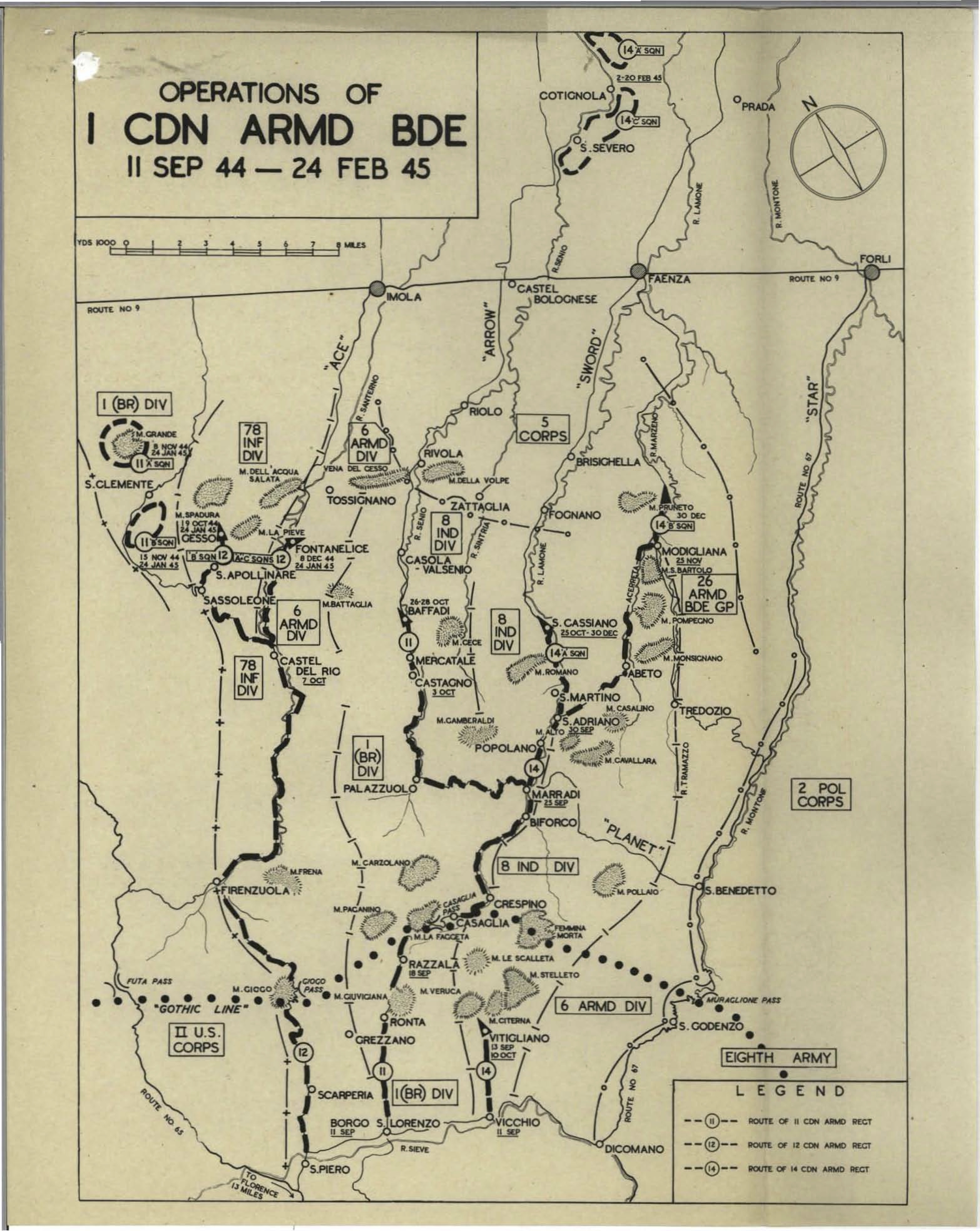
Kirkman noted in his letter that he had previously “personally addressed officers down to the rank of lieutenant-colonel before a big battle,” but this time, because of the need for reconnaissance and detailed plans, it was no time to take commanders away from their units. This was certainly the case with the Calgary Regt., tasked to assist the Indian infantry in following up the German withdrawal. The regiment’s war diary offers an account of the period. “9 Sept. Throughout the day the Royal Engineers worked to establish supply lines for further advance. 10 Sept. The C.O. crossed the river (Sieve) to recce tank routes. Territory 5000 yards north of the Sieve was utterly impassable to tanks, slopes were precipitous and roads deteriorated into wagon tracks and finally goat paths. 11 Sept. While fleets of medium bombers passed overhead to soften up the Gothic Line positions the day was spent in recce and preparations which were embodied in the CO’s orders group held at 2100 hours. B squadron reported combating nothing more serious than a traffic jam…. After battling for two months with the word Gothic on our minds we arrived on a bright Sept. morning to rub our very noses against this celebrated defence without a shot being fired.”
The unopposed advance came to an end that evening when a “hurried call from the Mahrattas (Indian Army regiment)” sent B Sqdn. forward to suppress machine-gun fire from Mount Veruca. The next day, by “laboriously dragging tanks to the absolute limit of their capabilities,” the squadron was able to support a Mahratta attack by firing immediately ahead of the infantry. The Calgary war diary records that “Indian troops once again showed their touching and even astonishing faith in Canadian tanks, by advancing without hesitation one or two hundred yards behind our fire…. The objective was taken with few casualties…. Careful planning, impeccable timing, good shooting and mutual confidence overcame a towering mountain defense position….”
Eighth Indian Div. had found a way through the “most mountainous, least roaded and apparently least defended sectors of the Gothic Line.” The tanks followed the engineers whenever they could, but the terrain limited their contribution and so the regiment—less one squadron—went into reserve on Sept. 17.
The relative success of 8th Indian Div. could not be matched by the British divisions on either flank. Enemy positions were situated above the narrow roads, and the roads themselves were blocked by demolitions that slowed the advance to a crawl. Fortunately, on Sept.18 the U.S. 91st Div. won a four-day battle for Monticelli Ridge. This proved to be the key to unlocking the central Gothic Line defences known to the German Command as Green Line I. Monticelli and the equally well defended Monte Altuzzo commanded the southern approaches to the Giogo Pass where German engineers had constructed what the American official history describes as “defences that were almost invisible to the approaching troops…reinforced concrete blasted into the rock” with barbed wire at 100-yard intervals and lots of mines in the two ravines that offered the obvious approach route to the mountain crest.
The struggle for Monticelli became an American epic. After most of the ridge was captured the Germans committed their corps reserve to repeated counterattacks. At one point the left flank of the American advance was held by a single soldier, Private Oscar G. Johnson who gathered up “all available weapons and ammunition from the dead and wounded.” He beat back counterattacks and held the position through the night until help arrived. Johnson was awarded the Medal of Honour.
Following this success was an equally desperate fight for Monte Battaglia, situated on the north side of the pass. Unlocking the Green Line I defences forced the Germans to withdraw to the northern slopes of the Apennines, but this did not mean there was any prospect of a rapid Allied advance.
When the Canadian armoured regiments moved forward in late September, they discovered that beyond the height of land the mountains continued northward as gradually descending spurs, providing the enemy with a series of natural, reverse-slope positions, each one requiring the sacrifice of brave men before the next ridge could be attacked.
Allied commanders at army and corps level remained publicly optimistic because the infamous Gothic Line had been breeched. Surely that meant they would soon pursue a shattered enemy north into Bologna and beyond. But the view at the sharp end was very different. The “seven weak battalions” confronting XIII Corps had been reinforced and a rebuilt German infantry division, the 44th, had arrived to block the advance.
The war diary of the Ontario Regt. tells the story of the late September battles in a series of brief entries that speak to the frustration experienced by the forward troops. Tasks were limited to providing protection for engineers along a route that was code-named Arrow while the other squadrons sent their men on leave to Florence or Rome. Finally, on Sept. 23, Lt.-Col. Robert Purves directed C Sqdn. to engage all enemy targets at Camurrano where the Canadians knocked out self-propelled guns and several key machine-gun posts that had been holding up the British infantry.
The next week was marked by more demolitions and a near-continuous period of cold, heavy rain that was to mark the autumn months in the mountains. The Calgary war diarist described the weather as “persistent, imperturbable, road-destroying rain all night and the following morning… reducing operations to nil.” Supply routes were “jeepable with chains only” and “some mule tracks impassable to mules.”
The Indian infantry had penetrated deep into the Gothic Line defences by the end of September, but “the fighting was in territory that precluded any hope of tank warfare” and any hope of rapid progress. The much-heralded advance to Bologna had become a series of battalion-level battles for a mountain pass or a weak spot in the enemy’s defences. As the Calgary war diary noted, “long-term, persistent mountain warfare…involved much shifting of plans, changing of pressure points from one feature to another as a wrestler tries one hold and then another to overcome his opponent.”
The frustration felt by everyone in Fifth Army might not have become a serious morale problem if it had been possible to overhear the discussions between Kesselring and Hitler. On Sept. 27, Kesselring formally requested permission to withdraw to the Po River and then the Alps. His Army Group South had persisted in following standard German battle doctrine, counterattacking each time the Allies made gains. Infantry battalions suffered heavy casualties in these immediate counterattacks even if they succeeded. Replacements had not kept up with losses and Kesselring feared his front might collapse.
Hitler insisted that the defences in front of Bologna and Ravenna be held “indefinitely.” The loss of the war industries of Northern Italy would endanger his plans to contain the Allies until his remaining “secret weapons,” the V2 rocket and jet aircraft, could be deployed. As well, the loss of Italy would damage morale on the home front. Hitler promised more men and more weapons would be allocated to the Italian theatre “so as to ensure that the Allies incurred high casualties for every inch of ground gained.” Intelligence on this fateful decision was available to the Allies within days.
So the struggle continued. Alexander decided to commit his only reserve division, the 78th, returning from four months in Egypt and Palestine, to XIII Corps. The Three Rivers Regt., which had spent September in reserve, provided armoured support, and on Oct. 14 it joined the British infantry in an assault on Monte Pieve, a well-defended position in the foothills south of Bologna. After an initial infantry assault collapsed in the face of a concealed minefield, “friendly fire” from divisional artillery and firm resistance from carefully camouflaged enemy positions, the Three Rivers tanks joined a battle that lasted four days ending in a German withdrawal to the next position a thousand metres to the north.
The Three Rivers war diary tells a familiar story. Individual troops of four tanks supported infantry battalions in battle for well-defended positions that seemed exactly like the one fought over a few days before. “The weather was as foul as it could possibly be—cold rain every day. The unpaved mountain roads were being washed away and had to be constantly repaired.”
Supplies arrived by mule train, bogged tanks had to be abandoned and the enemy—on the high ground beyond—shelled every likely tank harbour. And then the snow came.
The steady drain of Allied casualties and the refusal of American Chief of Staff, General George Marshall, to send additional troops to Italy ought to have called a halt to operations in the mountains, but Clark persisted. In retrospect, historians can argue that both 5th and 8th armies were fulfilling the strategic intent of diverting German formations from the vital battles in Northwest Europe, but there is no evidence that Clark thought in these terms. For the armoured regiments of 1st Cdn. Armd. Bde., Clark’s decision meant further weeks of heroic attempts to assist the infantry by shooting them on to an objective and providing fire support to repel German counterattacks. The Calgary Regt. war diary entry for Dec. 31, 1944, sums up the brigade’s achievements:
“We tried to follow the twin golden rules of never taking unnecessary chances, but if necessary risking everything rather than letting the infantry down.”
 Canada in Italy 1943-1945