From Sangro to Orsogna
By late October 1943, information from Ultra provided evidence of the enemy’s determination to defend the Winter Line south of Rome and to continue to build up forces in Italy and the Balkans. While the Allies deployed 11 divisions, General Albert Kesselring’s Tenth Army included 10 divisions with a further six allocated to Northern Italy to pacify the region, crush insurgents and to protect the coastal flanks of northern Italy.
Sixteen divisions in Italy, plus 13 more in the Balkans–where Hitler feared a second Allied invasion–amounted to a major diversion of German resources away from the Eastern Front where the Soviet armies were continuing the offensive that had begun with their overwhelming victory at Kursk.
Ultra also revealed that the fighting strength of German divisions in Italy were, on average, less than 50 percent of those available in Allied divisions. However formidable these formations might have been in defending favourable, fortified ground, they had limited offensive capacity. The withdrawal of German fighter aircraft to defend the Reich against Allied strategic bombing, further limited German options.
Despite this reality Eisenhower believed that the loss of veteran divisions leaving to join Overlord created an “unfavourable balance of forces,” presenting a very real threat to Allied forces in Italy. He informed the Combined Chief of Staff of his intention “to retain the initiative” by mounting a co-ordinated offensive with Rome as the objective. This would–at a minimum–prevent the enemy from attacking and forcing the Allies to the defensive “prematurely.” Eisenhower noted that “If we can keep him (the enemy) on his heels until early spring, then the more divisions he uses in counter-offensives against us, the better it will be for (Operation) Overlord (the planned invasion of Normandy) and it then makes little difference what happens to us if Overlord succeeds.”
This analysis of strategic imperatives was not communicated to the troops who would have to “retain the initiative” in the cold, rainy conditions an Italian winter. Their corps and divisional commanders were also in the dark. Originally, Alexander proposed strengthening Gen. Mark Clark’s Fifth Army with divisions from Eighth Army, allowing for an all-out offensive on Rome to be coupled with an amphibious landing at Anzio, southwest of Rome. This would have left Montgomery’s diminished forces with a minor role. However, Monty, who had previously argued that he lacked the logistical support and the necessary infantry replacements to mount a major offensive, insisted on retaining all his divisions so his army could “capture the high ground north of Pescara” and outflank the defenders of Rome before Fifth Army launched its main attack.
Monty’s chief of staff protested that the “poor road network and easily defensible river lines” meant “there was no future in an Adriatic drive.” However, Montgomery, who was well aware of the strength of the enemy, convinced himself that with “good weather” his army could reach Pescara and the east-west road to Rome in one great push. And so with three infantry divisions–the 78th British, 8th Indian and 2nd New Zealand–supported by 400 tanks and all available air power, Montgomery promised a surprise attack with “a crack that will be heard all over Italy.”

Unfortunately, surprise was lost and heavy rain, typical weather for that time of year, raised the level of seemingly minor rivers and turned the soil into deep, clinging mud. During a three-day period of waiting for better weather, Montgomery ordered light forces to seize the high ground on the north side of the Sangro River, the first obstacle on the road to Pescara. Today’s visitor to the Adriatic front is well advised to begin a visit to the area at the Commonwealth war cemetery, located high above the south bank of the river. The graves of the British, New Zealand and Indian soldiers who fell in the battles are laid out in a crescent shaped pattern, on ground surrounded by olive groves and vineyards. From the ridge overlooking the Sangro, you can see the wide valley and the 10-metre-wide river.
On our recent visit it was pouring rain and an attempt to follow paths to the river was hampered by the same kind of mud that foot soldiers endured in 1943. It was easy to see why tanks bogged down but some imagination was required to picture the Sangro in 1943, swollen to a 100-metre-wide torrent, filled with icy-cold melt water from the snow covered mountains inland.
It soon became apparent that the best the two lead divisions could do was secure a shallow bridgehead. The 2nd New Zealand Division, with its integral tank brigade, had to be used to secure the high ground beyond the Sangro, instead of crashing through to Pescara. By Dec. 1, Montgomery had committed all of his divisions except 1st Canadian which was attempting to divert German attention to the Upper Sangro through a series of battalion level attacks. This task, carried out by 3rd Canadian Brigade, gained some ground, but failed to confuse the enemy.
Montgomery was forced to reconsider his plans. He knew the Germans had committed reserves from both the 26th Panzer Div. and 90th Panzer Grenadier Div. to the Sangro battle, but he was determined to press on. The 1st Canadian Armoured Bde. was sent in to support the Indian Div. and Major-General Chris Vokes, now confirmed as commander of 1st Canadian Div., was told to take over the coastal flank from an exhausted 78th Div. Montgomery hoped to see the Canadians and the New Zealanders “competing as to which division can first get to the Pescara River.”
As preparation for this co-ordinated operation began intelligence from Ultra provided details of the heavy losses and demoralization of the German 65th Division as well as the exact location of the boundary between the 65th and 26th Panzer Division. This information proved to be too promising to both Montgomery and Lieut-General Sir Bernard Freyberg, the New Zealand divisional commander. Freyberg told Montgomery that with artillery his tanks and bulldozers he would “go through to Chieti… and blast my way in.” They would not wait for the Canadians.
The first divisional objective Castelfrentano fell on 1 December. Both Monty and Freyberg agreed “the Boche was broken” and two New Zealand brigades advanced to Orsogna. A typical stone-built, mountain town, Orsogna is perched on the edge of a long ridge, one of a series of natural fortress walls extending towards the Adriatic.
Freyberg committed two infantry battalions and two armoured regiments to Orsogna and on the 2-3 December the 26th Infantry Battalion entered the town. “It was obvious that the enemy was completely surprised,” one sergeant wrote, “we met no opposition until thew leading platoons reached the square well through the town.” The vanguard of a German battlegroup, sent to defend Orsogna, pinned down the New Zealanders until their panzers arrived. New Zealand tanks made it to the edge of town but were forced to withdraw unable to save the infantry who were surrounded and captured.
A set-piece attack was ordered for 7 December. New Zealand infantry was able to occupy ridges to the east of the town but the terrain meant that neither the wheeled vehicles nor the tanks could follow them. Further attempts to capture Orsogna led the Germans to send reinforcements to hold the town which remained in German hands well into 1944.
The Moro River
The Canadian advance began on the night of 5-6 December shortly after the takeover from 78th Division was complete. Pescara and the Via Valeria, the lateral road to Rome are less than 30 km north of the Sangro, and on a large-scale map the coastal plain seems like a much more inviting route than the one allotted to the New Zealanders but neither the A-14 Autostrada nor the post-war reconstruction of the S16 coastal highway existed in 1943. The old Highway 16 wound its way up and down a series of valleys, ridges and gullies with narrow bridges across rivers and creeks that “lost their banks” when warmer temperatures and rain sent melt waters racing to the sea.
The winding road from San Apollinare to San Leonardo was selected as the main axis of the Canadian advance with the Lanciano-Frisa road, four kilometres to the west, reserved for infantry of the 8th Indian Div. which was advancing with the tanks of the Calgary Regiment. Before operations could begin the rising waters of the Sangro washed away the Bailey bridges. This limited the amount of support to both divisions but on the night of December 5-6, Brigadier Bert Hoffmeister’s 2nd Canadian Infantry Bde. began to cross the Moro River with orders to capture San Leonardo and Villa Rogatti.
Hoffmeister, who commanded the Seaforths in Sicily and beyond, was developing the reputation that would lead his biographer, Royal Military College historian Doug Delaney, to title his book The Soldier’s General. During the rest period at Campobasso, brigade officers down to company commanders had been exposed to intensive training courses “designed to forge a common understanding of doctrine and procedure–the axle on which operations turned.” Hoffmeister gave the lectures himself making sure the lessons of the long pursuit were examined. He then turned everyone’s attention to the methods of a set-piece attack, Eighth Army style. The ideal sequence, he noted, was “air bombardment, followed by air-strafing, followed by an artillery barrage, followed by machine-gun, mortar and anti-tank fire from Brigade Support Group, followed closely by infantry assault.”
This well-tried doctrine depended upon a high volume of fire designed to neutralize the enemy while the infantry and tanks closed with the enemy. Problems began when the enemy had sufficient time to develop an elaborate defensive position on favourable terrain, such as Orsogna or the heights above the Moro River. The men of 90th Panzer Grenadier Div., who had arrived in the area just before the Canadian relief of 78th Div., had been told that the “watchword for one and all is into the ground.” The Germans placed the majority of their automatic weapons on the forward slope, carefully camouflaged with alternate positions. Riflemen were posted nearby to provide flank protection. The main force was held well back in deep dugouts available to serve as counter-attack forces or reinforcements for the most threatened sectors. Light machine-guns–MG-42s–were set up to cover every approach route with interlocking bands of fire and direct fire down tracks or trails.
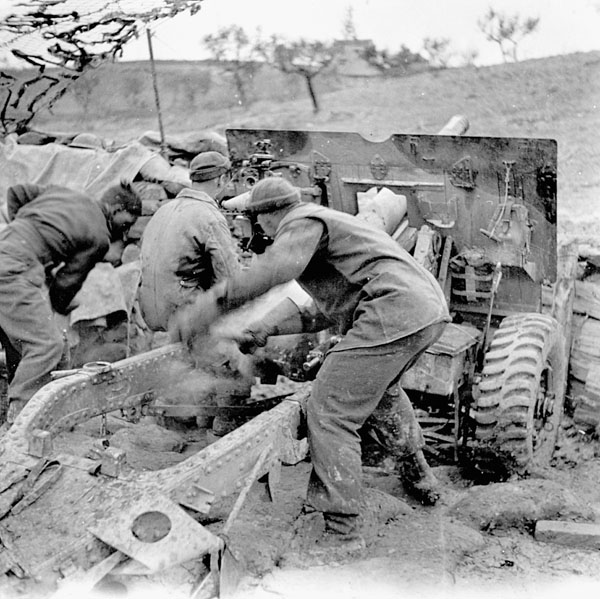
Operational Research teams who studied such defences noted that enemy positions could only be located by the closest observation as the “camouflage discipline and lack of daylight movement by the German troops in forward areas was excellent.” When the weather permitted photo reconnaissance, the natural appearance of the positions made them impossible to detect. The artillery and tactical air force could target strongpoints, such as San Leonardo and Villa Rogatti, but a very large and exceptionally accurate bombardment was needed to do any real damage or cause casualties. Little could be expected of the preliminary artillery bombardment at the Moro, given the shortage of munitions and the limited impact of 25-pounder shells in the wet, soft ground.
The Mediterranean tactical air force tried to offer increased support whenever weather allowed, but with battles raging across the width of the Italian peninsula only a limited number of Kittyhawk fighter-bombers and medium bombers were available. During the Sangro battle several incidents of short bombing had disrupted the advance of the 8th Indian Div. and new restrictions were introduced before the Canadians crossed the Moro. Pilots were told that “no bombing attacks were to be made without identification by smoke and artificial landmark.” Medium bombers were to be routed “over a permanent landmark which had smoke indicators to draw the pilot’s attention to it.”
Experiments with “cab ranks” of fighter bombers were also undertaken. A cab rank is a queue made up of aircraft that can be called upon for support. During the experiments, pilots of “Kitty bombers” reported to a forward rover tentacle by VHF radio. An RAF air controller with an army liaison officer could direct up to six Kittyhawks circling overhead, each plane ready to take on an impromptu target. No single attack was to be made unless the pilot and air controller were satisfied the target had been positively identified. This attempt to provide close support to the ground troops was good for morale because the ground troops could see the aircraft waiting to join in the attack. In reality, most cab ranks attacked pre-arranged targets behind enemy lines due to the limited time available for target identification.
The strength of the German defences, the limitations of the fire support available to Allied troops and the determined courage of the Canadian soldiers were all evident when the Seaforths and the Princess Patricia’s Canadian Light Infantry crossed the Moro. Hoffmeister gave his former battalion the task of capturing San Leonardo while the Patricias tried to seize Villa Rogatti, a small cluster of houses a kilometre to the west. Major-General Chris Vokes believed the main attack should go through San Leonardo with diversions at Villa Rogatti and across the mouth of the Moro. The attacks were to be made without the benefit of a preliminary barrage, an approach to battle suggested by the success of 8th Indian Div.’s silent night attacks that were said to have led to panic among German soldiers.
The Patricias made good use of the darkness to reach their objective just above the river, but the Seaforth’s found their axis–the San Leonardo road–well defended. Lieutenant-Colonel Doug Forin committed two companies to secure a bridgehead where the road crossed the river, hoping for the rapid construction of a Bailey bridge to carry the armour forward. A third company was to secure high ground to the south of the village, a move that would provide protection for the main advance. This flank attack, which did not challenge the main German defences, went according to plan, but nothing else did. The enemy was well prepared to defend the road and bridging site with “intense MMG (medium machine-gun) fire from high ground to the west firing along fixed lines.” Both main force companies suffered casualties and were forced to the ground a few hundred metres beyond the river.
The Patricias advanced to Villa Rogatti via an unguarded ford in the river. As the lead company approached the fortified hamlet, German machine-guns began firing on fixed lines. The machine-gun fire proved to be “high and ineffective” and Villa Rogatti fell to a two company attack. By first light all four Patricia companies were dug in, facing mortar and artillery fire. Two troops of tanks from the 44th Royal Tank Regt. reached them in time to help repel a series of counter-attacks. Hoffmeister requested permission to abandon the Seaforth bridgehead and reinforce success at Villa Rogatti. Problems with the construction of a Bailey bridge, which were later solved by Indian Div. engineers, led to sharp criticism of the Canadian sappers, but the decision to turn Villa Rogatti over to the 8th Division and concentrate the Canadians close to the coast was made by the corps commander, Lieutenant-General Sir Charles Alfrey in the context of the brilliant success of the Hastings and Prince Edward Regt. which had secured a bridgehead near the mouth of the Moro.
Overcoming The Moro
When General Bernard Montgomery began planning Eighth Army’s advance to the Valerian Way–the lateral road from Pescara to Rome–he considered the option of attacking directly north from the village of Isernia. But such an operation, begun in late November 1943, would have run the risk of snow blocking the passes through the Apennine Mountains. So, a route along the Adriatic coast seemed more promising.
When meteorologists attached to Montgomery’s headquarters reported that the average rainfall on the coastal plain in November and December was seven inches, the planners could do little but pray for dry weather. Unfortunately, the last days of November were typical. Overcast skies limited air support, and heavy showers and long stretches of continuous rain threatened the security of supply routes across the Sangro River.
Montgomery ordered Eighth Army to pause, allowing time for two brigades of 1st Canadian Division to replace the exhausted and under-strength battalions of 78th Div. He then proposed to launch a new attack with 1st Canadian, 8th Indian and 2nd New Zealand divisions. The aim was to seize the Ortona-Orsogna lateral road before launching a co-ordinated advance to the Valerian Way.
As preparations for this operation began, intelligence from Ultra provided details of the heavy losses suffered by the German 65th Div. and the exact location of the boundary between the 65th and 26th Panzer Div.
This information proved too tempting and Lieutenant-General Sir Bernard Freyberg, the well-regarded New Zealand commander, was ordered to exploit the “soft spot” in the German defences. The Kiwis were told to capture Orsogna and continue north to Chieti, the provincial capital, without waiting for the Canadians to cross the Moro River.
Orsogna, a typical stone-built mountain town, is perched on the edge of a long ridge, one of a series of natural fortress walls extending east towards the sea. If Freyberg’s men could take Orsogna and continue north towards Chieti they would force a German withdrawal from the Moro and Ortona.
The New Zealand division was an unusual formation made up of just six infantry battalions and three armoured regiments.
Freyberg committed three of his infantry battalions and two armoured regiments to the attack. In a superb feat of arms the lead battalion captured the town but lacked the strength to hold it. The Germans had formed a battlegroup sending a battalion from 1st Para Div. and a panzer battalion to reinforce the defenders. As a result, Freyberg’s men were pushed off the ridge.
When the battlefield is viewed from the German perspective it is hard to imagine how the New Zealanders could have accomplished more than they did. Their withdrawal seems inevitable when we consider the limited number of men they had, the low cloud that cancelled air support and limited rounds for the artillery. The New Zealand official war historian’s comment that “the Germans were willing to sell ground, but only at a price the New Zealanders were not willing to pay,” is quotable, but inaccurate as their 1,534 casualties demonstrate.
When the German high command learned of the New Zealand attack, Field Marshal Kesselring ordered his corps commander “to hold at all costs” so that the troops east of Orsogna would not be enveloped. He insisted that “the ground there is so favourable that it can be held by relatively small forces.” Kesselring was right; the natural defences were too strong to be overcome unless a means of outflanking the ridge could be found. It was up to the 8th Indian Division and the Canadians to accomplish this.
The Hasty Ps arrived at the Moro on the night of 2nd Bde.’s attack, taking over from the Royal Irish Fusiliers of 78th Div. Apart from some hurried conversations with the Irish there was no time for a briefing or to carry out reconnaissance. Patrols quickly established that a suitable crossing point existed just 200 yards from the mouth of the river and Major A.A. Kennedy, who had escape German captivity to return to the regiment, decided to send a company across the river, one platoon at a time. If a firm bridgehead could be obtained the entire battalion would cross and gain control of the reverse slope on the north side of the valley. German fire demonstrated that they were well positioned to counter such an unsupported attack and Kennedy ordered his men to withdraw.
Brig. Howard Graham and Kennedy met to consider their options. Kennedy reported that the Moro was no obstacle to infantry but “it is soft bottomed and in conjunction with the muddy condition of the whole valley it is a complete tank obstacle.” He was confident that a well organized battalion attack with observed artillery and mortar fire could win a bridgehead.
The Hasty Ps relied on the 4.2-inch mortars of the Saskatoon Light Infantry and the Forward Observation Officers (FOOs) of 2nd Field Regt. to suppress enemy posts. However, not all of the camouflaged machine-gun positions had been identified. The lead company came under heavy fire and went to ground. Smoke helped to obscure the battlefield allowing Dog Company–in a follow-up role–to swing left and penetrate the enemy position.
Farley Mowat’s history of the Hasty Ps, The Regiment, provides the best account of the events that followed. Kennedy, “watching from a high knoll on the south bank glimpsed victory ahead.” He was told that the supporting tanks had bogged down and his “naked infantry…was in danger of being overwhelmed.” Kennedy ordered a withdrawal, but was forced to reconsider when it became apparent that Dog Coy. “with its radio out of order and all three platoons running hog-wild in the centre of a disorganized enemy position neither heard nor could obey…. The battle that had been declared over began anew.”
The new Hasty P assault was initially intended to rescue Dog Coy. and complete the withdrawal, but the enemy panicked and fled allowing the battalion to establish a large bridgehead with advantageous reverse slope positions. When the battalion anti-tank platoon carried two six-pounder guns over to thicken the defences and the mortar platoon dug in with their tubes below the ridgeline, the Hasty Ps were ready for the inevitable counter-attacks. Mowat records Kennedy’s decision “not to wait for the counter-attack.” Instead, he sent two platoons forward onto the plateau, which had a commanding view not only of the highway to the north “but the vital lateral road to San Leonardo as well.”
When the German attack began, one of the advanced platoons withdrew, leading the enemy “into a deep salient” that became a killing ground. The Hasty Ps followed the German retreat and seized a house at the road junction. They also took prisoners from 1st Parachute Div., the first but not the last sign of the arrival of this elite German division in the Canadian sector.
During visits to the battlefields it was possible to follow the battalion’s movements on the ground. A steady rain produced the mud that soldiers remember but the temperature was much warmer than in December 1943 and the vineyards and olive trees were in full leaf. The Moro was running strong and it was not hard to see why it was a serious tank obstacle. It was difficult to believe that the anti-tank platoon had carried two six-pounder guns to the crest of the ridge, but then again these men often achieved the impossible.
The Hasty Ps’ success led Vokes to shift his main attack to their bridgehead. The Royal Canadian Regiment (RCR) was ordered to attack laterally towards San Leonardo, a distance of some 2,500 yards on a front less than 600 yards wide. An elaborate artillery program was to lead the RCR through six tactical bounds ending at “Nova Scotia,” the north end of the village and “Ontario,” the village’s south end. It was still impossible to bring tanks forward so Lieutenant-Colonel Dan Spry was told to follow the Hasty Ps’ example of “man-handling six-pounders” across to deal with enemy armour.
Attacking laterally through the front of German battalions was a new twist on tactical doctrine because it forced the artillery to fire accurate concentrations rather than a barrage. The gunners also had to support the 48th Highlanders of Canada, who were to cross the Moro in an attack designed to expand the bridgehead. The engineers would then rebuild the approaches and bridge the river at the main road to San Leonardo.
Both battalions began their attacks in the late afternoon while there was still enough light for accurate artillery observation. This cut both ways and the RCR advance across the flat table land above the Moro valley was savaged by German artillery and mortar fire. The road from the coastal highway to San Leonardo is signed today as Royal Canadian Avenue. In amongst a group of houses barely 500 metres from the battalion start line, there remains a building known to RCR veterans as Sterlin Castle. It was here that Lieutenant Mitchell Sterlin and 11 men of 16 Platoon, A Company, RCR, held off repeated attacks and then withdrew in good order when the enemy was spent.
While the Germans focused their considerable resources on the RCR thrust, the 48th Highlanders established a secure bridgehead in front of San Leonardo.
The 48th Highlanders arrived on the Moro during the night of Dec. 6-7 as the Seaforth Highlanders of Canada and the Princess Patricia’s Canadian Light Infantry staged the first unsuccessful attempt to cross the river. Dug-in on the crest overlooking the valley, the 48th suffered a steady drain of casualties from what the regimental history describes as the new “harsher, heavier type of warfare…a battle of shells.” When their turn came on Dec. 8, “the river valley vanished in the fire, shot puffs and plumes of thousands of shell explosions.” Both assault companies got across the river and the lack of light in the late afternoon is credited with saving Highlander lives. They were soon able to establish a bridgehead large enough to permit the engineers to begin work.
San Leonardo was still in enemy hands and despite the best efforts of the air force, which tried to limit the stream of enemy traffic on the roads to the battle area, the Germans were steadily reinforcing their positions. Vokes ordered 2nd Bde. to capture San Leonardo with the Seaforths and Calgary Tanks leading the way. This advance could only take place if 3rd Field Company, Royal Canadian Engineers, could bridge the Moro and repair the road. The RCE Report on the Moro River Diversion notes that a new bridge site was constructed with “corduroy roads” on both sides of the river.
No. 1 Field Co., RCE, had cut and delivered 14 truckloads of timber to build 1943 versions of the pioneer roads of 19th century Canada. Through the determined efforts of both field companies the crossing was open to traffic on the morning of Dec. 9. Tragically, 22 men of 3rd Field Co. were wounded when the enemy artillery caught the sappers as they withdrew.
Hoffmeister’s orders called for 2nd Bde. to move through the bridgehead, clear San Leonardo, advance to the Orsogna-Ortona road and then “exploit forward.” The Seaforth/Calgary battlegroup was to carry out the first two phases with the Loyal Edmonton Regt. and a squadron of Calgary Tanks by-passing Ortona to reach Tollo, a village to the west of the port city. This plan could only be implemented if the enemy fell back to a new line beyond Ortona, but there was little chance of this happening.
Kesselring had authorized the commitment of most of 1st Parachute Div. to the Ortona sector so that the Canadians “will be prevented from getting there at all costs.” German determination was also evident in their defence of San Leonardo and their renewed attempt to recapture the eastern bridgehead. The Hasty Ps, astride the coastal road, appeared to be the most dangerous threat and the 90th Div. committed elements of two battalions to a series of counter-attacks. One such action began in the early hours of the morning and seemed to the Canadians to be “partially suicidal…without control or ascertainable objective.” A total of 30 more prisoners of war were taken and at least 60 killed.
The fourth and final counter-attack with infantry–supported by self-propelled guns–was equally unsuccessful and the prisoner of war total rose to more than 100. After this attack the Hasty Ps “exploited to a depth of 1,000 yards” beyond the Moro.
The enemy was also forced to concede control of San Leonardo when a squadron of Calgary Tanks commanded by Major E.A.C. Amy and a company of Seaforth Highlanders commanded by Captain A.W. Mercer “fought a fierce and bitter engagement where both infantry and tankmen fought like lions.” Lieutenant J.F. Maclean and his platoon “battled their way up the hill, silencing an anti-tank gun, 10 enemy machine-gun posts, killing at least eight of the enemy and capturing 18.”
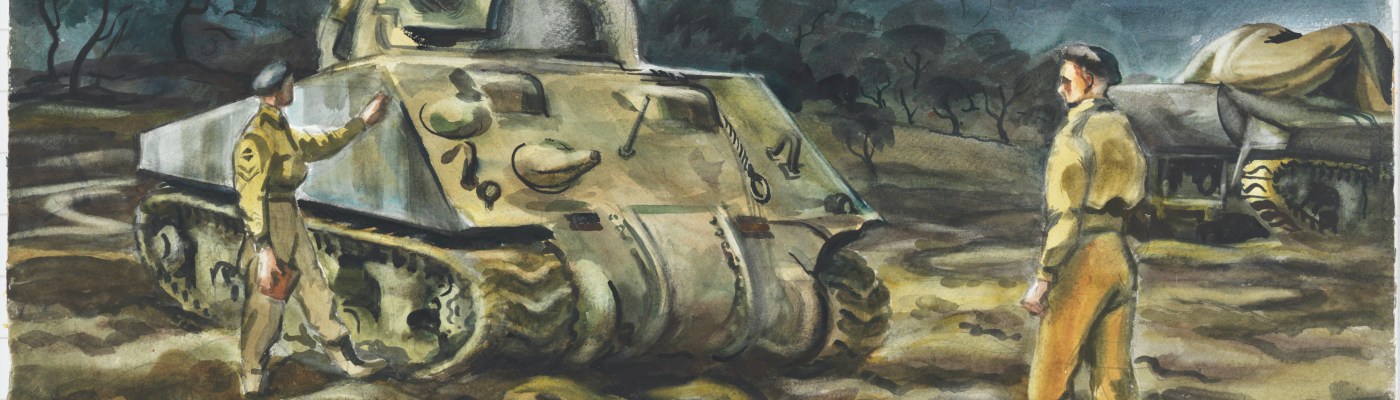
The Calgaries established a foothold in the village and placed their tanks to protect against counter-attacks. Co-operation between the tanks and infantry had been outstanding throughout the day and after one Calgary Sherman had knocked out a German tank at a range of 40 yards, a Seaforth soldier ran up to the Sherman to pat it on the side and say “You big cast-iron son-of-a-bitch I could kiss you!”
By nightfall the battlegroup reported that San Leonardo “was more or less firmly in our hand but no further progress could be made.” The Battle for the Moro River was finally over.

 Canada in Italy 1943-1945